When you click on links to various merchants on this site and make a purchase, this can result in this site earning a commission. Affiliate programs and affiliations include, but are not limited to, the eBay Partner Network.
The whole house is the laboratory. 🧪
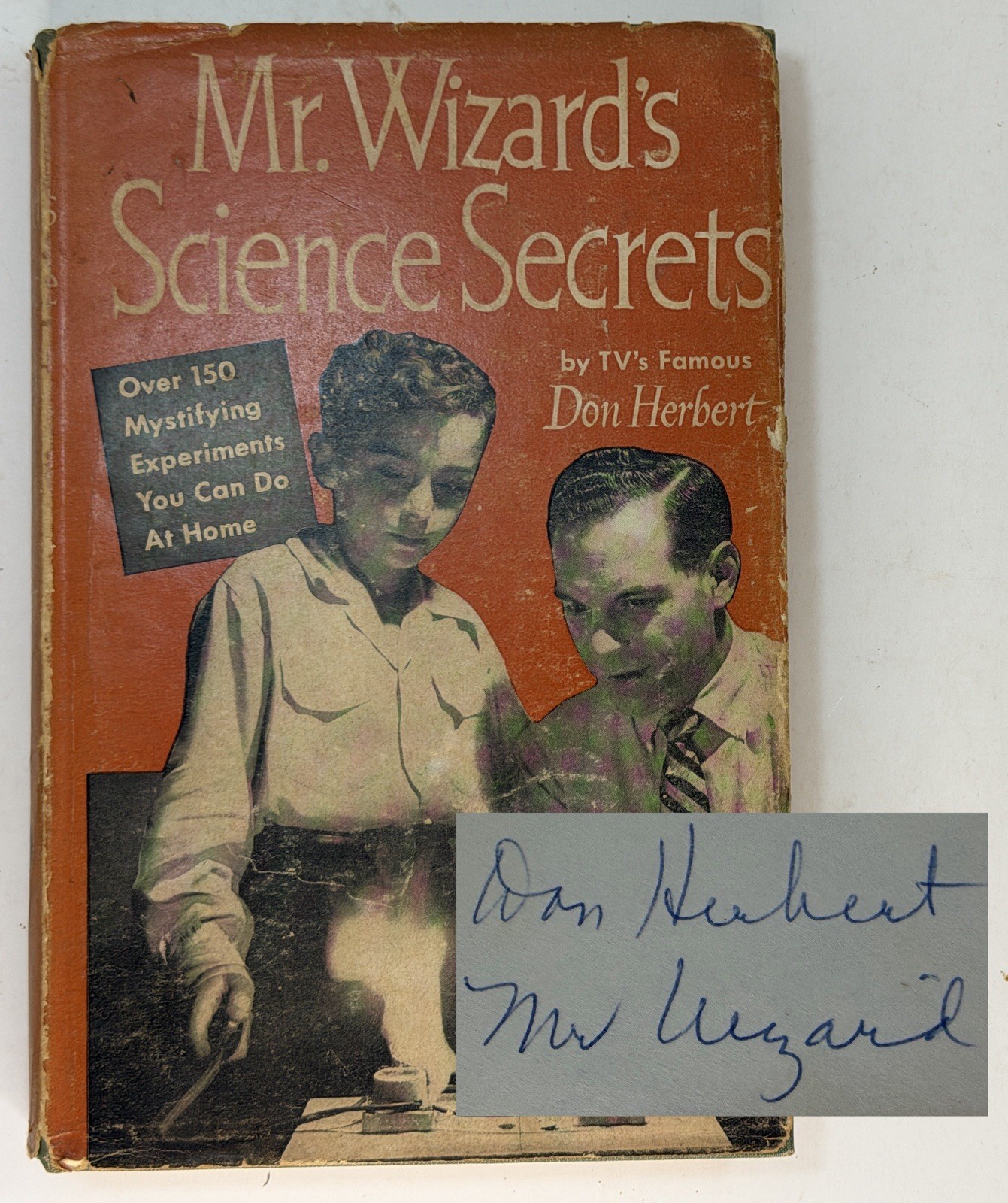
Milk bottles for flasks. Drinking glasses for beakers. An egg, a soda-water bottle, a knitting needle, and Saturday morning. That was the gospel of Watch Mr. Wizard—and in 1952 Don Herbert put it between boards so the experiment did not have to end when the kinescope faded. This is that book: Mr. Wizard\'s Science Secrets, Popular Mechanics Company, copyright 1952, stated Second Printing, 1953. Hardcover in the original dust jacket. 264 pages. Black-and-white photographs and Robert A. Barker’s drawings throughout. 8.75\" × 5.75\". Foreword by Wilbur L. Beauchamp of the University of Chicago, the school-science man who knew how to talk to teachers without talking down to kids.
And this copy is flat signed on the front flyleaf, black ink, two lines:
Don Herbert
Mr. Wizard
Signed copies of this title are uncommon; a clean two-line flat signature on an early printing, with the jacket still wearing its original $3.00 price, is the copy a collector actually wants to live with.
The book turned up at a Chicago suburban estate sale—the right zip code for the origin story. Watch Mr. Wizard premiered March 3, 1951, on Chicago’s WNBQ/WMAQ. Popular Mechanics was a Chicago house. Beauchamp taught at the University of Chicago. A prior owner left a pencil name and street address on the inner front cover, tucked under the jacket flap (no city written). The show started in this town; the book came home to a suburb of it.
The book. More than 150 home experiments that look like parlor magic until Herbert walks you through the physics. Pressure, heat, magnets, air, water, electricity—the Saturday-morning catalog, printed so a kid (or a parent who was secretly watching) could redo it in the kitchen. Barker’s line drawings and the studio photographs keep the page as clear as the show’s close-ups. Popular Mechanics was the right publisher: this is science you can build, not science you have to take on faith.
The man. Donald Herbert Kemske, Waconia, Minnesota, 1917–2007. English-and-general-science degree, summer stock opposite Nancy Davis (later Reagan), then a B-24 pilot: 56 missions over Europe, Distinguished Flying Cross, Air Medal. After the war he was an actor and radio writer in Chicago when he sold the local NBC station a half-hour about a neighbor who did science in his garage. No white coat, no beard, no “don’t try this at home.” The announcer said it every week: Watch Mr. Wizard. That’s what all the kids in the neighborhood call him, because he shows them the magic and mystery of science in everyday living. Herbert’s own line was better: “Milk bottles are your flasks. Glasses your beakers, and the whole house your laboratory.”
By mid-decade there were some 5,000 Mr. Wizard Science Clubs and more than 100,000 members. At peak the show drew hundreds of thousands an episode; half the applicants to Rockefeller University’s science doctorates later said he was why they started. Bill Nye put it without blushing: Herbert “sent us to the moon.” Watch Mr. Wizard won a Peabody in 1953—the same year this second printing left the press—plus Thomas Alva Edison Foundation awards and, decades later, the AAPT’s Millikan Medal. NBC ended the live run in 1965 after 547 episodes; Herbert came back for a 1971 season and then Mr. Wizard’s World on Nickelodeon (1983–1990). He wrote the sequels collectors also hunt: Mr. Wizard’s Experiments for Young Scientists (1959), 400 Experiments in Science (1968), Supermarket Science (1980), plus the kits. MythBusters dedicated a special to him. The papers are at the Smithsonian.
Why this copy. Early enough to still be the Popular Mechanics green cloth with the strong orange lettering, not a later Hawthorn reprint. Jacket present and not price-clipped—the $3.00 flap is intact. The signature is the dual identity, stacked the way a kid who wrote in for a club charter would have wanted it. Beauchamp’s foreword places the book inside real mid-century science education, not just TV merch. 1953 is the Peabody year: the printing and the prize arrived together. And the Chicago-suburb find is not a stretch—it is where the experiment began.
Condition — Good or better (book); jacket worn, as photographed.
Pages lightly toning with age. No stamps, labels, or writing except the author’s two-line black-ink signature on the front flyleaf and a former owner’s name and street address in pencil on the inner front cover, hidden under the jacket flap. Page edges and corners sharp. Text-block edges have some spots of staining on the top edge. Binding tight; no loose pages. Green cloth shows very little wear. Back cover has some white staining, likely from brief liquid exposure; no bubbling. Orange spine and cover lettering and design remain strong. Dust jacket has a number of small chips and tears and edge wear; the longest tear is about 1.5\". Liquid staining along the back spine, some staining around the flap edges, and some rubbing. Crease across the back panel. Front flap not price-clipped ($3.00). See photos for additional insight on content and condition.
This is the kitchen-table copy: early, jacketed, priced as issued, signed in both of his names, and found where Mr. Wizard first went on the air.