When you click on links to various merchants on this site and make a purchase, this can result in this site earning a commission. Affiliate programs and affiliations include, but are not limited to, the eBay Partner Network.
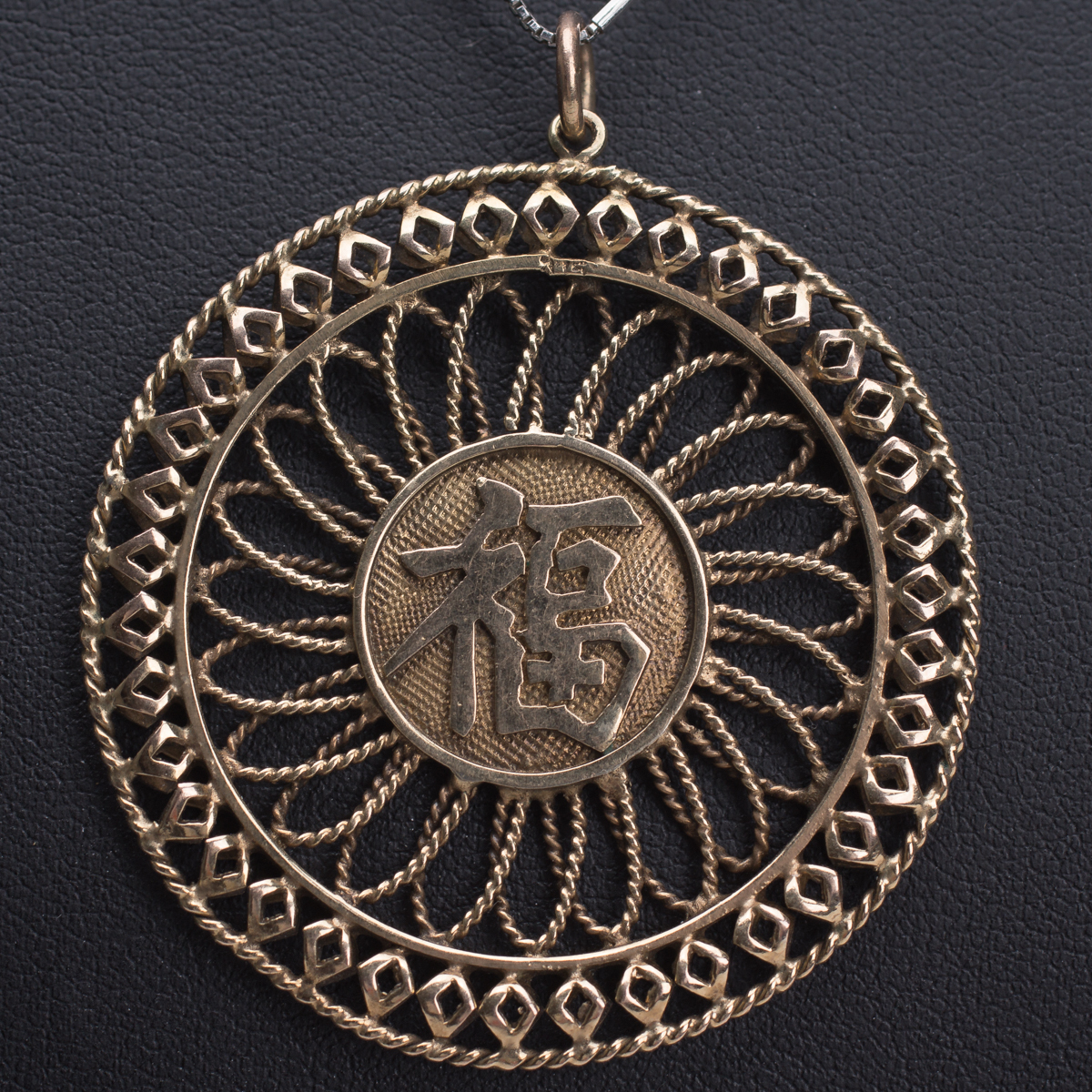
On offer is an interesting antique Chinese pendant / amulet featuring the traditional Chinese character 福 (Fu) on one side and 壽 (Shou) on the other.
福 (Fu) represents good fortune, happiness and good luck, while 壽 (Shou) symbolises longevity and a long life. Together, these two auspicious characters give the piece wonderful traditional meaning and make it a particularly thoughtful gift for a parent, grandparent or elder.
The pendant is marked “585” and “14K”, indicating 14-carat gold.
The piece shows some surface marks and signs of wear consistent with its age and previous use, but otherwise remains in excellent overall condition. Please refer to the photos for further details regarding condition.
Approximate Measurements:
Inner Diameter: 1.8 cm
Outer Diameter: 4.8 cm
Weight: 11.1 g
Please note: The necklace/chain shown in the photos is for display purposes only and is not included in the sale. This listing is for the pendant only.
A charming and meaningful vintage Chinese gold pendant featuring two of the most auspicious symbols in Chinese culture.
The character Fú (福) meaning \"fortune\" or \"good luck\" is represented both as a Chinese ideograph, but also at times pictorially, in one of its homophonous forms. It is often found on a figurine of the male god of the same name, one of the trio of \"star gods\" Fu, Lu, Shou.
Mounted Fú are a widespread Chinese tradition associated with Chinese New Year and can be seen on the entrances of many Chinese homes worldwide. The characters are generally printed on a square piece of paper or stitched in fabric. The practice is universal among Chinese people regardless of socioeconomic status, and dates to at least the Song Dynasty (AD 960 – 1279).
When displayed as a Chinese ideograph, Fú is often displayed upside-down on diagonal red squares. The reasoning is based on a wordplay: in nearly all varieties of Chinese: the words for \"upside-down\" (倒, Pinyin: dào) and \"to arrive\" (到, Pinyin: dào) are homophonous. Therefore, the phrase an \"upside-down Fú\" sounds nearly identical to the phrase \"Good luck arrives\". Pasting the character upside-down on a door or doorpost thus translates into a wish for prosperity to descend upon a dwelling.
Your browser does not support JavaScript.To view this page, enable JavaScript if it is disabled or upgrade your browser.