When you click on links to various merchants on this site and make a purchase, this can result in this site earning a commission. Affiliate programs and affiliations include, but are not limited to, the eBay Partner Network.
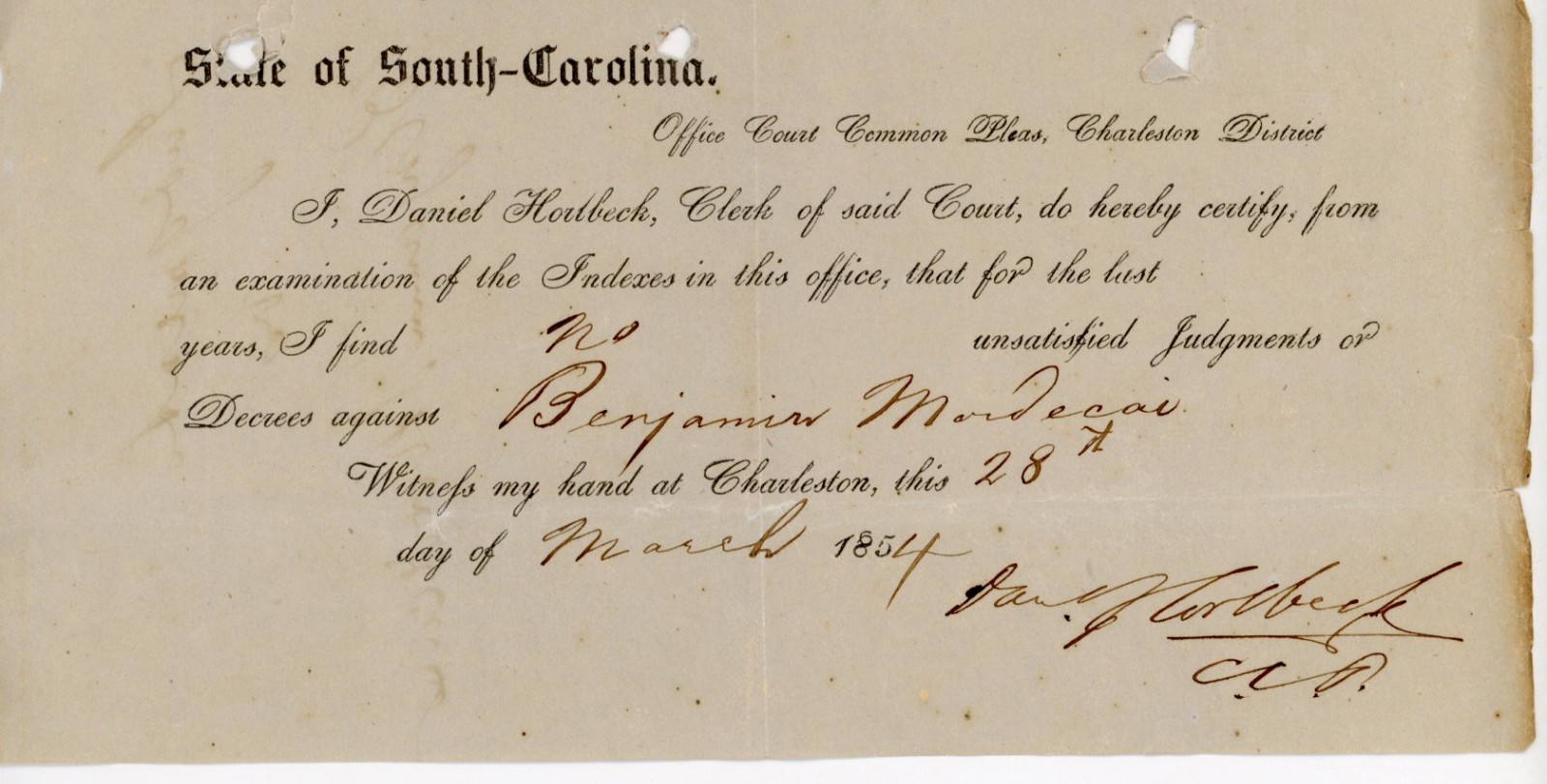
1854 Charleston SC Ephemera Benjamin Mordecai Legal Document No Judgments
Approximately 8.5" by 7.25"
Type: Historical Manuscript / Legal Ephemera
Date: March 28, 1854
Location: Charleston District, State of South-Carolina
Key Figures: Benjamin Mordecai (Subject), Daniel Horlbeck (Clerk of Court)
🖋️ Description
Up for sale is a fascinating piece of mid-19th-century Southern legal history. This is a certified official document issued by the Office Court Common Pleas in the Charleston District, South Carolina, dated March 28, 1854.
In this document, Daniel Horlbeck, the Clerk of Court, certifies after an examination of the office indexes that there are "no unsatisfied Judgments or Decrees" against Benjamin Mordecai for the specified past years.
Benjamin Mordecai was a highly prominent and wealthy mid-19th-century merchant, broker, saleeer, and commission agent based in Charleston, South Carolina. A member of Charleston’s established Jewish community, his life and career were deeply intertwined with the economic fabric of the antebellum South and the subsequent rise and fall of the Confederate States of America.
💼 Antebellum Business and Slave Trading
During the 1850s—the exact era of the Court of Common Pleas certificate—Mordecai operated a highly successful brokerage and sale business in Charleston. He was known for acquiring struggling mercantile inventories and operated broadly as a general commission agent.
A central component of his immense wealth came from his active participation in the institution of slavery. Mordecai was recognized as one of the largest slave traders in South Carolina, conducting extensive slave sales and human property transfers from his commercial offices in Charleston.
🏛️ Role in the American Civil War
When the secession crisis peaked in late 1860 and early 1861, Mordecai became an ardent and vocal supporter of the Southern secessionist movement.
The War Chest: Following South Carolina’s secession from the Union, Mordecai made history by contributing $10,000 to the state's military fund. This was recognized as the very first—and largest single individual—monetary contribution made to the war chest of South Carolina.
Official Recognition: His financial backing was so significant that he was formally thanked for his patriotism by the South Carolina Secession Convention.
Wartime Philanthropy: Throughout the American Civil War, he established and personally funded a major charitable organization in Charleston designed to provide food, clothing, and financial support to the widows and children of Confederate soldiers.
📉 Financial Ruin and Post-War Life
Mordecai fully committed his financial portfolio to the survival of the Confederacy, investing the entirety of his vast fortune into Confederate bonds, currency, and war efforts.
With the total collapse of the Confederate government and economy in 1865, alongside the abolition of slavery, Mordecai's investments became entirely worthless. Having spent the remainder of his liquid capital on wartime relief for soldiers' families, he was left completely penniless at the end of the war. He lived out his remaining decades in stark contrast to his antebellum opulence, passing away in 1893.