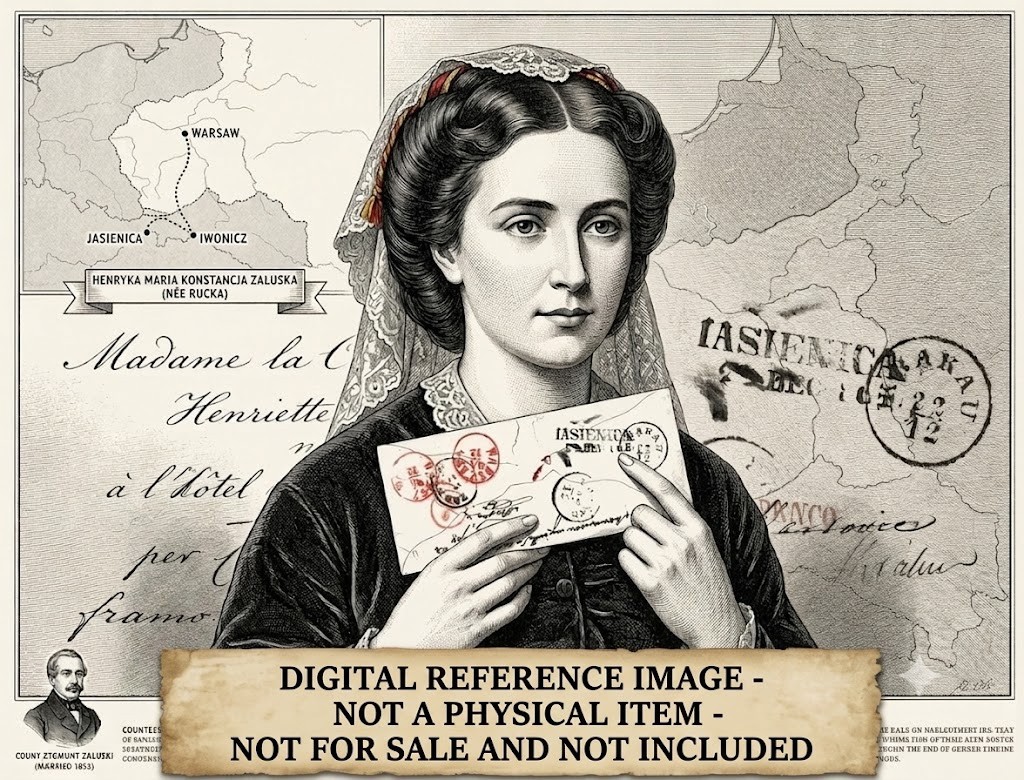
The Venue: The Hôtel d\'Angleterre (located on Wierzbowa Street in Warsaw) was the premier luxury hotel for visiting dignitaries, revolutionaries, and wealthy landowners. Notably, just one year later in 1862, it was the site where imperial insurgent leader Jarosław Dąbrowski staged key secret meetings ahead of the January Background (December 1861)
This letter moved between two entirely different empires during a period of intense political friction:
The Border Crossing: Moving mail from Austrian Galicia to Russian Poland required passing a strict imperial customs and political border. The tricolor cord and heavy wax seals on this letter were legal and practical requirements to secure the contents against border inspection and postal theft.
Tensions in Warsaw: December 1861 was a time of massive political unrest in Warsaw. Following deadly Russian crackdowns on Polish patriotic demonstrations earlier in the year, martial law was declared in October 1861. A noblewoman like Countess Załuska staying at a high-profile hub like the Hôtel d\'Angleterre would have been moving through a city under heavy military surveillance.
The Postal Rate: The 25 Kreuzer total postage (10kr + 15kr stamps) paid the mandatory foreign transit tariff required by the Austro-Russian postal treaty for a secure, cross-border letter traveling via the Kraków-Tarnów rail and courier routes.
The identity of the woman on this cover is Countess Henryka Maria Konstancja Załuska (née Rucka). In the elegant French social style of the 19th-century Polish aristocracy, her name was written on the envelope as Madame la Comtesse Henriette Załuska née Rucka.
Unlocking her specific family context reveals why this cover was moving between Austrian Galicia and Warsaw in December 1861.
Biographical ProfileFull Polish Name: Henryka Maria Konstancja Rucka
Lifespan: July 17, 1825 – November 27, 1888
Birthplace: Mała, Ropczyce region, Western Galicia (Austrian Empire)
Place of Death: Kwilcz, Greater Poland (Posen region)
Social Status: Born into the wealthy landed gentry (szlachta), she ascended to the high title of Countess upon her marriage into the prominent Załuski family.
Marriage and Aristocratic NetworkIn 1853, Henryka married Count Zygmunt Bogumił Antoni Załuski (1817–1872).
Through this marriage, she became inextricably tied to one of the most powerful and historically significant lineages in Poland—the same family that founded the famous Załuski Library in Warsaw and played major roles in Poland\'s military and cultural history.
The Iwonicz ConnectionCount Zygmunt and Henryka were heavily associated with the development of Iwonicz-Zdrój in southeastern Poland (Galicia). The Załuski family owned and transformed Iwonicz into one of the most celebrated, elite spa and health resort towns in Central Europe.
Archival records at the National Museum in Warsaw even preserve photographs of an aging Henryka Rucka-Załuska later in life (dated 1886), summering on the terraces of the Iwonicz resorts with her daughters and grandchildren.
Their children included:
Zofia Załuska (1854–1939), who later married into the prominent Wysocki family.
Jadwiga Załuska (1858–1923), who married Count Hektor Kwilecki.
Context of the December 1861 CoverThis specific envelope perfectly maps onto Henryka’s dual life as a Galician estate owner and a member of high society with deep ties to Warsaw:
The Origin (Jasienica): The letter was posted from Jasienica, which is located a mere 25 kilometers (about 15 miles) north of the Załuski family strongholds around Iwonicz and Sanok. It was likely sent by an estate administrator, an attorney, or a close family member managing affairs at the family estates while she was away.
The Destination (Hôtel d\'Angleterre, Warsaw): In the winter of 1861, Countess Henryka was staying at Warsaw\'s premier luxury enclave. High-born noblewomen of her stature frequently traveled to Warsaw during the winter \"season\" for high-society galas, family legal matters, or political networking.
The Atmosphere She Stepped Into: When Henryka picked up this exact envelope at the front desk of the Hôtel d\'Angleterre in late December 1861, Warsaw was a powder keg. Martial law had been declared just two months prior. The hotel itself was being watched closely by czarist secret police because the very circles Henryka moved in—the wealthy Polish aristocracy—were quietly funding and organizing the underground movement that erupted into the January Uprising of 1863.
This artifact isn\'t just a piece of cross-border postal transit; it is a direct personal link to a prominent 19th-century Countess navigating life across the fractured borders of partitioned Poland.
Evaluating the rarity of a 19th-century cover requires analyzing it through four distinct lenses: the scarcity of the stamps/rates, the postmarks, the social provenance, and the physical condition.
On a scale of philatelic rarity, this item ranks as highly scarce to rare, specifically appealing to advanced collectors of Polish postal history, Austrian Galicia, and cross-border maritime/land routes.
Here is a detailed breakdown of why this cover stands out.
1. The Rate and Stamp Combination (High Scarcity)The 25 Kreuzer Tariff: Under the updated Austrian postal rates of 1858/1861, standard inland letters cost 5, 10, or 15 Kreuzer depending on distance. A 25 Kreuzer franking represents a significant premium. This was the exact cross-border rate required for a heavy or double-weight letter traveling from the Austrian Empire into the Russian Empire (Kingdom of Poland).
The Issues: The stamps are from the 1860–1861 Embossed Franz Joseph I series. Because these stamps were only in use for a short period before being replaced by the 1863 oval performance issues, finding multi-stamp, high-rate combinations on intact commercial covers—rather than single-stamp domestic mail—is quite uncommon.
2. The Transit and Border Route (Very Scarce)The Jasienica Origin: Small, regional town post offices in Austrian Galicia had significantly less mail volume than major hubs like Lemberg (Lwów) or Kraków. Finding a crisp, perfectly struck two-line JASIENICA boxed cancel from this specific era is a localized rarity.
The Fast Cross-Border Flow: The back of the cover tells a phenomenal logistical story. To move from Jasienica (Dec 21) through Kraków (Dec 22) and arrive in Warsaw (Dec 24) across an imperial border in the dead of winter in 1861 required seamless connection with the Galician Carl Ludwig Railway. Fast-transit, multi-city tracking covers like this are highly sought after by transit-route specialists.
3. Social Provenance & Destination (Exceptional Value)The Recipient: Covers addressed to top-tier historical Polish nobility (Countess Załuska) command a significant premium over ordinary commercial or merchant mail.
The Location (Hôtel d\'Angleterre): Mail sent directly to famous luxury hotels of this era has a high survival rate but a incredibly high demand. Because this hotel became the epicenter for the revolutionary January Uprising planning just months later, it ties the cover directly to Polish national heritage and political history.
4. Preservation of Structural Elements (Rare Factor)Summary Market Value FactorsFeatureRarity RatingTarget Market AppealJasienica Boxed CancelScarceGalician Regional Specialists25kr Cross-Border RateHighly ScarceClassic Austria / Imperial Treaty CollectorsCountess Załuska ProvenanceHighPolish National History / Social PhilatelyIntact Cord & SealsRareCondition & Structural Artifact PuristsConclusion: It is an elite, museum-quality cross-border cover. Its combination of high-society provenance, excellent visual strikes, precise winter 1861 timeline, and intact physical security elements makes it a standout piece that would easily serve as a centerpiece in a specialized collection of Polish or Austrian Imperial postal history.
The Mail Route Timeline (December 21–24, 1861)Step 1: Origin and Local Dispatch (December 21)Location: Jasienica (Jasienica Rosielna), Sanok/Brzozów District, Austrian Galicia.
Action: The letter is prepared on behalf of the Załuski family estates. It is secured with a tricolor silk cord and red wax seals, which are legal requirements for high-value or aristocratic cross-border mail to prevent tampering at the imperial border.
Postal Processing: The clerk applies a 25 Kreuzer tariff (using 10kr and 15kr stamps) to pay the double-weight international rate mandated by the Austro-Russian postal treaty. The stamps are canceled with the two-line boxed JASIENICA / 21 DEC. 861 postmark, and a red FRANCO stamp is applied to verify full prepayment.
Transit: The letter leaves Jasienica via local postal stagecoach heading northwest toward the nearest major rail line.
Step 2: The Galician Railway Arterial (December 21–22)Route: The stagecoach connects to the Galician Carl Ludwig Railway (Kolej Karola Ludwika). This newly expanded line was the backbone of Galician transit, running parallel to the Vistula River straight toward the western border of the Austrian Empire.
Transit Hub: The mail train passes through Tarnów (indicated by the partial black circular strike on the reverse) where regional mail bags are sorted and aggregated.
Step 3: The Austrian Border Hub (December 22)Location: Kraków (Krakau), Free City territory recently annexed into Austrian Galicia.
Action: The letter arrives at the central Kraków rail depot.
Postal Processing: The back of the envelope receives a crisp, black circular transit stamp: KRAKAU / 22 / 12 (December 22). It is routed north toward the strict Austro-Russian imperial border crossing at Granica (Maczki).
Step 4: The Russian Border & The Iron Line (December 22–24)The Crossing: The letter clears Russian Imperial Customs and is transferred from the Austrian rail system to the Warsaw-Vienna Railway (Droga Żelazna Warszawsko-Wiedeńska). This was the critical infrastructure link connecting the Russian Empire\'s Polish capital to Western Europe.
Transit: The mail car travels north-northeast through the industrial spine of the Kingdom of Poland, bypassing Radom and Częstochowa, heading straight for Warsaw.
Step 5: Final Arrival (December 24)Location: Warsaw (Warszawa), Capital of the Kingdom of Poland (under Russian Martial Law).
Action: The mail train terminates at the Warsaw-Vienna Railway Station.
Postal Processing: The letter is taken to the Warsaw Central Post Office, where international incoming mail is processed. The back of the envelope is struck with two distinctive circular red ink arrival stamps: WARSZAWA / 12 / 24 (December 24).
Delivery: A local postal courier delivers the intact, sealed packet directly to the front desk of the Hôtel d\'Angleterre on Wierzbowa Street, where Countess Henriette Załuska is residing for the winter season.
Route Summary ChecklistStagecoach: Jasienica $\ightarrow$ Local Rail Junction (Dec 21)
Carl Ludwig Rail: Junction $\ightarrow$ Tarnów $\ightarrow$ Kraków (Dec 21–22)
Imperial Exchange: Kraków (Austria) $\ightarrow$ Granica Border Crossing $\ightarrow$ Warsaw-Vienna Rail (Russia) (Dec 22–23)
Warsaw-Vienna Rail: Imperial Border $\ightarrow$ Warsaw Central Station (Dec 23–24)
Local Courier: Warsaw Post Office $\ightarrow$ Hôtel d\'Angleterre (Dec 24)
Total elapsed time for this highly secure, cross-border journey: Just 3 days.
The Thread of Empire: A Philatelic and Social Analysis of an 1861 Cross-Border CoverIn the field of social philately, a postal artifact ceases to be a mere scrap of antiquarian paper and becomes a lens through which the geopolitical fractures, aristocratic networks, and logistical triumphs of a vanished era can be examined. A definitive example of this transformation is found in a remarkable cross-border cover dispatched in December 1861 from the small town of Jasienica in Austrian Galicia to the prestigious Hôtel d\'Angleterre in Warsaw, then the capital of Russian-ruled Congress Poland. Bearing a heavy 25 Kreuzer international franking and secured by paper-backed wafer seals, this envelope maps out the stark reality of partitioned Poland and captures a vivid snapshot of high society navigating a region on the brink of open insurrection.
I. The Visual and Philatelic Syntax: \"Three-Color\" Eye AppealTo the classic philatelist, the obverse of the 1861 cover offers an exceptional display of what is prized as \"three-color\" eye appeal. During the mid-19th century, the vast majority of domestic mail relied on single-stamp, single-color frankings. International or multi-rate correspondence, however, necessitated complex combinations that resulted in striking visual contrast.
On this specimen, the composition is anchored by two definitive stamps from the short-lived 1860–1861 Emperor Franz Joseph I embossed profile series, featuring the left-facing monarch in an oval frame. The stamps include a 10 Kreuzer red-brown and a 15 Kreuzer blue. Clustered alongside these issues is a bright, vibrant red FRANCO accountancy handstamp, applied at the point of origin to verify full prepayment to destination. This triad of blue, red-brown, and bright red ink instantly distinguishes the cover as a high-tariff, specialized mailing designed to cross international boundaries.
The stamps are tied by a crisp, black, two-line regional boxed postmark reading JASIENICA / 21 DEC. 861. The standard omission of the initial digit in the year slug (\"861\" for 1861) was a common characteristic of smaller Galician post offices of the era. The 25 Kreuzer total franking paid the mandatory double-weight or premium distance tariff required under the bilateral Austro-Russian postal treaty, a cost that underscores the substantial nature of the packet’s contents.
II. The Logistical Journey: Rail, Coach, and EmpireThe reverse of the cover reveals a detailed logistical timeline that highlights the rapid modernization of Central European postal networks. In the dead of winter in 1861, this letter achieved an astonishingly rapid three-day transit across a heavily fortified imperial border, traveling from the outer rim of the Austrian Empire to the heart of Russian Poland between December 21 and December 24.
[Jasienica] (Dec 21) ──> [Tarnów Hub] ──> [Kraków Depot] (Dec 22) ──> [Border/Customs] ──> [Warsaw Arrival] (Dec 24)Upon leaving the manorial estates of Jasienica via local postal stagecoach on December 21, the letter was conveyed north to connect with the Galician Carl Ludwig Railway (Kolej Karola Ludwika). This railway served as the technological backbone of Austrian Galicia, funneling mail through regional sorting hubs like Tarnów—partially evidenced by a faint black transit strike on the back—before arriving at the central hub of Kraków on December 22. Here, the envelope received its clean backstamp: KRAKAU / 22 / 12.
From Kraków, the letter was routed to the strict Austro-Russian frontier at Granica. Once cleared by imperial customs, the mail packet was transferred to the Warsaw-Vienna Railway (Droga Żelazna Warszawsko-Wiedeńska). This iron corridor cut through the spine of Congress Poland, enabling the letter to reach the Warsaw Central Post Office by December 24. The arrival was recorded via a pair of circular datestamps reading WARSZAWA / 12 / 24, struck in the brilliant red ink strictly reserved by czarist postal authorities for incoming foreign mail.
III. Structural Security and Imperial FrictionThe physical anatomy of the envelope reflects the socio-political friction of its transit. Moving correspondence between the Austrian and Russian empires required adherence to rigorous security protocols designed to prevent both postal theft and political espionage.
Along the top margin of the cover rest the remnants of three paper-backed wax seals, often referred to as wafer tabs. Rather than applying hot wax directly to the fragile rag paper of the envelope flap, the sender affixed thick, fibrous paper tabs across the seal lines before dropping hot red sealing wax over them and striking them with an official signet.
These wafer seals served a dual purpose. Legally and practically, they locked the contents against unauthorized inspection by border guards or opportunistic sorting clerks. Symbolically, they speak to an era of intense surveillance. In December 1861, mail moving into Warsaw was subject to strict scrutiny; these unbroken seals ensured the recipient that the privacy of the aristocratic correspondence had been maintained from the moment it left Galicia until it crossed the czarist frontier.
IV. Social Provenance: The Countess and the Powder KegBeyond its postal mechanics, the primary allure of the cover lies in its rich social provenance. The address field is written in elegant, flowing French cursive—the universal language of the 19th-century European intelligentsia and nobility—and reads:
Madame la Comtesse Henriette Załuska née Rucka / à l\'hôtel d\'Angleterre / per Cracovie / franco
The recipient was Countess Henryka Maria Konstancja Załuska (1825–1888), born into the wealthy Polish landed gentry (szlachta) as Henryka Rucka. Her 1853 marriage to Count Zygmunt Bogumił Antoni Załuski elevated her into one of the most illustrious and historically significant dynasties of Poland. The Załuski lineage was famous for founding the landmark Załuski Library in Warsaw and for developing the celebrated, elite alpine spa resort town of Iwonicz-Zdrój, located just 25 kilometers south of the Jasienica post office from which this letter was mailed.
When Countess Henryka retrieved this letter from the concierge of the Hôtel d\'Angleterre on Wierzbowa Street in late December 1861, she was stepping into a city under siege. Following a series of bloody czarist crackdowns on Polish patriotic demonstrations earlier in the year, Imperial Russia had declared martial law across Warsaw in October 1861.
The luxury hotel itself, a premier enclave for wealthy landowners and visiting dignitaries, was a hotbed of political gravity. Just months later, in 1862, the Hôtel d\'Angleterre became the clandestine headquarters where the brilliant insurgent leader Jarosław Dąbrowski convened secret meetings to organize the underground Central National Committee. These meetings laid the direct structural foundation for the January Uprising of 1863, the largest Polish rebellion against Russian conscription and tyranny in the 19th century.
V. ConclusionThe 1861 Załuski cover stands as a brilliant synthesis of philatelic rarity and historical narrative. Its technical attributes—the scarce 25 Kreuzer multi-color franking, the regional Jasienica boxed cancel, and the pristine survival of the paper-backed wafer seals—make it a highly desirable artifact of classic European postal history. Yet, its true value is found in its humanity. By linking a Galician country estate to a martial-law-bound luxury hotel in Warsaw, the cover preserves the exact footprint of a Polish noblewoman caught between empires, mirroring the underlying political currents that would shake Poland to its core just one year later.
IMPORTANT NOTE REGARDING EXHIBIT GRAPHICS: Thehistorical routing maps, geographic overlays, and enhanced composite visualsfeatured in this listing are custom-designed digital graphics createdexclusively for this online presentation. They are intended to provide deepprovenance and tell the social history of the cover. No physical prints ordigital files are included with the purchase of the physical philatelic itemunless explicitly stated.
\"Digital Exhibit Graphic Only – Not Included inPurchase,but you are more than welcome to download the images directly from and print them out for your records!\"
Track Page Views With
Auctiva\'s Counter