When you click on links to various merchants on this site and make a purchase, this can result in this site earning a commission. Affiliate programs and affiliations include, but are not limited to, the eBay Partner Network.
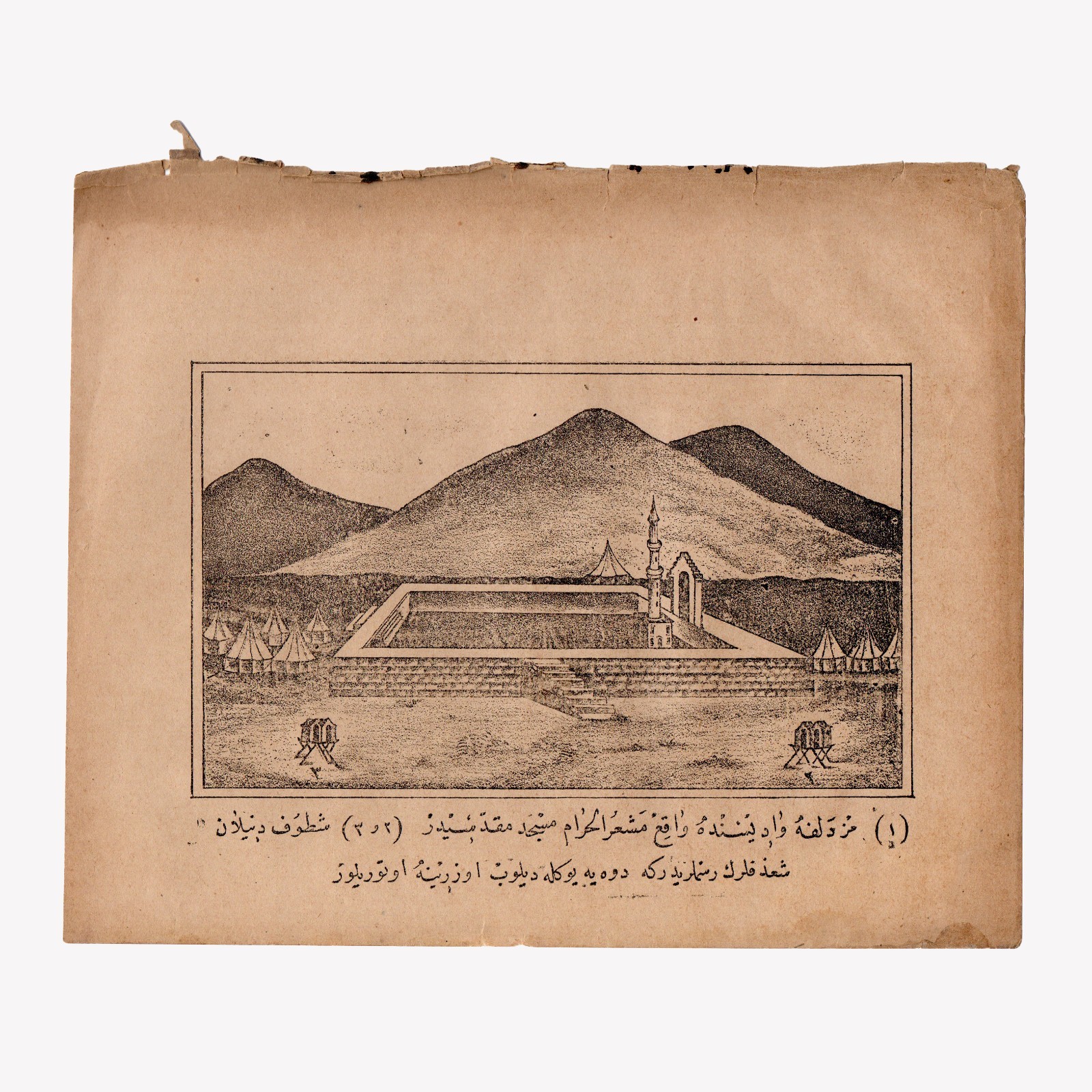
2 Pages of rare 1885 Muzdalifah Valley Mosque - Ottoman Turkish Hajj Saudi Arabia &1885 Cave of Hira Jabal al-Nour - Ottoman Turkish Mecca Hajj Saudi Arabia Viewlithography print plate extracted from old book.
About the book the plate extracted:Eyüp Sabri Paşa was a Turkish naval officer and Ottoman official who had served in the Hejaz; his magnum opus offers a comprehensive study of the religion, history, geography, and peoples of the Haramayn (Mecca and Medina). Complete sets are uncommon: we have traced only three others at sale.
This attractive publication was printed in three parts: Mir\'âtü Mekke (\"Mirror of Mecca\"), in two volumes, published in 1301 H/1885 CE; Mir\'âtü Medîne (\"Mirror of Medina\"), similarly in two volumes, published in 1304 H/1888 CE; and Mir\'âtü Cezîreti\'l-Arab (\"Mirror of the Arabian Peninsula\"), one volume published in 1306 H/1890 CE. Sabri Paşa originally wrote a series of articles in the Turkish newspaper, Tercüman-ı Hakikat (\"Translation of the truth\"), and the articles were later expanded into the present publication.
The work covers the developments of settlements in the Hejaz, especially around Mecca and Medina, including descriptions of tribes, prophets, and emerging religions. The author focuses on the birth and spread of Islam, with a thorough history of Al-Masjid an-Nabawī (\"The Prophet\'s Mosque\") and other holy structures, including their reconstruction, instructions on visiting them, and the social and economic history of the area.\"The diversity of the sources in the work, and the use of them, as well as the adoption of a thematic narrative style, laid the groundwork for its author to be remembered among the leading historians of the period. Although it is essentially a history book, this work also gives advice and practical information to pilgrims\".
The author, Eyüp Sabri Paşa (1248-1308 H/ 1832-1890 CE) was born in Ermiye, Rumelia. After some years in the navy, he served as a civil servant in the Hejaz and became very knowledgeable on Hejazi affairs. He began work on this survey, based on existing sources and his own observations, in 1872 and completed it 15 years later.
Mir\'âtü\'l-Haremayn also describes the beginning and spread of Wahhabism - \"Istanbul\'s quintessential tribal bête noire\" (Low, p. 238). Sabri Paşa was an ardent anti-Wahhabi polemicist: \"His account [in Mir\'âtü Cezîreti\'l-Arab] was recognized as the original source of the Mr Hempher conspiracy in many references [a fiction concerning a British spy who incited Wahhabism], although this is unfounded. For Eyüp Sabri Paşa, Wahhabism came into being as a result of the ignorance, seditiousness, moral corruption and fanaticism of the Bedouins, reflecting 19th-century Ottoman orientalism and the colonial aversion to the savagery of the desert Arab rather than a British plot. Yet applying a \'respectable\' Ottoman origin to this 20th-century forgery rendered it more persuasive and exalted\" (Gürpınar; who adds in a footnote that a colleague has confirmed that \"no reference to Hempher exist[s] in the book\").
In the late 18th century, the Wahhabis began raiding Iraq and then besieged Mecca, which they definitively conquered in 1806. The Ottomans urged Muhammed Ali Pasha, viceroy of Egypt, to drive the Wahhabis from the holy cities. Egyptian troops invaded Arabia, and after a seven-year war, the viceroy\'s forces recaptured Mecca and Medina, occupying western Arabia for some 20 years. \"In the wake of the Wahhabi occupation and the wider crises set in motion by Mehmed Ali\'s empire-building at the expense of the Ottoman center during the 1830s, Ottoman control would not be restored until 1841 when Egyptian troops were forced to withdraw from the Hijaz and Syria in accordance with the terms of the 1840 Convention of London … In Sabri Paşa\'s narration of the environmental and infrastructural history of the Hijaz, the Wahhabi occupation of Mecca and Medina represents the beginning of an era of overlapping social, technical, and natural collapse, providing an alternative reading of the uneven restoration of the Ottoman Hijaz\"
Measures 20 x 16 centimeters (approx.)Will be sent folded as it was in its original era.
We always ensure your item is securely packed in a protective plastic sleeve, placed between hard cardboard, and shipped in an envelope withregistered mail tracking!
Have questions? We\'re happy to help!Browse our storefor more.We are happy to offer combined shipping on multiple collectible purchases to help you save! Just add all items to your cart and request an invoice before paying, or send us a quick message — we’ll calculate the best shipping rate soyou can buy more and save more!
Please examine the listing, some bent corners, era folds, small tears and slight stains due to their genuine antique aging.As is, what you see is what you will get. We try to present the real state of the object as completely as possible with photos.Antique Condition: Fine
Copyright ©2025 by LavenaVintage. All Rights Reserved. All photographs are the intellectual property of LavenaVintage and are protected under international copyright laws. Use or distribution of these images in any form without purchase or prior written permission is strictly prohibited.