When you click on links to various merchants on this site and make a purchase, this can result in this site earning a commission. Affiliate programs and affiliations include, but are not limited to, the eBay Partner Network.
1908-S PHILIPPINES PESO • HISTORIC SILVER DELIBERATELY SUNK BEFORE THE JAPANESE OCCUPATION DURING WWII
U.S. Territorial Coinage with AU details • Manila Bay Salvage • NGC Graded • Deliberately Scuttled by U.S. Forces Before Japanese Occupation • Japanese Salvage Efforts Sabotaged by POW Divers • Partially Recovered by the U.S. Navy After WWII
OVERVIEW:
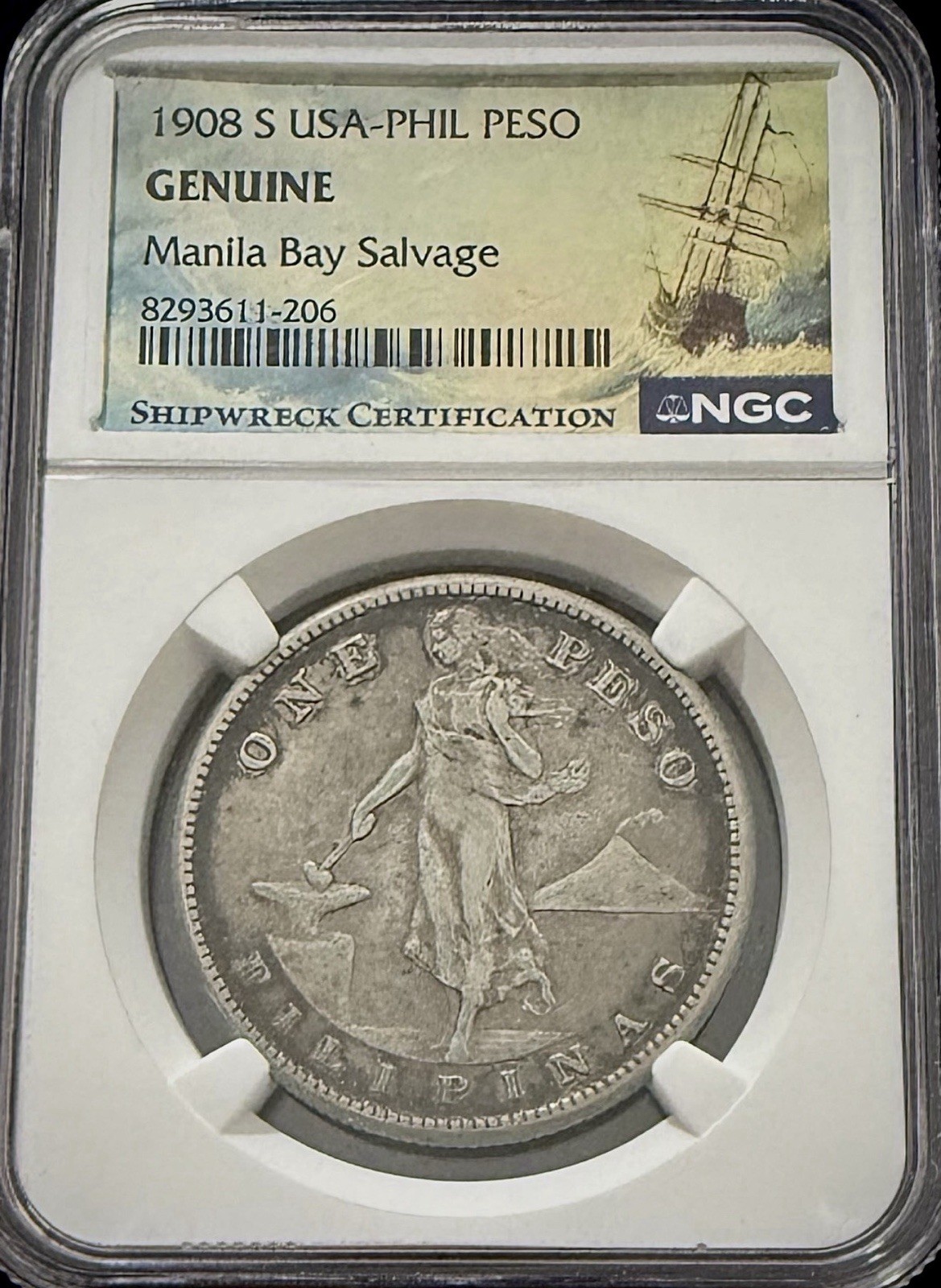
This is a beautiful example of a 1908-S 1 Peso from The United States of America’s administration of the Philippines which was recovered post World War II after it was sunk to prevent Japanese Forces from capturing the Philippine Treasury to fund the Japanese War Effort.
Just before the fall and imminent defeat of the Philippines by invading Japanese forces, American and Philippine authorities systematically secured, evacuated, or destroyed the nation’s monetary reserves through a combination of secret submarine transport, massive bonfires, and deep-sea scuttling in Caballo Bay. Paper money was burned while under the cover of night, U.S. personnel loaded the crates onto barges, towed them out, and dumped them into water over 110 feet deep. The Japanese military learned of the scuttled silver and immediately launched a salvage operation using American and Filipino divers who were POW’s. American POW divers actively sabotaged the operation. Working in pitch-black, muddy water, they used knives to slash open the canvas coin bags, spilling the silver into the deep mud where Japanese cranes couldn't scoop it up. The POWs also smuggled thousands of coins up in their diving suits, passing them to the Philippine resistance to buy food and medical supplies for the prison camps. When the U.S. military liberated the bay in 1945, the U.S. Seventh Fleet Ship Salvage Group recovered many Pesos but the majority were lost to the sea forever. Today, recovered examples are collectively known among numismatists as “Corregidor Pieces” or “Manila Bay Salvage Coins—hold a unique and highly prized position in the world of coin collecting and in history.
*Due to prolonged marine exposure, shipwreck and sea-salvaged coins often receive a “Genuine” grade rather than numeric grades from NGC or PCGS. requires sellers to select a standardized grade category, but the official certification, as always, is displayed on the NGC holder.*
IDENTIFICATION:
* Country: Philippine Islands (U.S. Administration)
* Denomination: Peso
* Date: 1908-S
* Mint: San Francisco (S)
* Engraver: Melecio Figueroa
* Designer: Charles Edward Barber & Melecio Figueroa
* Composition: .800 Silver
* Weight: 20.00 g
* Diameter: 35 mm
* KM: KM#172
* Issued Under: United States Bureau of Insular Affairs
* Grading Service: NGC
* Certification: Manila Bay Salvage
* Grade: Genuine
⸻
OBVERSE:
The obverse features the iconic standing Filipina, designed by renowned Filipino sculptor Melecio Figueroa. Holding a hammer before an anvil, she symbolizes the dignity of labor and the industrial future envisioned for the Philippine Islands under American administration. Behind her rises Mayon Volcano, one of the world’s most recognizable and perfectly conical volcanoes, representing the natural beauty and identity of the archipelago.
The remaining design elements display considerable detail for the issue. Drapery folds, the hammer, anvil, and much of Mayon’s profile remain well defined, while the legends and denticles are bold and evenly struck.
⸻
REVERSE:
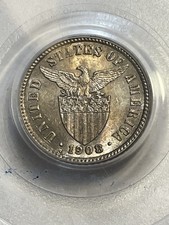
The reverse displays the large heraldic eagle of the United States perched above the American shield, accompanied by the legend UNITED STATES OF AMERICA with the denomination below.
This example exhibits a sharp, well-centered strike. The eagle’s wings retain substantial feather detail, while the shield’s vertical stripes and upper stars remain clearly defined. The 1908 date and San Francisco “S” mintmark are bold and easily attributable, an important diagnostic for this early U.S.-Philippine issue.
⸻
DIE & STRIKE ANALYSIS:
This piece displays a strong, well-centered strike typical of better-preserved early San Francisco issues. The legends remain crisp, denticles are largely complete, and the shield lines are distinctly rendered. Only modest circulation wear softens the highest points while preserving the coin’s overall eye appeal.
No significant strike weakness is evident in the principal design elements, allowing both the artistry of the obverse and the intricate reverse shield to remain attractive.
⸻
SURFACE CHARACTERISTICS:
As expected for a certified Manila Bay Salvage specimen, the surfaces exhibit evidence of prolonged immersion and recovery from a historic wartime wreck. Natural marine exposure has produced mottled black and gray coloration with localized darker areas exhibiting what’s commonly referred to by numismatists as “volcanic patina,” reflecting the interaction of prolonged marine exposure with the volcanic sediments of Manila Bay. With a subdued luster these characteristics are what distinguish genuine recovered examples from ordinary circulated pieces.
Rather than detracting from its desirability, these surfaces document the coin’s remarkable provenance. Every recovered Manila Bay Peso is a tangible survivor of one of the most dramatic naval salvage stories of the Second World War.
⸻
HISTORICAL SIGNIFICANCE & CONTEXT:
The Philippine Peso series introduced under American administration represents one of the most successful colonial coinages ever produced by the United States. Authorized following the Philippine Coinage Act of 1903, these coins were struck to circulate specifically within the Philippine Islands while maintaining parity with the U.S. monetary system.
Designed by Filipino artist Melecio Figueroa, the coin intentionally blended American sovereignty with Filipino national symbolism. The standing Filipina and Mayon Volcano acknowledged the local identity of the islands, while the American eagle emphasized the new political administration established after the Spanish-American War.
This particular example possesses an extraordinary additional chapter in its history through its NGC Manila Bay Salvage designation.
During the opening months of World War II, as Japanese forces advanced into the Philippines in late 1941 and early 1942, enormous quantities of Philippine silver coinage remained stored in government vaults, banks, and the Treasury. To prevent these reserves from falling into Japanese hands, American and Philippine authorities loaded millions of silver coins—including Pesos, Fifty Centavos, Twenty Centavos, and smaller denominations—onto barges in Manila Bay.
When the defense of Manila became untenable, the decision was made to deliberately sink the barges in the bay rather than allow the silver reserves to be captured and used to finance the Japanese occupation. The coins remained submerged for years beneath saltwater, mud, and wartime debris while the Philippines endured occupation.
Following the liberation of the Philippines in 1945, extensive salvage operations recovered large portions of the submerged treasure. Although many coins were successfully reclaimed, years beneath Manila Bay permanently altered their surfaces, creating the distinctive appearance now recognized by collectors. Modern certification by NGC authenticates coins recovered from these historic wartime salvages.
Consequently, this coin is more than an early American territorial silver Peso—it is also a documented survivor of one of World War II’s most fascinating monetary preservation efforts. It connects three major historical periods: the American colonial administration, the Japanese invasion of the Philippines, and the Allied liberation of Manila.
Collectors of U.S. territorial coinage, Philippine numismatics, military history, and shipwreck or salvage coins all pursue these certified Manila Bay examples because they unite numismatic importance with an exceptional and fully documented wartime provenance.
⸻
Why This Example Stands Out:
* Certified NGC Manila Bay Salvage
* Historic World War II recovery provenance
* Early 1908-S San Francisco issue
* Designed by celebrated Filipino sculptor Melecio Figueroa
* Highly collectible U.S. Territorial silver coinage
* Strong strike with bold date and mintmark
* Genuine recovered artifact from one of history’s largest intentional wartime treasure sinkings
As with all inventory this will ship the next business day and you will receive the exact coin pictured - No stock photos.