When you click on links to various merchants on this site and make a purchase, this can result in this site earning a commission. Affiliate programs and affiliations include, but are not limited to, the eBay Partner Network.
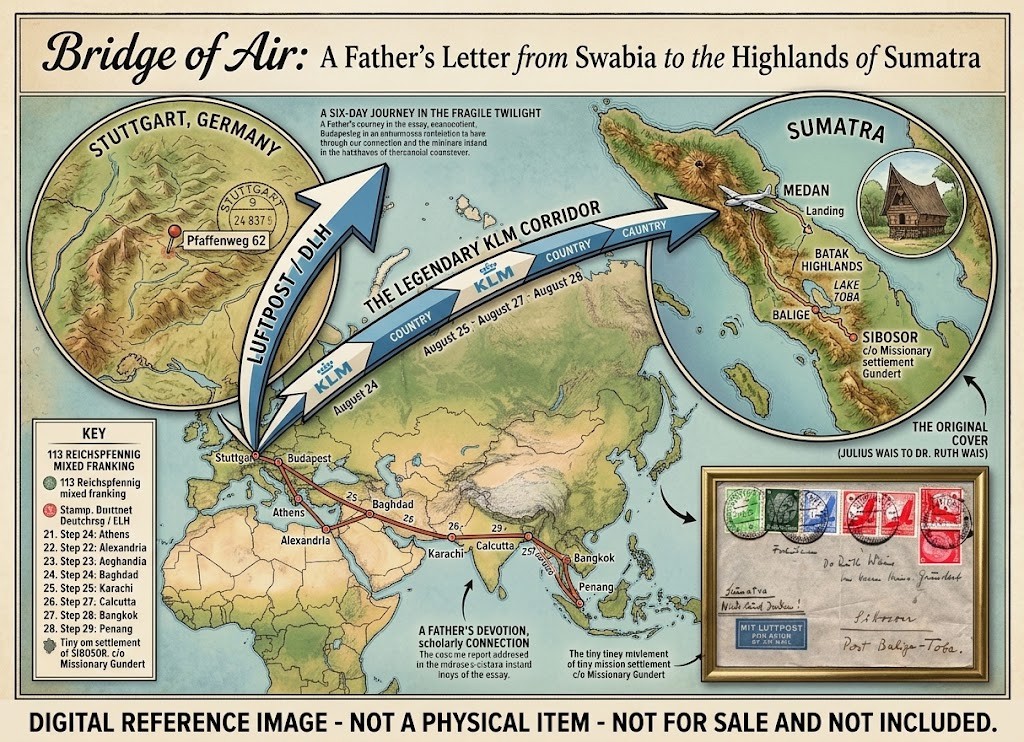
⚠️ IMPORTANT NOTE REGARDING EXHIBIT GRAPHICS: The historical routing maps, geographic overlays, and enhanced composite visuals featured in this listing are custom-designed digital graphics created exclusively for this online presentation. They are intended to provide deep provenance and tell the social history of the cover. No physical prints or digital files are included with the purchase of the physical philatelic item unless explicitly stated.\"Digital Exhibit Graphic Only – Not Included in Purchase, but you are more than welcome to download the images directly from and print them out for your records!\"
1937 Germany to Sumatra Netherlands East Indies Airmail Cover – Wais Family Correspondence
Item Overview
Origin: Stuttgart, Germany
Departure Date: August 24, 1937 (24.8.37)
Arrival Date: August 30, 1937 (30.8.37 backstamp)
Transit Time: 6 days door-to-door via high-speed intercontinental air service
Franking & Postal Markings
Postal Route & Transit Breakdown
Feeder Leg: Flown via Deutsche Reichspost / Deutsche Lufthansa connection from Stuttgart to the international airmail exchange hub.
Trunk Line: Transferred to the scheduled KLM Royal Dutch Airlines East Indies trunk route (Amsterdam–Batavia service), operating modern multi-engine Douglas transports across Europe, the Middle East, and South Asia.
Sumatra Offload & Inland Transit: Unloaded at Medan-Polonia Airport in Northern Sumatra on August 29, transferred to the Deli railway line toward Pematang Siantar, and conveyed by regional motor post up into the volcanic highlands of Lake Toba, arriving at the Balige/Sibosor postal district on August 30.
Provenance & Historical Context
Sender: Corner imprint on reverse for Julius Wais, Pfaffenweg 62, Stuttgart-Süd—a celebrated German author, topographer, and pioneer of the Swabian hiking movement.
Addressee: Addressed to his daughter, Dr. Ruth Wais (noted literary scholar and author), in care of missionary Heinrich Gundert at Sibosor. Gundert was active with the historic Rhenish Mission Society serving the Toba Batak communities in the remote central interior of Sumatra.
Light perimeter wear, gentle handling creases, and expected faint toning from tropical transit.
Adhesives and circular cancellations remain vivid, well-centered, and intact.
Key Value Drivers
Remote Destination: Airmail to interior Sumatra (Sibosor / Lake Toba) commands a stronger premium than routine commercial covers to major ports like Batavia or Surabaya.
Attractive Multi-Color Franking: Clean five-stamp combination featuring the 1934 Airmail set, Hindenburg definitive, and the 1936 Winter Relief charity stamp.
Tied Slogan Cancels: Clear, readable strikes of the Stuttgart \"Stadt der Auslandsdeutschen\" commemorative postmark.
Missionary / Family Provenance: Correspondence from noted regional author Julius Wais to scholar Dr. Ruth Wais c/o missionary Heinrich Gundert adds solid crossover appeal for mission and regional German history collectors.
Historical & Biographical Context: Julius & Dr. Ruth Wais (1937)
The Sender: Julius Wais (1866–1939)
Identity: Julius Wais was a prominent German author, geographer, and pioneer of the Swabian hiking movement (Schwäbischer Albverein). He authored several definitive regional trail guides and topographic studies of Southwestern Germany.
Origin: Pfaffenweg 62 in Stuttgart-Süd (southern district of Stuttgart, Württemberg).
Historical Backdrop: In 1937, Stuttgart had been designated by the Nazi regime as the official Stadt der Auslandsdeutschen (\"City of Germans Abroad\"), highlighted by the postmark on the cover. This campaign aimed to centralize cultural, economic, and political ties between the Third Reich and the large diaspora of German academics, missionaries, and emigrants living overseas.
The Receiver: Dr. Ruth Wais (1909–1996)
Identity: Daughter of Julius Wais, Dr. Ruth Wais was a German literary scholar, philologist, and writer who conducted extensive field studies.
Location in 1937: Residing in Sibosor, an interior settlement in the Batak highlands near Balige on Lake Toba, Northern Sumatra (Dutch East Indies).
Host (Heinrich Gundert): The cover is addressed \"bei Herrn Heinr. Gundert\". Heinrich Gundert was associated with the longstanding German Protestant missionary presence in the region—primarily under the auspices of the Rhenish Mission Society (Rheinische Missionsgesellschaft), which had been active among the Toba Batak people since the 1860s.
Colonial & Geopolitical Background: Sumatra (Netherlands East Indies)
Pre-WWII Dutch East Indies: In August 1937, Sumatra was part of the Dutch colonial empire. The Batak highlands around Lake Toba maintained an active network of European mission stations, schools, and hospitals.
The Rapid Air Corridor: Before the advent of reliable long-distance commercial aviation, mail between Central Europe and the East Indies took up to a month by sea. By 1937, regular bi-weekly airmail runs operated via KLM (from Amsterdam) with Lufthansa connections cut total transit down to just 6 days (departed Stuttgart August 24; arrived in Sumatra August 30), representing the absolute cutting edge of pre-war intercontinental communication.
Postal Route Breakdown: Stuttgart to Sibosor, Sumatra (August 1937)
LegTransport / CarrierRoute SegmentDate / Schedule1. Origin & FeederDeutsche Reichspost / Deutsche Lufthansa (DLH)Stuttgart → Halle/Leipzig or Amsterdam (Schiphol)Aug 24, 1937 (Postmarked Stuttgart 9)2. Trunk IntercontinentalKLM Royal Dutch Airlines (Summer Service, Douglas DC-3 / DC-2)
Amsterdam (Schiphol) → Batavia line via:
• Halle/Leipzig – Budapest – Athens
• Alexandria – Lydda – Baghdad – Basra
• Jask – Karachi – Jodhpur – Allahabad
• Calcutta – Rangoon – Bangkok – Penang
Departed Wednesday, Aug 25, 1937 from Schiphol3. Sumatra OffloadKLM Royal Dutch AirlinesMedan (Medan-Polonia Airport, Northern Sumatra)Arrived Sunday, Aug 29, 19374. Regional DispatchDeli Spoorweg Maatschappij (DSM) rail & inland postal coach / motor dispatchMedan → Pematang Siantar → Balige (Lake Toba)Dispatched southward toward the Batak highlands5. Destination DeliveryPTT (Post-, Telegraaf- en Telefoondienst) / Local courierBalige → Sibosor Mission StationAug 30, 1937 (Backstamp: ...30.8.37...)
Route Insights
Total Transit Time: Exactly 6 days door-to-door (August 24 to August 30).
The KLM Fast Corridor: By the summer of 1937, KLM operated twice-weekly departures (Wednesdays and Saturdays) from Amsterdam to Batavia with modern Douglas transports. Eastbound flights took only 5½ days.
Direct Northern Sumatra Offload: Instead of flying all the way to Java (Batavia) and backtracking, East Indies mail destined for Northern Sumatra was unloaded at the scheduled stop at Medan (Polonia), then carried via the Deli railway line to Siantar and by postal motor coach up into the Lake Toba mountain basin at Balige.
Bridge of Air: A Father’s Letter from Swabia to the Highlands of Sumatra
In the late summer of 1937, an ultralight envelope began a remarkable intercontinental journey, propelled by the pinnacle of pre-Second World War aviation. Sent from Pfaffenweg 62 in Stuttgart-Süd, the cover bears the corner imprint of Julius Wais, the celebrated Swabian geographer, author, and champion of Southwestern Germany’s hiking trails. Addressed across thousands of miles to his daughter, Fräulein Dr. Ruth Wais, the letter carried familial devotion and scholarly connection deep into the interior volcanic highlands of Northern Sumatra, addressed in care of missionary Heinrich Gundert at Sibosor near Lake Toba.
The outward journey captured on the face of the cover represents a technological wonder of its era. Canceled in Stuttgart on August 24, 1937, with commemorative postmarks celebrating the city as the Stadt der Auslandsdeutschen (\"City of Germans Abroad\"), the envelope was franked with 113 Reichspfennig in mixed adhesives—combining the stylized eagles of the 1934 Airmail issue, a classic green Hindenburg medallion, and the 1936 Winter Relief charity stamp. Tied by bold strikes, these stamps funded conveyance into Europe\'s fastest intercontinental airway. Deutsche Lufthansa carried the cover to link with the legendary KLM Royal Dutch Airlines corridor. Aboard modern multi-engine Douglas transports, the letter leaped across the Mediterranean, the deserts of the Middle East, India, and the Bay of Bengal, disembarking at Medan’s Polonia airfield on Sumatra’s northeastern coast before ascending the rugged rail and mountain roads into the Batak plateau.
Arriving on August 30—just six days after leaving Württemberg—the cover stood at the fragile twilight of an epoch. Within three years, the outbreak of war in Europe would shatter this peaceful postal corridor, leading to the immediate internment of German missionaries and expatriates across the Dutch East Indies. Today, this delicate, cross-braced airmail letter endures not only as a masterpiece of pre-war philatelic transit, but as an intimate relic of familial reach bridging the tranquil Swabian hills and the remote heights of Lake Toba.
⚠️ IMPORTANT NOTE REGARDING EXHIBIT GRAPHICS: The historical routing maps, geographic overlays, and enhanced composite visuals featured in this listing are custom-designed digital graphics created exclusively for this online presentation. They are intended to provide deep provenance and tell the social history of the cover. No physical prints or digital files are included with the purchase of the physical philatelic item unless explicitly stated.\"Digital Exhibit Graphic Only – Not Included in Purchase, but you are more than welcome to download the images directly from and print them out for your records!\"
Get your own free counter at Auctiva
Try Auctiva free for 30 days, no credit card required