When you click on links to various merchants on this site and make a purchase, this can result in this site earning a commission. Affiliate programs and affiliations include, but are not limited to, the eBay Partner Network.
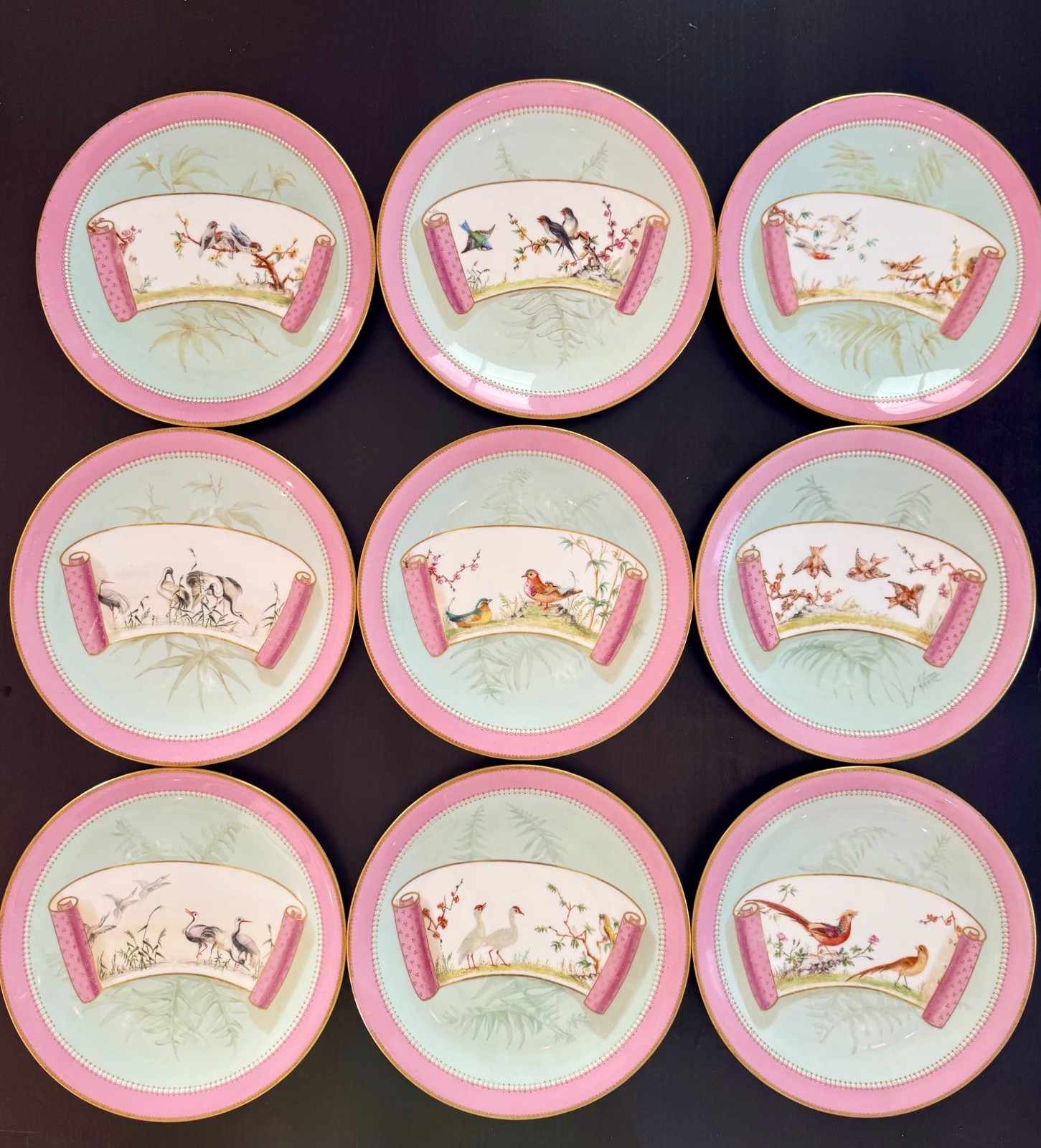
1874 - Set of 9 Royal Worcester Hand-Painted Bird Dessert Plates, Each UniqueOffered here is a remarkable surviving set of nine Royal Worcester porcelain dessert plates, each measuring approximately 9 inches in diameter and dating to 1874. Each scene is unique, for 9 paintings in total.Details
Maker: Worcester Royal Porcelain Company / Royal Worcester
Place: Worcester, England
Date: 1874
Period: Victorian
Movement/style: Aesthetic Movement / Japonisme / Anglo-Japanese
Material: Porcelain
Decoration: 9 individual hand-painted birds and botanical scenes; enamel and gilt decoration
Ground colors: Pale celadon/mint green and rose pink
Diameter: Approximately 9 inches each
Quantity: Nine plates
Factory mark: Crowned Worcester circular “51” mark with 1874 date indication
Additional marks: Hand-painted factory/decorator marks
sale and collection comparisons
There are strong documented comparisons for this set.
Christie\'s has catalogued Royal Worcester dessert wares bearing the same 1874 date. One documented group comprised twelve Royal Worcester dessert plates, approximately 23 cm / 9 inches in diameter, individually painted with botanical subjects and carrying factory marks and date codes for 1874. Christie\'s
Christie\'s — Twelve Royal Worcester Dessert Plates, 1874
Christie\'s has also catalogued an 1874 Royal Worcester pale-blue dessert service consisting of eleven plates and compotes painted with Japanese plants, together with another period dessert service whose plates were individually painted with birds. The Worcester plates were approximately 9½ inches across. Christie\'s
Christie\'s — Royal Worcester 1874 Dessert Service
An even closer market comparison appeared at Locati in October 2025: a Royal Worcester partial dessert service consisting of eleven plates and four tazzas, each with hand-painted bird decoration and all dated 1874. The plates ranged from approximately 8¾ to 10¼ inches in diameter. offersquare
Locati — 1874 Royal Worcester Hand-Painted Bird Dessert Service
These documented examples provide useful context for both the date and original function of the present nine plates.
Royal Worcester — definitively dated 1874
Each plate bears the historic Worcester Royal Porcelain Company crowned circular factory mark, incorporating the number 51. The Museum of Royal Worcester explains that the “51” appearing in this mark refers to 1751, the founding year of the Worcester Porcelain Company by Dr. John Wall.
More importantly for dating this particular service, the Museum records that between 1862 and 1875 Worcester occasionally printed the last two digits of the manufacturing year beneath the standard factory mark.
- These plates bear “74” beneath the mark, identifying their manufacture as 1874.
The Museum\'s independent Worcester date-code table also assigns the letter “I” to 1874. Thus, these plates are now approximately 152 years old and can be securely attributed to the Worcester Royal Porcelain Company in Worcester, England.
Reference: Museum of Royal Worcester, Royal Worcester Factory Marks. Museum of Royal Worcester
Museum of Royal Worcester — Royal Worcester Factory Marks
An exceptional example of Victorian Japonisme
The plates were created during one of the most fascinating periods in Royal Worcester\'s history. Following the opening of Japan to Western trade in the mid-19th century, Japanese art and design had an enormous influence on European decorative arts. The resulting movement became known as Japonisme. The Metropolitan Museum of Art specifically notes that after the formation of the Royal Worcester Porcelain Company in 1862, the factory became increasingly recognized for its Japanese-inspired designs. The Metropolitan Museum of Art
The Metropolitan Museum of Art — Worcester and Japonisme
These nine plates are wonderful examples of that aesthetic. Each incorporates an Asian-inspired unfurling scroll with shadowing, containing a naturalistic bird scene. The individual compositions include colorful birds among flowering branches, bamboo, grasses and foliage.
The scroll itself is rose pink and embellished with minute gilt decoration. In this time period, the gilt was typically 24 karat gold. Surrounding it is a beautiful pale celadon or mint-green ground with subtle botanical decoration, bordered by a broad rose-pink band.
Most striking is the elaborate raised white enamel “jeweling”, individually accented with tiny gilt dots, which forms an inner border around each plate. The outer rim is also extensively gilded.
The overall effect is considerably richer and more sophisticated in person than conventional Victorian tableware.
Nine individual paintings — one coordinated service
Each contains its own arrangement of birds, branches and vegetation while maintaining the identical pink-scroll, celadon-ground, jeweled and gilded decorative scheme.
Please examine all photographs carefully. The listing includes photographs of each of the nine plates individually so their next steward can see the complete series of paintings rather than merely representative examples
The backs retain additional hand-painted factory/decorator marks. These appear consistent with the production and decorating practices used at Worcester, but no attribution to a particular named artist is being claimed.
The Metropolitan Museum of Art, for example, documents Royal Worcester pieces bearing letter marks attributable to anonymous factory gilders, illustrating the use of such individual workshop marks during this period. The Metropolitan Museum of Art
Provenance
Private family collection, United States.
The nine plates have descended together within the present owner\'s family for more than 150 years. We used these plates in my family for our finest events, and served simple treats on them like cheese straws, divinity, pecan clusters, fudge--they are remarkably strong and have been lovingly cared for, but not \"sheltered\" as useless objects. They are very much alive and graceful pieces of table ware. I encourage you, if you are their next steward, to use them and enjoy them. The hand painted details on each bird are captivating. These plates have a weight in history and in careful production you just can\'t find today, anywhere, at any price. PROVENANCE
The plates have been together in my family for 150 years, and are being offered as a themed, complete group of nine. Family history places them as from the Ashton Plantation, St. Charles Parish, Louisiana, in the hands of Edna Brady Dirker, born on that plantation. Her parents, who I believe originally purchased the china, were Mathilda Jones — b. Mississippi, about 1848–1855; her father born South Carolina, her mother Georgia. Widowed and head of house on Camp Street, New Orleans, in 1910. Her husband was James S. Brady — b. about 1845 in South Carolina (both his parents born there too). He was the farm/plantation manager at the Ashton Plantation in St. Charles Parish, Louisiana.Their daughter Edna married William Dirker in 1905 (he was born in England). They lived together in New Orleans and moved to Portland. The plates came with her. She and William had a son William Dirker, Jr. who married my grandmother Blanche Dirker; the plates came to me, Blanche\'s grand daughter.
There are no bills of sale; this is oral history in my family.