When you click on links to various merchants on this site and make a purchase, this can result in this site earning a commission. Affiliate programs and affiliations include, but are not limited to, the eBay Partner Network.
Greek Coin of Attica
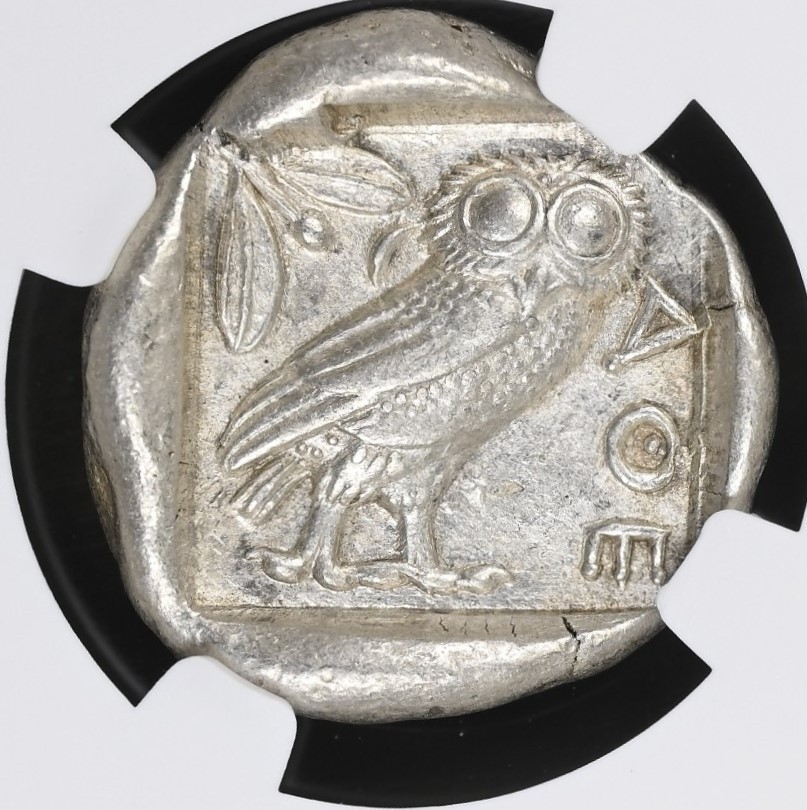
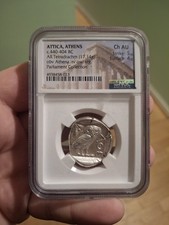
AthensStuck circa 440-404 BC.
AR Silver Tetradrachm -25mm - 17.10 grams - 10h
Mid-mass coinage issue
Reference: HGC 4, 1597, SNG Copenhagen 31-40, Kroll 8
Certification: NGC AU8233610-215Obverse: Head of Athena facing right, wearing earring, necklace, and crested Attic helmet ornamented with three laurel leaves and vine scroll
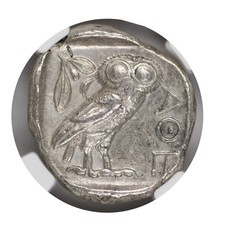
Reverse: AΘE, Owl standing right, head facing; olive sprig with two leaves and one berry, and crescent moon behind, all within incuse squareArrives with specifications page for your reference
See theGenuine HistoryCollection
Minted in Athens during its heyday as a powerful city-state, these tetradrachms were a staple of trade and commerce throughout the ancient Mediterranean. The period of 440-404 BC corresponds to the height of Athenian power and cultural influence.
The obverse features the iconic portrayal of Athena, the city\'s patron goddess, wearing her distinctive helmet. The meticulous rendering of Athena\'s image reflects the artistic achievements of Athenian coinage during this period.
The reverse depicts the owl, symbolizing wisdom and Athena\'s association with the city. The olive sprig, berry, and crescent moon in the incuse square add symbolic depth, likely representing agricultural abundance and the city\'s connection to goddess Athena.
In Greek mythology, a little owl (Athene noctua) traditionally represents or accompanies Athena, the virgin goddess of wisdom, or Minerva, her syncretic incarnation in Roman mythology. Because of such association, the bird—often referred to as the \"owl of Athena\" or the \"owl of Minerva\"—has been used as a symbol of knowledge, wisdom, perspicacity and erudition throughout the Western world. The city of Athens seems to have adopted the owl as proof of allegiance to its patron virgin goddess, who, according to a popular etiological myth reproduced on the West pediment of the Parthenon, secured the favor of its citizens by providing them with a more enticing gift than Poseidon. Owls were commonly reproduced by Athenians in vases, weights and prize amphoras for the Panathenaic Games. The owl of Athena even became the common obverse of the Athenian tetradrachms after 510 BC and according to Philochorus, the Athenian tetradrachm was known as glaux (γλαύξ, little owl) throughout the ancient world and \"owl\" in present-day numismatics. They were not, however, used exclusively by them to represent Athena and were even used for motivation during battles by other Greek cities, such as in the victory of Agathocles of Syracuse over the Carthaginians in 310 BC—in which owls flying through the ranks were interpreted as Athena\'s blessing —or in the Battle of Salamis, chronicled in Plutarch\'s biography of Themistocles.
Little Owl (Athene Noctua)
The FirstPeloponnesian War(460–445 BC) was fought between Sparta, leading the Peloponnesian League along with allies such as Thebes, and the Delian League led by Athens with support from Argos. It consisted of multiple smaller conflicts, including the Second Sacred War. Causes included the construction of Athens’ Long Walls, Megara’s defection from the Peloponnesian League, and Sparta’s growing concern over the expanding Athenian Empire.
The war began in 460 BC with the Battle of Oenoe, where Spartan forces were defeated by the Athenian-Argive alliance. Initially, Athens prevailed both at sea, using its superior navy, and on land. In 457 BC, however, Sparta and its allies defeated Athens at the Battle of Tanagra. Athens quickly recovered, winning a decisive victory over the Boeotians at Oenophyta and conquering most of Boeotia except Thebes.
Athens strengthened its position by bringing Aegina into the Delian League and raiding the Peloponnese. In 454 BC, Athens suffered a major defeat to Persia in Egypt, leading to a five-year truce with Sparta. Hostilities resumed in 448 BC with the Second Sacred War. In 446 BC, Boeotia revolted, defeating Athens at Coronea and regaining independence.
The war concluded with the Thirty Years’ Peace (winter 446–445 BC), which maintained the main holdings of both sides: Athens retained naval supremacy while Sparta dominated on land. Megara returned to the Peloponnesian League, and Aegina became a tribute-paying but autonomous member of the Delian League. This peace collapsed in 431 BC with the outbreak of the Second Peloponnesian War, which ended in 404 BC with Sparta’s occupation of Athens.
The Athenian long walls which connected Athens to Piraeus
The Second Peloponnesian War (431–404 BC), often called simply the Peloponnesian War, was an ancient Greek conflict between Athens and Sparta and their respective allies for dominance over the Greek world. The war remained undecided until the Persian Empire intervened in support of Sparta. Led by Lysander, the Spartan fleet, built with Persian subsidies, defeated Athens and ushered in a period of Spartan hegemony over Greece.
Historians divide the war into three phases. The first phase (431–421 BC), called the Ten Years War or Archidamian War, was named after Spartan King Archidamus II, who invaded Attica several times with the hoplite army of the Peloponnesian League. Athens’ Long Walls nullified this strategy, while its superior navy raided Peloponnesian coasts to incite rebellions against Sparta. The Peace of Nicias was signed in 421 BC and lasted until 413 BC. During this period, proxy battles occurred, most notably the Spartan victory at Mantinea in 418 BC against an alliance of Elis, Mantinea, Argos, and Athens. The key event was the Sicilian Expedition (415–413 BC), in which Athens lost nearly its entire navy in a failed attempt to seize Syracuse, a Spartan ally.
The Sicilian disaster led to the third phase (413–404 BC), called the Decelean War or Ionian War, when Persia aided Sparta in reclaiming control over the Greek cities of Asia Minor that had joined the Delian League. With Persian funds, Sparta built a massive fleet under Lysander, who won decisive victories in the Aegean, especially at Aegospotamos in 405 BC. Athens surrendered the following year, losing its empire. Sparta imposed puppet oligarchies across the former Delian League, including the Thirty Tyrants in Athens. Ten years later, the Corinthian War (394–386 BC) weakened Sparta’s dominance and allowed Athens to regain independence.
The Peloponnesian War reshaped the Greek world. Athens, formerly the strongest city-state, was reduced to near subjugation, while Sparta became Greece’s leading power. Economic hardship spread across Greece; poverty struck the Peloponnese, and Athens never regained its pre-war prosperity. The war’s political and social effects were profound: the rivalry between democratic Athens and oligarchic Sparta, each backing like-minded factions in other states, made warfare commonplace. Once limited and ritualized, Greek warfare became an all-out struggle between city-states, involving mass atrocities, the devastation of countryside, and the destruction of cities. The conflict shattered religious and cultural norms and marked theend of the fifth century BC and the golden age of Greece.
Encounter between Cyrus the Younger (left), Achaemenid satrap ofAsia Minor and son of Darius II,
and Spartan general Lysander (right), in Sardis. The encounter was related by Xenophon. Francesco Antonio Grue (1618–1673)