When you click on links to various merchants on this site and make a purchase, this can result in this site earning a commission. Affiliate programs and affiliations include, but are not limited to, the eBay Partner Network.
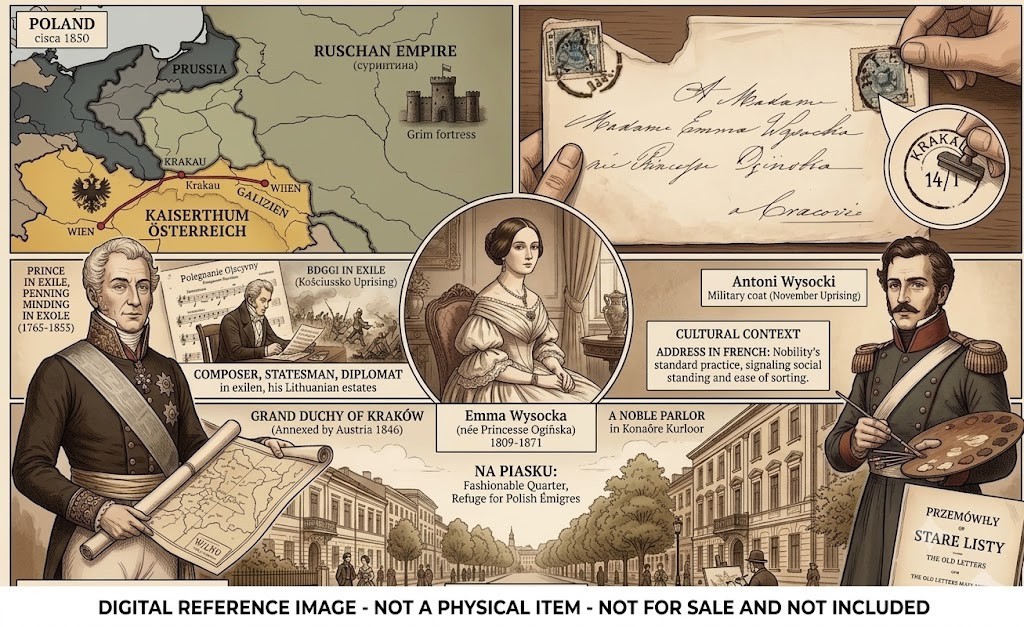
⚠️ IMPORTANT NOTE REGARDING EXHIBIT GRAPHICS: The historical routing maps, geographic overlays, and enhanced composite visuals featured in this listing are custom-designed digital graphics created exclusively for this online presentation. They are intended to provide deep provenance and tell the social history of the cover. No physical prints or digital files are included with the purchase of the physical philatelic item unless explicitly stated.
\"Digital Exhibit Graphic Only – Not Included in Purchase, but you are more than welcome to download the images directly from and print them out for your records!\"AUSTRIA 1850 18kr Double-Rate Cover to Princess Emma Ogińska (Kraków/Galicia)Item Description
A fascinating mid-19th-century Austrian Empire postal history cover sent from the imperial capital of Vienna to Cracovie (Kraków), which had been annexed into the Habsburg Empire as the Grand Duchy of Kraków following the geopolitical upheavals of 1846.
The cover features an elegant, high-society address written in French—the standard lingua franca of the European aristocracy—and is addressed to Madame Emma Wysocka, née Princesse Ogińska. Delivery is specified to the fashionable Na Piasku (\"On the Sand\") residential quarter, located just outside Kraków\'s medieval Old Town walls.
Philatelic & Postal History Breakdown
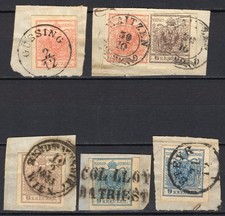
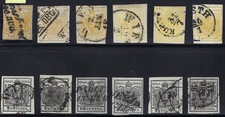
Franking: Features a double-weight or heavy-tier 18 Kreuzer domestic rate, paid via a pair of the iconic Austria 1850 First Issue 9 Kreuzer stamps (featuring the double-headed Habsburg eagle coat of arms).
Transit & Mail Route: This cover traveled the historic hybrid rail route connecting Vienna to Kraków via the Kaiser Ferdinands-Nordbahn, transferring onto the Prussian Wilhelmsbahn system through Upper Silesia (Ratibor/Myslowitz) under the Austro-Prussian Postal Convention of 1850, before crossing back into the Kraków central terminal via the Kraków-Upper Silesian Railway line.
Important Social Philately Context
The recipient, Princess Emma Wysocka (née Ogińska, 1809–1871), belonged to the illustrious princely House of Ogiński. She was the daughter of Prince Michał Kleofas Ogiński (1765–1833)—the famed Grand Treasurer of Lithuania, diplomat, statesman, and composer of the legendary polonaise \"Farewell to the Homeland\" (Pożegnanie Ojczyzny). Her husband, Antoni Wysocki, was a known artist and military veteran of the Polish November Uprising. Their intimate family letters were later immortalized in the acclaimed Polish biographical anthology \"Przemówiły stare listy\" (The Old Letters Have Spoken).
Condition Report
As-Is / Space-Filler / Study Piece: Please note that this cover has a significant, large structural piece missing along the top center/left edge. This tear has cut away the upper left corner of the left-hand 9kr stamp and removed a portion of the origin cancellation mark.
Despite the prominent structural flaw, the remaining stamps, the rare and highly desirable aristocratic address script, and the destination markings remain beautifully clear. An excellent, affordable opportunity to own a premium piece of 1850s European princely mail.
Please review the high-resolution scans carefully to evaluate condition prior to offerding.
Shipping & Handling
Intact Potential$250 – $400+ USDIf completely sound, an 18kr double-rate franking from the 1850 first issue, addressed in French court script to a prominent Princess of the House of Ogiński, and delivered via a complex Austro-Prussian transit route to Kraków would easily command a strong three-figure premium at a specialized postal history sale.
In the early 1850s, the transmission of mail between the imperial capital of Vienna (Wien) and the newly annexed Grand Duchy of Kraków (Krakau) was undergoing a major technological shift.
Letters traveling this specific postal corridor relied on a hybrid route consisting of the burgeoning Kaiser Ferdinands-Nordbahn (Emperor Ferdinand Northern Railway) and a temporary loop through Prussian Upper Silesia.
The standard route for this cover would have progressed as follows:
[ VIENNA ] (Originating Depot / Sorting Center) │ ▼ (Via Kaiser Ferdinands-Nordbahn Railway) [ ODERBERG ] (Austrian Border Station / Modern Bohumín) │ ▼ (Crossed into Prussian Territory via Wilhelmsbahn Railway) [ RATIBOR & MYSLOWITZ ] (Prussian Upper Silesia Mail Transit) │ ▼ (Kraków-Upper Silesian Railway Line) [ KRAKÓW ] (Grand Duchy of Kraków / Destination Office)1. The Rail Segment: Vienna to Oderberg
The letter departed Vienna via the Kaiser Ferdinands-Nordbahn. By 1850, this trunk line was fully operational, heading northeast from Vienna through Lower Austria, Moravia, and up to the Austrian imperial border station at Oderberg (now Bohumín, Czech Republic).
2. The Prussian Transit Loop (The Geopolitical Detour)
An entirely internal Austrian rail line tracking straight through Galicia from Oderberg to Kraków was not completed until 1856. Therefore, in the early 1850s, mail bags arriving at the Oderberg border were transferred onto the Prussian Wilhelmsbahn railway network.
The mail made a quick, efficient loop through Prussian Upper Silesia, running through Ratibor (Racibórz) and Myslowitz (Mysłowice). This international transit was heavily governed by the Austro-Prussian Postal Convention of 1850, ensuring that domestic mail bags sealed in Vienna could cross Prussian rails smoothly without being assessed foreign transit tariffs or slowing down for custom inspections.
3. Arrival via the Kraków-Upper Silesian Line
From Myslowitz, the route connected to the Kraków-Upper Silesian Railway (Krakau-Oberschlesische Bahn), which carried the mail directly across the frontier into the Kraków central terminal.
Upon clearing the rail station sorting room, local city couriers transferred the letter to the post office operating out of the fashionable Na Piasku suburb to be hand-delivered to Princess Emma Ogińska\'s residence at House No. 52.
Epistolary Geopolitics: The Ogiński Cover and the Fractured Landscape of 1850s Central Europe
The material remnants of nineteenth-century correspondence often serve as profound historical vectors, collapsing the distance between intimate personal networks and macroscopic geopolitical shifts. A prime exemplar of this intersections is an 1850 Austrian Empire postal cover addressed to Madame Emma Wysocka, née Princesse Ogińska. Despite sustaining significant structural damage along its upper edge, this artifact—bearing a heavy 18-Kreuzer double-rate franking and sent from the imperial capital of Vienna to the annexed city of Kraków—stands as a compelling testament to the partitioned Polish homeland, the aristocratic resilience of the House of Ogiński, and the rapid technological integration of the mid-nineteenth-century European postal systems.
The Geopolitical Canvas: A Partitioned Poland and the Annexation of Kraków
To understand the trajectory of this cover, one must examine the fractured geopolitical landscape of Central Europe in the wake of the Congress of Vienna (1815). By the 1850s, Poland had ceased to exist as a sovereign state, its territories systematically dissected by the Russian Empire, the Kingdom of Prussia, and the Austrian Habsburg Monarchy. For the Polish nobility, navigating this tripartite occupation required constant adaptation, as family estates, loyalties, and physical bodies were forcibly distributed across three competing empires.
The destination of the letter, Kraków (rendered in the elegant French court script on the cover as Cracovie), occupied a uniquely painful position in this narrative. Following the defeat of Napoleon, Kraków had been designated the \"Free, Independent, and Strictly Neutral City of Kraków,\" a tiny republican sanctuary of Polish culture surrounded by absolute monarchies. However, this semi-independence was short-lived. Following the desperate, nationalistic fervor of the Kraków Uprising of 1846, the Austrian Empire unilaterally dissolved the free republic. The city was formally absorbed into the Habsburg domains as the Grand Duchy of Kraków (Großherzogtum Krakau).
The physical stamps affixed to the cover—a pair of 9-Kreuzer blue stamps from Austria’s iconic 1850 First Issue—are the direct bureaucratic consequence of this annexation. Because Kraków was now legally and administratively an internal territory of the Austrian Empire, a letter sent from Vienna did not cross an international border; it traveled via a domestic rate, denominated in imperial Kreuzer, and cleared through a unified Habsburg postal infrastructure.
Social Philately: Emma Ogińska and the Echoes of Exile
While the stamps and destination capture the macro-history of imperial expansion, the address script anchors the artifact in the poignant realities of social philately and aristocratic exile. The letter is addressed to \"Madame Emma Wysocka, née Princesse Dginolska\" (a contemporary or clerical variant of Ogińska). Princess Emma (1809–1871) was a scion of the House of Ogiński, a highly distinguished princely family of the Grand Duchy of Lithuania and Polish heritage.
The pedigree of the recipient infuses the cover with profound cultural resonance. Emma was the daughter of Prince Michał Kleofas Ogiński (1765–1833), a celebrated diplomat, statesman, and the Grand Treasurer of Lithuania. Internationally, however, Prince Michał was immortalized as a composer. Following the collapse of the 1794 Kościuszko Uprising—a failed but valiant attempt to defend the Polish-Lithuanian Commonwealth against Russian and Prussian aggression—Prince Michał was forced into exile. During this painful departure from his ancestral lands, he composed the haunting, melancholy polonaise, Pożegnanie Ojczyzny (\"Farewell to the Homeland\"), a piece of music that became an anthem of longing for generations of displaced Poles.
Emma’s marriage to Antoni Wysocki further entwines this cover with the history of Polish insurrection. Wysocki was an artist and a veteran of the 1830 November Uprising, another bloody, unsuccessful revolt against Russian hegemony. The Ogiński family estates, situated in the eastern borderlands under harsh, repressive Russian governance, became increasingly untenable for family members associated with revolution. Consequently, many sought refuge or established secondary residences within the culturally and politically more permissive Austrian partition of Galicia and Kraków.
The choice of French for the address line—A Madame / Madame Emma Wysocka / née Princesse... à Cracovie—is a crucial socio-cultural marker. French was the universal lingua franca of the European aristocracy, signaling high social standing, elite education, and a shared continental identity that transcended the immediate, oppressive realities of local imperial rule. Furthermore, the specific delivery instruction to Na Piasku Nro. 52 (\"On the Sand,\" House No. 52) locates Emma within a fashionable, progressive suburb just outside Kraków’s medieval walls, an area that rapidly evolved into a vibrant enclave for wealthy families, artists, and political émigrés.
Industrialization and Postal Mechanics: The Hybrid Rail Route
Beyond its human and political dimensions, the cover is a artifact of the Industrial Revolution, mapping a transitional moment in European transport history. To travel from Vienna to Kraków in the early 1850s, mail bags relied on a sophisticated, hybrid transit system that utilized both the expanding railway networks and strategic international treaties.
The letter began its journey from the sorting depots of Vienna via the Kaiser Ferdinands-Nordbahn (Emperor Ferdinand Northern Railway). By 1850, this impressive steam-powered trunk line ran northeast through Lower Austria and Moravia, terminating at the Austrian imperial border station of Oderberg (modern-day Bohumín). However, an internal, direct Austrian rail connection tracking straight through Galicia from Oderberg to Kraków would not be completed until 1856.
To bridge this geographic gap in the early 1850s, the Austrian postal administration utilized a fascinating geopolitical detour through Prussian territory. Upon arriving at Oderberg, the mail bags were transferred to the Prussian Wilhelmsbahn network, looping efficiently through Prussian Upper Silesia via the railway hubs of Ratibor (Racibórz) and Myslowitz (Mysłowice). This cross-border transit was facilitated by the groundbreaking Austro-Prussian Postal Convention of 1850. The treaty allowed domestic mail bags to traverse Prussian rails sealed and exempt from foreign transit tariffs or customs inspections, maximizing speed without compromising imperial sovereignty. From Myslowitz, the route linked to the Kraków-Upper Silesian Railway, bringing the letter across the frontier and into Kraków’s central terminal, where local couriers carried it to the Na Piasku neighborhood.
Conclusion: The Beauty of the Damaged Artifact
In the lexicon of philately, the physical condition of this cover—marked by a prominent tear that cleaves through the top border and damages the left-hand stamp—relegates it to a compromised state. Yet, from the perspective of material culture and historical narrative, the damage does not diminish its capacity to educate; rather, it underscores the fragile survival of personal histories amidst the friction of time.
The cover stands as a multi-layered historical text. It encapsulates the aggressive cartographic shifts of the Austrian Empire, the logistical triumphs of early steam railroading, and the bittersweet geography of the Polish diaspora. Through its elegant ink script and faded blue stamps, the letter silently broadcasts the resilience of Princess Emma Ogińska and her family, ensuring that while empires crumble and borders shift, the physical evidence of their interconnected lives endures.
⚠️ IMPORTANT NOTE REGARDING EXHIBIT GRAPHICS: The historical routing maps, geographic overlays, and enhanced composite visuals featured in this listing are custom-designed digital graphics created exclusively for this online presentation. They are intended to provide deep provenance and tell the social history of the cover. No physical prints or digital files are included with the purchase of the physical philatelic item unless explicitly stated.
\"Digital Exhibit Graphic Only – Not Included in Purchase, but you are more than welcome to download the images directly from and print them out for your records!\"
Track Page Views With
Auctiva\'s Counter