When you click on links to various merchants on this site and make a purchase, this can result in this site earning a commission. Affiliate programs and affiliations include, but are not limited to, the eBay Partner Network.
BASIC INFORMATION
Object: Blackened earthenware jar / pot
Origin: Thailand, probably north-central Thailand
Period: Ayutthaya period
Estimated Date: 16th–17th century
Material: Fine earthenware
Technique: Wheel-thrown, unglazed, smoke-blackened / reduction-blackened surface
PHYSICAL DESCRIPTION
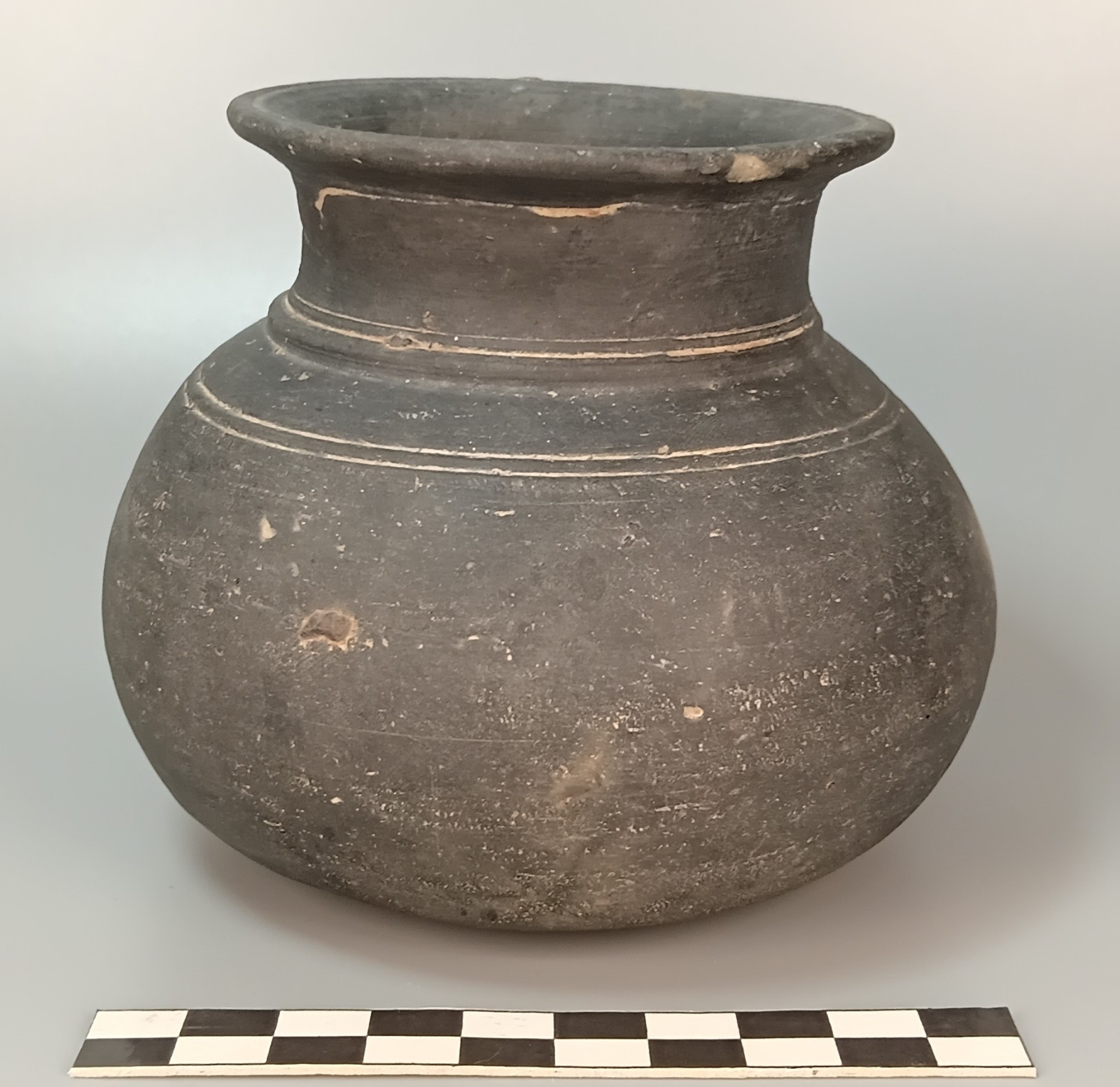
Substantial wheel-thrown Thai earthenware vessel with a rounded body, tall cylindrical neck and broad everted rim. The shoulder and neck are decorated with several cleanly cut horizontal lines made while the vessel was still on the wheel.
The pottery has a distinctive flat matte black surface rather than a glaze. The black coloration continues into the interior. Areas of abrasion and scuffing show that the darker surface treatment does not penetrate completely through the ceramic body, consistent with a vessel whose surface was blackened during firing rather than coated with a black glaze.
The thick construction, wheel finishing, unglazed surface and smoke-blackened appearance are particularly interesting features of this piece.
DIMENSIONS
Height: approximately 90 mm / 9 cm / 3.54 inches
Outer Rim Diameter: approximately 84 mm / 8.4 cm / 3.31 inches
Mouth Opening: approximately 57 mm / 5.7 cm / 2.24 inches
CONDITION REPORT
Very good archaeological condition for its age. The vessel remains structurally intact.
There is surface wear, rubbing, scratches, small abrasions and scattered deposits consistent with age and burial. Some abrasions reveal the lighter underlying ceramic body beneath the blackened surface. Minor edge wear and small nicks are visible around the rim.
No glaze is present or expected on this type.
Please examine all photographs carefully, as they form an important part of the condition description.
PROVENANCE & CONTEXT
This vessel compares closely in ceramic fabric, wheel-thrown manufacture and matte blackened surface treatment with documented examples of unglazed blackened pottery attributed to the Ayutthaya period.
An especially useful museum comparison is a kendi in the Smithsonian National Museum of Asian Art, accession S2005.2. The Smithsonian example is catalogued as north-central Thai earthenware of the Ayutthaya period and dated to the 16th–17th century.
That museum example is described as fine-grained, wheel-thrown earthenware with no glaze and a smoke-blackened matte surface.
The Smithsonian vessel is a different functional form, so this comparison should not be taken as proof that the present jar came from the same kiln. However, the similarities in material, firing treatment, manufacture and surface appearance provide a useful documented comparison for this unusual Thai blackware tradition.
Museum Reference:
Smithsonian National Museum of Asian Art
Kendi
Accession S2005.2
North-central Thailand, Ayutthaya period, 16th–17th century
The accession number can be searched directly in the Smithsonian National Museum of Asian Art collection database for further comparison.
This museum comparison is provided for scholarly reference and stylistic context only and is not intended to claim direct provenance, identical kiln manufacture or an exact match.