When you click on links to various merchants on this site and make a purchase, this can result in this site earning a commission. Affiliate programs and affiliations include, but are not limited to, the eBay Partner Network.
A wonderfully atmospheric antique cast-iron cauldron dating to approximately circa 1870–1890, with circa 1880 being a reasonable single-year estimate.
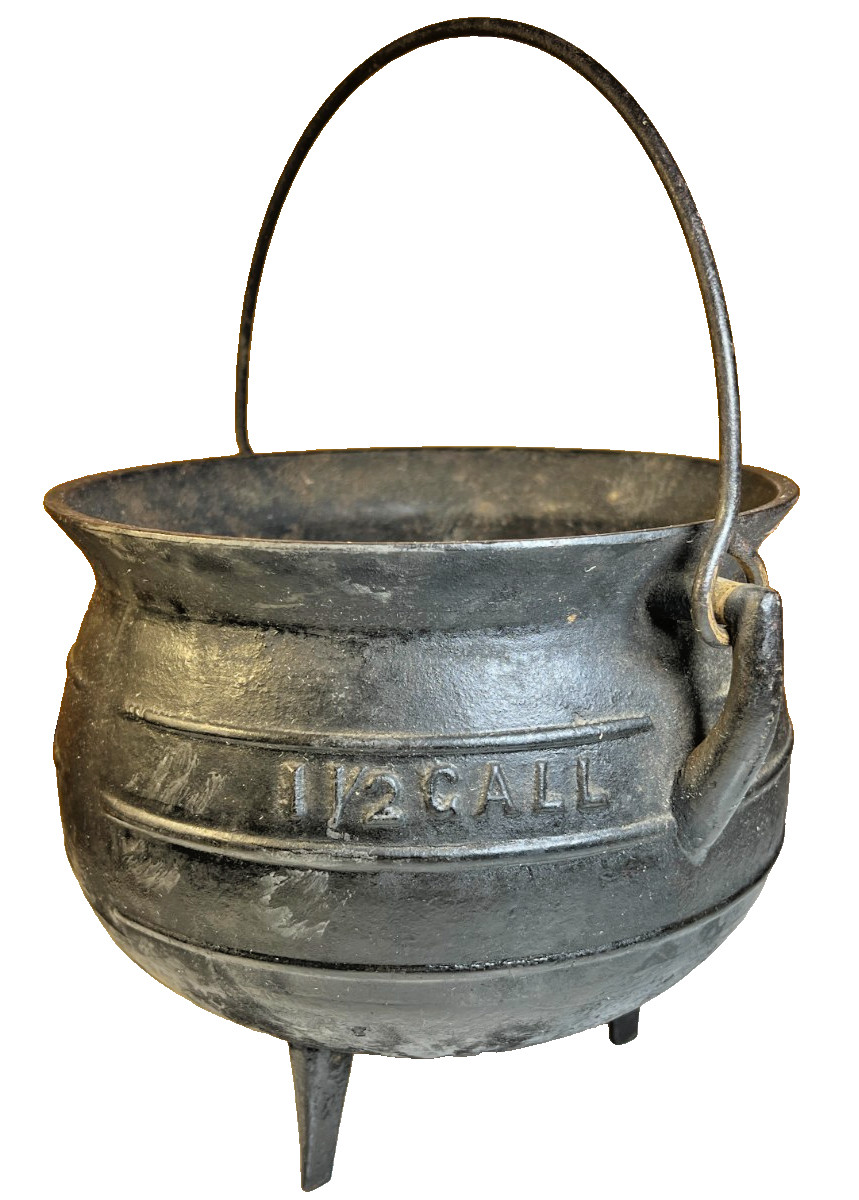
This is the real article—not a modern decorative reproduction. It was cast as a functional household cooking vessel, with a deep rounded body, three integral feet, a swinging iron bail handle, flared upper rim, decorative horizontal ribs, and a prominent raised capacity marking:
1 1/2 GALL
The word is correctly abbreviated “GALL,” with a single final L, exactly as molded by the foundry.
Traditional Hearth Construction
Before kitchen ranges became universal, three-legged kettles like this were positioned directly among the coals of an open hearth. The feet kept the rounded vessel stable above the fire while the tall swinging bail allowed it to be lifted, suspended, or repositioned.
The underside retains its conspicuous elongated gate mark—the scar left where molten iron entered the sand mold. Gate marks of this type, combined with the foot shape, molded body ribs, flared rim, and bail-ear construction, are characteristic of genuine 19th-century manufacture.
These small cauldrons were useful for beans, stews, soups, warming liquids, rendering fat, heating water, and countless other household tasks. The compact 1 1/2-gallon capacity made this a practical family-sized kettle rather than one of the enormous farm or industrial boiling pots.
Maker and Origin
The cauldron does not carry a visible foundry name. Its form is consistent with American production, probably by a Northeastern or Mid-Atlantic foundry, but assigning it to a specific company or city without a maker’s mark would be speculation.
During the 19th century, numerous regional furnaces and stove foundries made utilitarian hollowware, and a great deal of it was marked only by size or capacity. The bold 1 1/2 GALL inscription served the practical purpose of identifying its volume while also giving the vessel a particularly attractive early-industrial appearance.
Exceptional Decorative Appeal
Today, this piece has tremendous crossover appeal. It is an authentic early cooking vessel for the cast-iron or Americana collector, but it is equally irresistible as:
- Halloween or Gothic décor
- A traditional “witch’s cauldron” display
- Wiccan, Pagan, or ritual-room décor
- An altar vessel for holding dry objects
- A fireplace or hearth accessory
- A candy, pinecone, dried-herb, or seasonal display
- Primitive farmhouse or colonial kitchen décor
The beautifully rounded form, upright tripod feet, dark old surface, and dramatic arching handle give it precisely the silhouette people picture when they hear the word cauldron—except this one is genuinely well over a century old.
It would make a fantastic centerpiece filled with wrapped Halloween candy, dried botanicals, LED lights, crystals, spell bottles, or other nonflammable decorative objects.
Measurements
- Opening: approximately 8 3/4 inches wide
- Interior depth: approximately 6 1/4 inches
- Overall height to the top of the body/feet: approximately 8 1/8 inches
- Capacity marking: 1 1/2 GALL
- Three integral cast feet
- Swinging iron bail handle
Better-Than-Average Condition
This cauldron survives in notably better condition than most examples of its age.
The body is solid and displays beautifully. All three original feet are intact, the bail handle remains present, and the cast-in lettering and horizontal ribs remain distinct. There are no obvious signs that it spent decades abandoned outdoors—a common fate for early iron cauldrons.
The exterior appears to retain an old, possibly original black-painted surface with expected age-related rubbing, scuffs, and scattered finish loss. This naturally aged surface gives the piece far more character than a harshly stripped or freshly repainted example.
Inside is some minor, cosmetic, surface-level rust, but nothing severe. The interior has not been heavily scaled or deeply corroded. Overall, its preservation is considerably better than the weathered, pitted, cracked, or foot-damaged cauldrons usually encountered.
Please examine all photographs closely, as they form an important part of the description.