When you click on links to various merchants on this site and make a purchase, this can result in this site earning a commission. Affiliate programs and affiliations include, but are not limited to, the eBay Partner Network.
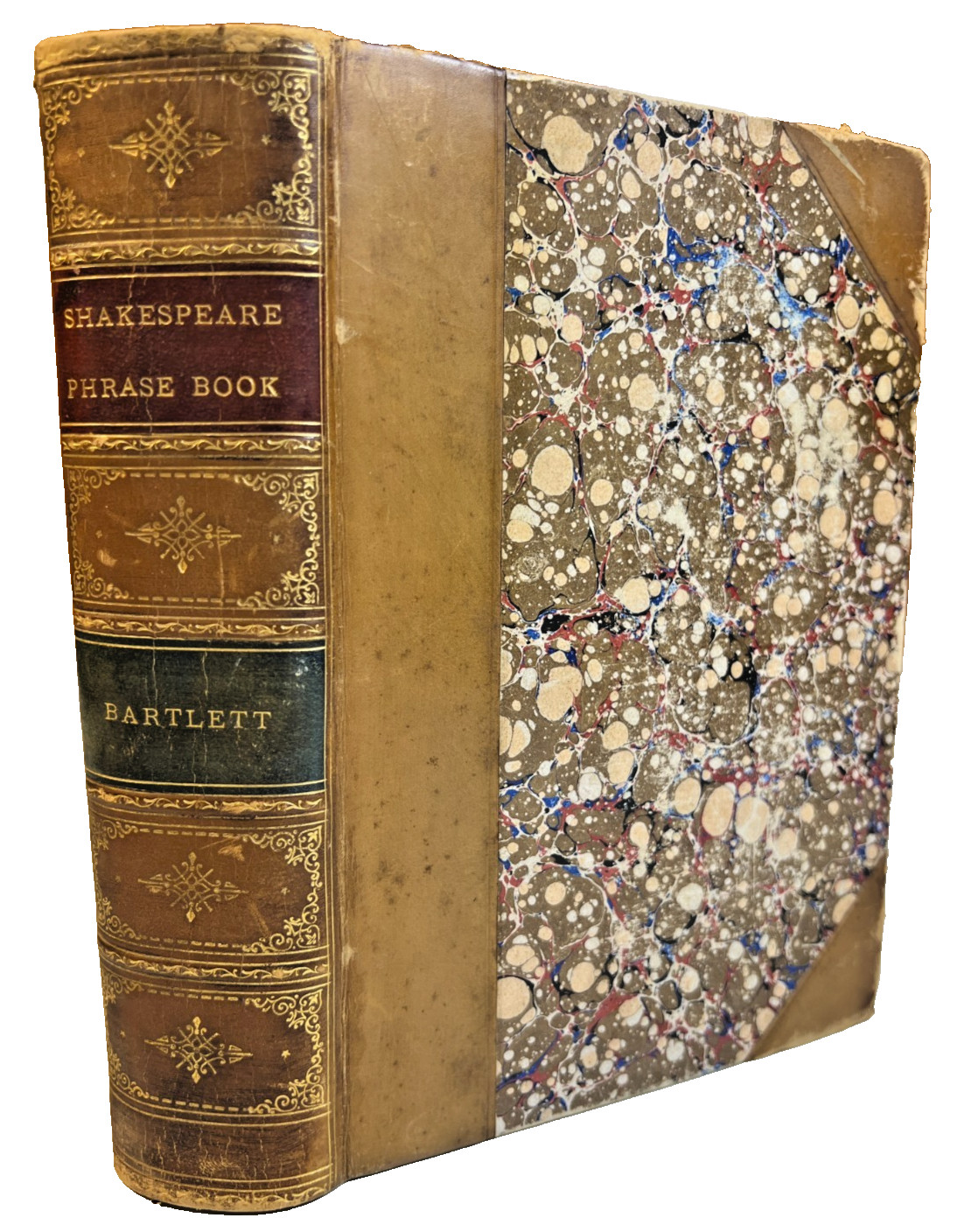
The Shakespeare Phrase Book
By John Bartlett
Published: 1881
Publisher: Little, Brown, and Company (Boston)
What you’ve got is a classic late-1800s half-leather binding:
- Spine: brown calf (or sheep) leather with gilt tooling and title panels
- Boards: marbled paper over boards
- Endpapers: matching marbled paper (a nice touch—often a sign of a slightly better binding tier)
- Corners: leather-tipped (you’ve got visible wear there)
This was a mid-grade “library or gentleman’s shelf” binding—not luxury, but not cheap either. The kind of book meant to be used, quoted, and pulled off the shelf often.
Condition
Positives
- Complete, tight
- Clean interior pages
- Strong gilt still visible on spine
- Attractive marbling—still vibrant
Condition issues (value impact)
- Edge/corner wear with some loss
- Spine leather dryness and cracking
- General rubbing to boards
About the book itself
John Bartlett is better known for Bartlett’s Familiar Quotations, but this book is essentially:
- A reference index of Shakespeare phrases
- Designed for writers, speakers, clergy, and educated readers
- Think of it as a Victorian-era search engine for Shakespeare quotes
In 1881:
- No Google, no Ctrl+F—this was how people found quotes fast
- Shakespeare was cultural currency; quoting him well made you sound educated (and still does, frankly)
Historical context (quick snapshot of 1881)
Boston in 1881:
- A major publishing hub (Little, Brown was a heavyweight)
- Peak of American literary culture and education expansion
- Industrialization booming, but intellectual life still very book-centered
Wider world:
- Post–Civil War America stabilizing and industrializing fast
- Telegraphs everywhere, electricity just starting to emerge
- Medicine still… let’s say “optimistic but experimental”
This book lived in a world where:
- People memorized literature
- Public speaking mattered
- Quoting Shakespeare was basically a social skill