When you click on links to various merchants on this site and make a purchase, this can result in this site earning a commission. Affiliate programs and affiliations include, but are not limited to, the eBay Partner Network.
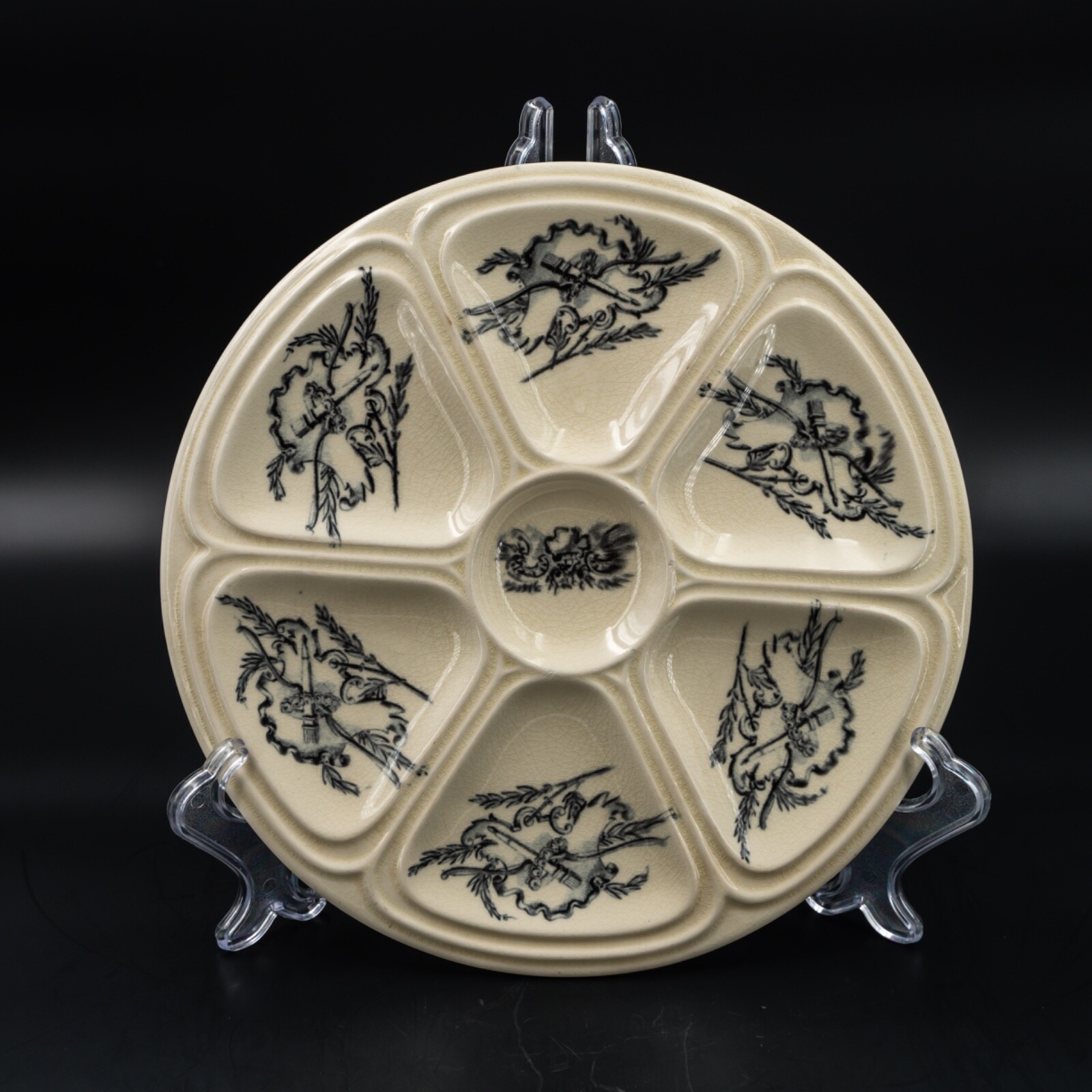
Rare Antique French Oyster Plate by CLAIREFONTAINE pottery, Signed, in tender white and blue colors, circa 1889.
Item description:
Antique 19th century oyster plate coming from French pottery of Clairefontaine which carried a long and beautiful history which can be found below. This oyster plate is dating back to 1889.Terre de Fer earthenware mark and workshop\'s signature of the brand is printed on the back where S.G. stands for JulesSanejouand and LeonGraves, who were owning and developing the workshop at that time.
It features 6 wells for oysters, and a center well for lemon or sauce.
Dimensions:
Diameter of the plate:24.5 cm (9.64\"), weight 555 gr (19.5 oz)
Condition:
Very good antique condition. No cracks or repairs, normal crazing age wear to glaze, one tiny backside chip on one of the plates. And one plate has a bit of discoloration effect. These two will be sold last. Please see the photos for details.
Clairefontaine faince pottery history:
Founded in 1131, the Cistercian abbey of Clairefontaine was completely rebuilt from 1711. It was sold as National Property in 1793 to the merchant Jean-François Estienne, who established there, associated with Mr. Charles Henriot, a glassworks authorized by a decree of the Directory of August 28, 1798. The factory produced white glass and gobletware, but quickly declined and closed its doors in 1802 or 1803. J.F. Estienne then joined forces with his three brothers-in-law, Pierre-Etienne and Charles-Philippe Révillout , and Joseph Jacquot, to found an earthenware factory, whose oven was lit in 1804. The Ruby mill, established 500 m downstream on the Cité stream, served as a workshop for grinding materials. The earthenware factory was described as a \"cailloutage factory\" in 1814. On the death of J.F. Estienne in 1833, the establishment was managed by Jean-Baptiste Rigal (husband of his niece), who gradually abandoned the manufacture of \"cailloutage\" to produce opaque porcelain with printed decoration. The value of the products reached 21,000 F in 1843.Emile Rigal succeeded his father Jean-Baptiste in 1860, associated with his brother-in-law Jules Sanejouand. In 1869, the establishment produced fine white earthenware, called \"opaque porcelain\", and fine yellow earthenware, called \"Nanking stoneware\", for an annual value of 120,000 to 125,000 F. Around 1875, the arrival by a decorator from Sèvres, Victor Ameline, corresponds to a period of expansion of production: opaque porcelains, slips, shading enamels, fine earthenware. The Clairefontaine earthenware factory was rewarded at the Universal Exhibition of 1878 for its collection of majolica enamel items and an octagonal Indiana table service.Between 1876 and 1879, the factory supplied white earthenware (undecorated baked biscuits) for the Nancy artists Charles and Emile Gallé. When Emile Rigal left for the Salins earthenware factory in 1885, Jules Sanejouand joined forces with his son-in-law Léon Graves and created the collective company Sanejouand et Cie, which became Sanejouand-Graves in 1889. L. Graves alone operated the earthenware factory in from 1890 and gave it significant development by modernizing it (mechanization).The abbey\'s outbuildings were abandoned in favor of new workshops and installations (furnace, shed, \"enamel building\", house) built at the end of the 19th and beginning of the 20th century. Léon Graves specializes in particular in the manufacture of modestly priced table services. When he died in 1913, the company was managed by his widow, born Mathilde Lenoble, under the company name Veuve Graves.Having fallen into difficulty following the crisis of 1929-1930, the factory was sold in 1932 to the Consortium des Faïenceries de France which transferred the installations to Choisy-le-Roi and closed the establishment. The buildings were purchased in 1938 by the Hôpitaux de Seine-et-Marne, via the Société Asile de Saint-Rémy, and converted into a psychiatric hospital. They have retained the same vocation and are today the property of the Franche-Comté Hospital Association. Most of the remains of the factory have been destroyed (chimney, boiler room), making it difficult to understand the industrial aspect of the site. The main dwelling of the old abbey was listed in the Supplementary Inventory of Historic Monuments in 1971.In 1846, the factory had a baking oven, two drying ovens, five grinding stones and seven molding towers. In 1862, replacement of wood-fired ovens with coal-fired ovens. Mention of a 6 hp hydraulic motor in 1873 and a steam engine in 1893. Presence of a hydraulic wheel and a 25 hp Brosse (Paris) steam engine in 1904, and a steam boiler steamer Scheidecker and Kohl (Lure-Thann) in 1908. Introduction of airbrush painting around 1905. The earthenware factory employed around ten workers at its beginnings, 25 people in 1846, and 53 men and 15 children in 1873. The workforce rose to 86 men, 27 women and 39 children in 1893, and 75 workers during the First World War.
Shipping:
For this piece we offer FREE shipping to the buyer. We will ship by French Postal services with tracking and insurance. Parcel normally arrive within 6-8 days to US. By now we ship to Americas and Europe. Please make sure to be aware of your local importing duties to avoid any unpleasant surprises or delays.
Every piece will be carefully wrapped in professional air bubble plastic, paper wrap and placed in a thick cardboard box.
Returns are acceptedwithin 30 days and will be fully refunded upon piece delivery back. Returnshipping however will be on the buyers cost.
About us:
We are a multinational couple living in France. We are passionated by the beauty and elegance of French savoir-fair in decorative crafts and on our page we will offer interesting finds. With over 20 years of work experience in international companies with high service standards we are striving for highest customer satisfaction. If you have any comments or response or questions please get in touch before leaving any negative response. We speak English, French, Polish and Russian and we believe that through communication we will always find a way out.