When you click on links to various merchants on this site and make a purchase, this can result in this site earning a commission. Affiliate programs and affiliations include, but are not limited to, the eBay Partner Network.
Circa 1875–1882 Gettysburg Katalysine Spring Mineral Water Bottle – M-19-A – GKW Monogram – Whitney Glassworks, Glassboro, New Jersey – Rich Teal Aqua – Crude Applied Lip
A beautiful and historically fascinating example of the famous Gettysburg Katalysine Water bottle, dating to approximately 1875–1882, most likely the late 1870s.
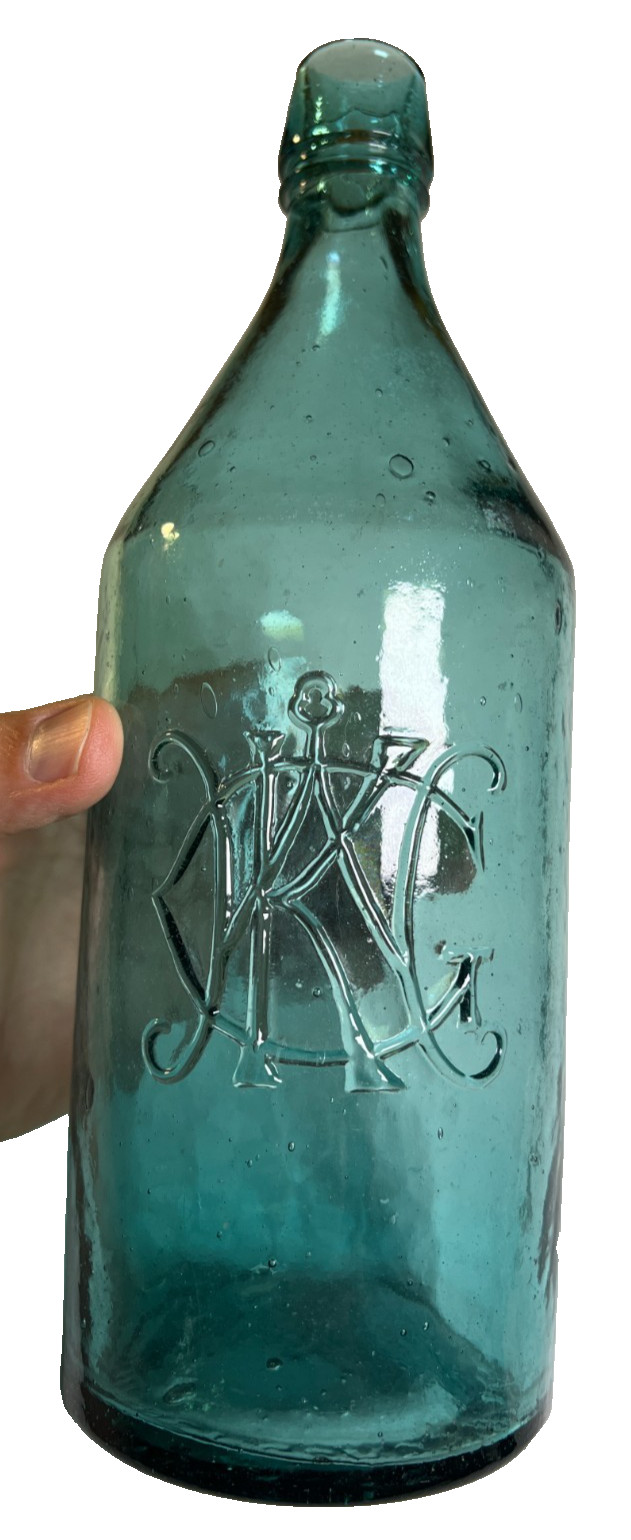
This large 10-inch-tall quart mineral-water bottle is blown in a gorgeous deep green-tone aqua / rich teal aqua glass and features the elaborate intertwined “GKW” monogram for Gettysburg Katalysine Water prominently embossed across the front.
For bottle collectors, this particular form is documented as:
Collector Classification: M-19-A
The base is boldly embossed:
WHITNEY GLASSWORKS / GLASSBORO, N.J.
The combination of the M-19-A form, Whitney Glassworks base marking, applied finish and hand-blown construction supports a date of approximately 1875–1882, with a late-1870s date particularly plausible for this example.
Wonderful Early American Glass Character
This bottle has exactly the character collectors hope to find in genuine 19th-century glass.
The body displays wonderful whittle, waviness, seed bubbles and variations in glass thickness, all beautifully emphasized by the unusually rich teal-aqua coloration.
Especially impressive is the crude hand-applied lip. An additional gather of molten glass was applied to the neck and worked into shape while hot. On this example, the lower edge remains so wonderfully irregular that it almost appears as though the glass was still dripping when the glassworker finished it.
It is a terrific little fingerprint of the individual craftsman who made the bottle more than 140 years ago.
The front GKW monogram is large, ornate and strongly embossed, with sweeping intertwined Victorian lettering that gives the bottle tremendous display appeal.
What Was Gettysburg Katalysine Water?
GKW = Gettysburg Katalysine Water
The bottle originally contained natural mineral water from the celebrated Katalysine Springs in Gettysburg, Pennsylvania.
This wasn't marketed simply as refreshing bottled water.
Like many fashionable mineral springs of the Victorian era, Katalysine was aggressively promoted as a therapeutic mineral water with supposedly remarkable medicinal properties.
Period advertising recommended it for an extraordinary range of complaints, including gout, rheumatism, neuralgia, dyspepsia, kidney and urinary ailments, liver trouble, asthma, catarrh, constipation, skin disorders and general debility, among others.
One period advertisement even promoted the water as beneficial following excessive eating or drinking.
Victorian marketing had apparently discovered a treatment for both the ailment and the party the night before.
The unusual word “Katalysine” was excellent 19th-century branding. It sounded scientific at a time when chemistry, mineral analysis and new medical discoveries fascinated the public. Advertisements emphasized the mineral composition of the water and invoked medical and scientific authorities to give the product credibility.
Gettysburg – From Battlefield to Victorian Resort
The historical setting makes these bottles especially fascinating.
The Battle of Gettysburg had occurred July 1–3, 1863, only about a dozen to fifteen years before this bottle was probably made.
By the 1870s, Gettysburg was already transforming into one of America's earliest major destinations for battlefield tourism and remembrance.
Veterans returned to walk the ground where they had fought.
Families came to locate graves.
Visitors arrived to experience a battlefield that had already assumed enormous importance in American memory.
At the same time, entrepreneurs were promoting Gettysburg as something seemingly very different—a fashionable Victorian health and leisure destination.
The Gettysburg Spring Railroad was organized in 1868, and its first car operated in June 1869, providing transportation to the spring area. A large resort hotel associated with the springs also opened that month.
A visitor could therefore tour America's most famous Civil War battlefield and then retreat to a fashionable resort to dine, socialize and “take the waters.”
This bottle survives from that remarkable intersection of Civil War memory, tourism, medicine and commerce.
Life When This Bottle Was Made – Circa 1878
Imagine Gettysburg around 1878.
The Civil War wasn't ancient history—it was recent memory.
Many of the men who had fought at Gettysburg were still only in their 30s and 40s. Reconstruction had just ended in 1877, while the United States was rapidly entering the industrial and commercial expansion of the Gilded Age.
Railroads were transforming travel and commerce. Telegraph wires carried information across enormous distances at speeds unimaginable only a generation earlier.
Yet much of what we consider modern technology hadn't arrived.
Alexander Graham Bell patented the telephone in 1876.
When this bottle was probably blown, transmitting the human voice electrically over a wire was astonishing new technology.
Thomas Edison's breakthrough work on practical incandescent electric lighting came in 1879.
This bottle may therefore have been manufactured before most Americans had ever seen a practical incandescent electric light.
Gettysburg hotel guests still inhabited a world illuminated primarily by gas, kerosene lamps and candles.
There were no automobiles, airplanes, radios, televisions or household electrical appliances.
Cases of Katalysine Water would have traveled by horse-drawn wagon and railroad.
Medicine Before Modern Medicine
Medicine was undergoing an equally dramatic transition.
Germ theory was gaining acceptance, but there were no antibiotics, no insulin, no X-rays and no modern FDA policing extravagant medicinal claims.
The boundary between conventional medicine, proprietary remedies, patent medicines and therapeutic mineral waters could be surprisingly fluid.
This helped create America's great mineral-spring craze.
People traveled long distances to fashionable resorts to “take the waters,” while bottled mineral water allowed the supposed health benefits of famous springs to be shipped to customers around the country.
Gettysburg Katalysine Water was part of this fascinating medical and cultural phenomenon.
Whitney Glassworks – Glassboro, New Jersey
Although the water came from Gettysburg, Pennsylvania, this bottle was manufactured in Glassboro, New Jersey, one of America's important historic glassmaking centers.
The Whitney family became deeply involved in Glassboro's glass industry during the 19th century, and their works grew into one of South Jersey's major glass manufacturers.
The bottle proudly identifies its maker on the base:
WHITNEY GLASSWORKS
GLASSBORO, N.J.
Before automatic bottle machines transformed the industry, production depended upon teams of highly skilled glassworkers working around tremendously hot furnaces.
Molten glass was gathered on a blowpipe, inflated into a mold, removed while hot and completed by hand. That process explains the wonderful individuality seen in bottles like this one.
The whittle, bubbles, asymmetry and crude applied finish aren't modern manufacturing defects—they are evidence of how the bottle was actually made.
The M-19-A Classification
This particular Gettysburg Katalysine quart is known to collectors as M-19-A.
The classification identifies the distinctive cylindrical quart form featuring the elaborate GKW monogram, including examples produced with the Whitney Glassworks / Glassboro, N.J. base embossing.
It belongs to the later generation of Gettysburg Katalysine bottles, following the earlier Saratoga-style forms.
At approximately 10 inches tall, this is the full quart-size M-19-A.
Condition
Overall bright, clean and shiny!
No chips. No cracks.
There is very faint content haze in the lower neck, which is difficult to notice under normal display conditions.
There is also a tiny in-manufacture open seed bubble toward the upper-right of the GKW logo. Please see the close-up photograph where this feature is indicated beside the thumb.
This is a small manufacturing bubble that opened at the exterior surface of the glass during production rather than a later impact chip.
As expected with genuine hand-blown 19th-century glass, there are natural manufacturing irregularities including bubbles, waviness, whittle and variations in glass thickness.
Details
Collector Classification: M-19-A
Bottle: Gettysburg Katalysine Water
Monogram: GKW
Original Contents: Therapeutic natural mineral water
Spring: Gettysburg Katalysine Springs
Location: Gettysburg, Pennsylvania
Glassmaker: Whitney Glassworks
Glassworks Location: Glassboro, New Jersey
Date: Circa 1875–1882, likely late 1870s
Height: Approximately 10 inches
Capacity/Form: Quart mineral-water bottle
Color: Deep rich green-tone / teal aqua
Construction: Hand blown in mold
Finish: Crude hand-applied lip
Base: Embossed “Whitney Glassworks / Glassboro, N.J.”
Front: Large ornate intertwined GKW monogram
Condition: Bright, clean and shiny; no chips or cracks; very faint lower-neck content haze; tiny in-manufacture open seed bubble as photographed
A Remarkable Gettysburg Survivor
This is much more than an attractive antique mineral-water bottle.
It connects Gettysburg and the aftermath of the Civil War, early battlefield tourism, Victorian health culture, extravagant 19th-century medical advertising and South Jersey's great hand-blown glass industry.
More than 140 years later, the deep teal-aqua color, bold GKW monogram, wonderful whittled surface, crude dripping-looking applied lip and Whitney Glassworks signature make this an especially handsome example of the M-19-A Gettysburg Katalysine Water quart.
A superb piece of Gettysburg, Pennsylvania history and a wonderful survivor from the early Gilded Age.