When you click on links to various merchants on this site and make a purchase, this can result in this site earning a commission. Affiliate programs and affiliations include, but are not limited to, the eBay Partner Network.
Antique Hudson Broom Label NOS 🧹 1910s–20s Hudson River Steamer Advertising Art
6 x 3.5 inches of American commercial art from the golden age of Hudson River steamboat travel — printed in the United States, never applied to a single broom handle, and surviving in New Old Stock (NOS) condition exactly as it left the lithographer\'s shop a century ago.
🌊 The river made the label. And the label made you want the broom.
That was the whole logic of early American broom marketing, and nobody worked that logic harder than the companies that understood regional identity. You did not just buy a broom. You bought the name on the label, and the name meant something. Hudson meant the river. And the river, in the 1910s and 1920s, meant something very specific to anyone who had ever stood on a dock and watched one of those magnificent multi-deck side-wheel steamers come around a bend trailing a column of black smoke against a sky full of hills and hemlocks. That image was not just transportation. It was an experience. It was a destination. It was the thing you told your grandchildren about.
🚢 The Hudson River Day Line — officially incorporated in 1879 but operating in various forms since 1863 when Alfred Van Santvoord and John McB. Davidson first put a quality steamer on that run — reached the absolute zenith of its operations in the 1920s. By that decade, it was operating the largest and finest fleet of river passenger steamers to be found on any American waterway. The boats were enormous, beautifully appointed, and filled on summer weekends with families making the excursion run between New York City and Albany or the mountain landings in between. The Hudson River gorge — the Highlands, the Palisades, Storm King, the Catskill Mountain backdrop — gave the run a scenic drama that no other river passage in the country could match. A broom company that put a Hudson River steamer on its label was not choosing a random boat. It was invoking the most culturally vivid inland waterway experience in early 20th-century American life.
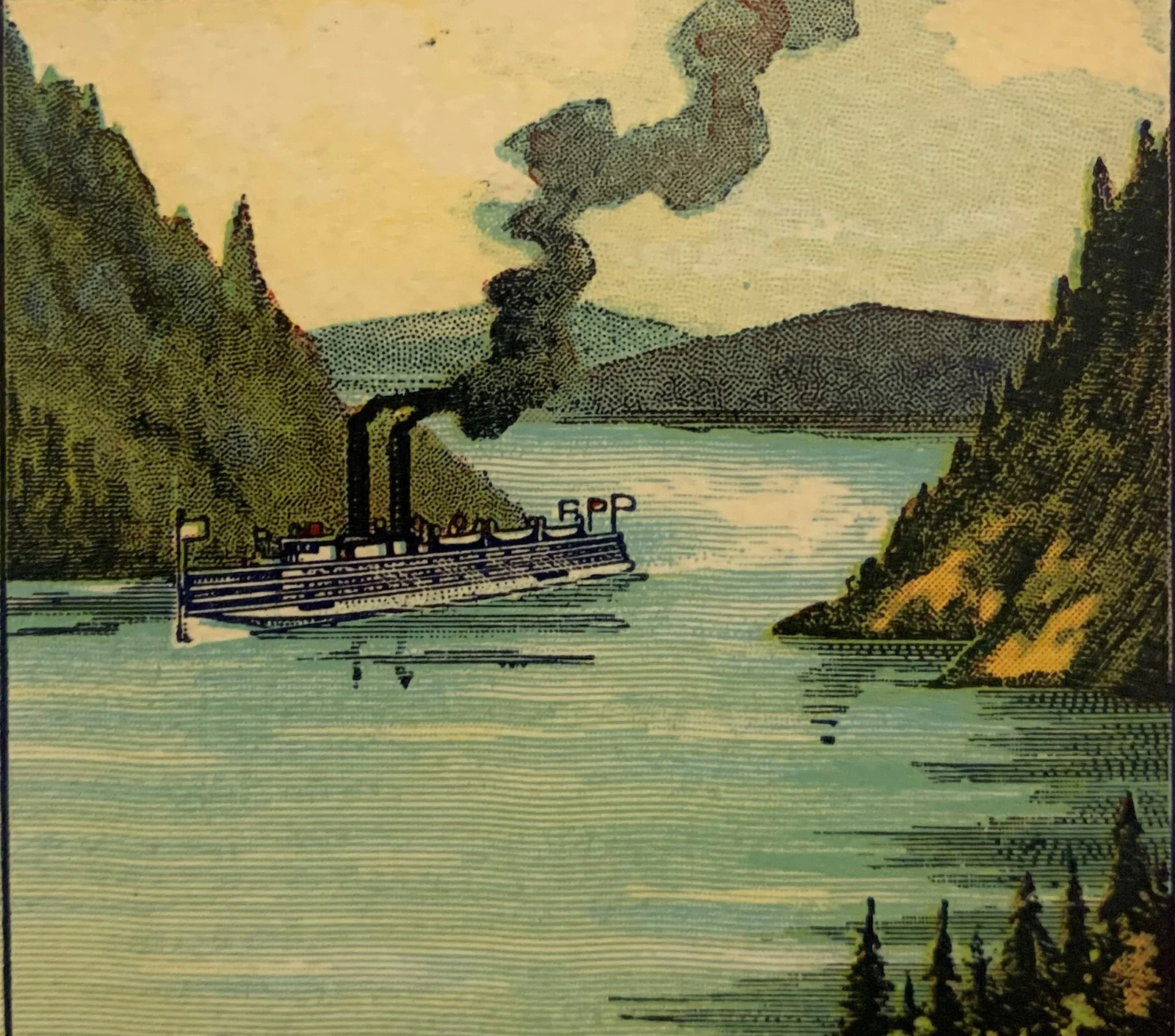
The label captures exactly that. 🎨 A broad river fills the composition, flanked by densely forested hillsides that slope dramatically to the water. Rocky promontories jut into the frame from the right. The sky above is hazy with the characteristic warm yellow-gold tone of early chromolithographic printing, where clouds billow in soft greenish-gray. And out on the water, cutting a confident line across the river\'s middle distance, is the steamer herself — a multi-deck side-wheel vessel with twin smokestacks producing two separate columns of dark smoke that rise and spread against the sky. The lettering \"SPP\" is visible on the vessel\'s upper deck. The whole scene is rendered in the dot-matrix lithographic printing style of the era — you can see the halftone grain up close — and the color registration is clean and vivid, with the green of the forests, the blue-green of the river, and the warm yellows of the sky all holding their original intensity.
The label measures 6 x 3.5 inches. The border carries the characteristic red-and-gold cartouche framing typical of early 20th-century broom label design — a dark navy band across the top carries the name HUDSON in bold yellow lettering outlined in white against the dark field, and the whole composition is framed in red with the ornamental cut-corner detailing you see on premium commercial labels of this period. At the bottom it reads MADE IN U.S.A., and the printer\'s credit reads U.S.P. & L. Co., Balto. — a Baltimore lithography house that produced commercial labels for a range of American manufacturers during exactly this window. 🖨️ That printer\'s mark is itself a piece of documentation — it places the label squarely in the American commercial printing trade of the early 20th century, when Baltimore was one of the major lithographic printing centers on the Eastern Seaboard.
No documented founding records for a company specifically calling itself \"Hudson Broom\" have surfaced in available historical sources — and that is entirely consistent with how the early broom industry worked. 🧹 Broom companies of this era regularly adopted evocative regional names — river names, railroad names, landmark names — as marketing identities rather than literal corporate affiliations. The name on the label was the brand. The brand was the image. And the image was whatever the commercial artist could conjure on a 6 x 3.5-inch sheet that would make a hardware store customer reach for this broom over the ten similar brooms standing next to it on the shelf.
The label artists who produced work like this almost never signed their names. The lore that circulates among paper ephemera collectors holds that most of these commercial illustrators were genuinely skilled — trained artists working for modest wages during an era when advertising art was exploding in volume, with lithographic presses running around the clock to meet demand from manufacturers who had no other advertising medium. There was no radio spot, no magazine spread, no regional television buy. The label was the entire marketing department. So broom companies invested in their labels, and the artists who drew the steamers and the mountains and the river scenes were, in their way, the art directors of the household goods trade. Their names are almost never recorded. The images survive. The artists do not.
🏞️ The Hudson River landscape itself had an almost mythological status in American visual culture by the 1910s and 1920s. The Hudson River School painters — Thomas Cole, Frederic Church, Asher B. Durand — had spent the better part of the previous century training American eyes to see that particular combination of wooded gorge, open water, and dramatic sky as a template for the American sublime. By the time chromolithographic broom labels were being printed in Baltimore, those visual codes were deeply embedded in the culture. A river between forested hills with a steamer in the middle distance was not just a pretty picture. It was a specific emotional shorthand — for nature, for progress, for American possibility — that any viewer of the period would have read instantly. The broom company understood that. The lithographer understood that. They put it on a label and let it do its work.
Old-timers in the collector community tell of hardware store backrooms and farm supply warehouses where unopened stock of lithographed labels survived undisturbed for decades — the broom industry having largely collapsed after affordable vacuum cleaners reached the middle class in the post-World War II era, leaving behind unsold inventory that nobody bothered to discard and nobody got around to using. Whether any specific cache was found in any specific location is the kind of lore that is very hard to pin down with documentation. What is clear is that NOS broom labels do surface, and when they do, they carry exactly the condition story this one tells — paper that was never soaked with paste, never pressed against a wooden handle, never exposed to the humidity and handling of retail life. 🌟 New Old Stock (NOS). A label that outlasted the industry it was printed for.
🖼️ Display possibilities are genuinely varied with a piece like this. The horizontal composition and the strong color palette — navy, red, gold, the green of the forests, the blue-green of the river — read beautifully in a frame. A navy or dark green mat pulls out the deep blue of the header band. UV-protective glass preserves the color integrity. The label is small enough to work in a tight gallery grouping and strong enough to anchor one on its own.
🗺️ The transportation collectibles crossover is real here, and it opens the piece to a much wider collecting audience than broom labels alone. Hudson River Day Line enthusiasts, Hudson Valley Americana collectors, steamboat and maritime history collectors, early American railroad and transportation ephemera devotees — all of them share an interest in this particular piece of visual history, because the steamer is the subject. The broom is almost incidental. What you are actually looking at is a portrait of Hudson River travel in its golden age, rendered in the commercial art idiom of the era, printed in Baltimore, and somehow surviving the entire 20th century without ever touching a broom handle.
✨ Who this piece belongs with —
🌊 The Hudson River Valley collector who wants primary-source visual material from the steamer era, not a reproduction
🚢 The maritime and inland waterways enthusiast building a collection around American river travel history
🎨 The paper ephemera collector who understands that chromolithographic broom labels are a serious and genuinely undervalued category of early American commercial art
🏔️ The Hudson Valley Americana collector — the landscape depicted is unmistakably the Highlands, and that has regional significance that goes well beyond a generic \"pretty river\" image
🖼️ The display and framing collector who gravitates toward small-format period pieces with strong color and identifiable historical subjects
🎁 The Hudson Valley history enthusiast, the river town local historian, the steamboat fan who has everything except something genuinely printed in the era they love
🏠 The home decorator working with navy, forest green, red, and warm gold — the label\'s palette is nearly perfect for a library, study, or dining room with those anchor colors
📚 The American transportation history researcher who wants something tangible to hold alongside the published histories — a real artifact from the moment when Hudson River steamer travel was the cultural touchstone this label says it was
The broom industry built these labels to be consumed. Glued down, handled, weathered, discarded. That is what happened to most of them. This one didn\'t go that route. It stayed clean, stayed flat, stayed exactly as it was produced in a Baltimore print shop sometime in the 1910s or 1920s, when the Hudson River Day Line was running the finest inland passenger fleet in America and a broom company in the United States thought that image was worth putting on its product. 🧹🌊
MADE IN U.S.A. It says so right on the label. It always did.