When you click on links to various merchants on this site and make a purchase, this can result in this site earning a commission. Affiliate programs and affiliations include, but are not limited to, the eBay Partner Network.
a.imagelink {color:#0000FF;} a:hover.imagelink {color:#0000FF;} a:visited.imagelink {color:#800080;} a.imagelink img.saleimage { border: 2px solid #0000FF; } a:visited.imagelink img.saleimage { border: 2px solid #800080; } Antique Japanese Woodblock Print by Utagawa Kuniyoshi -Empress Komyo Washing Buddha- c.1852
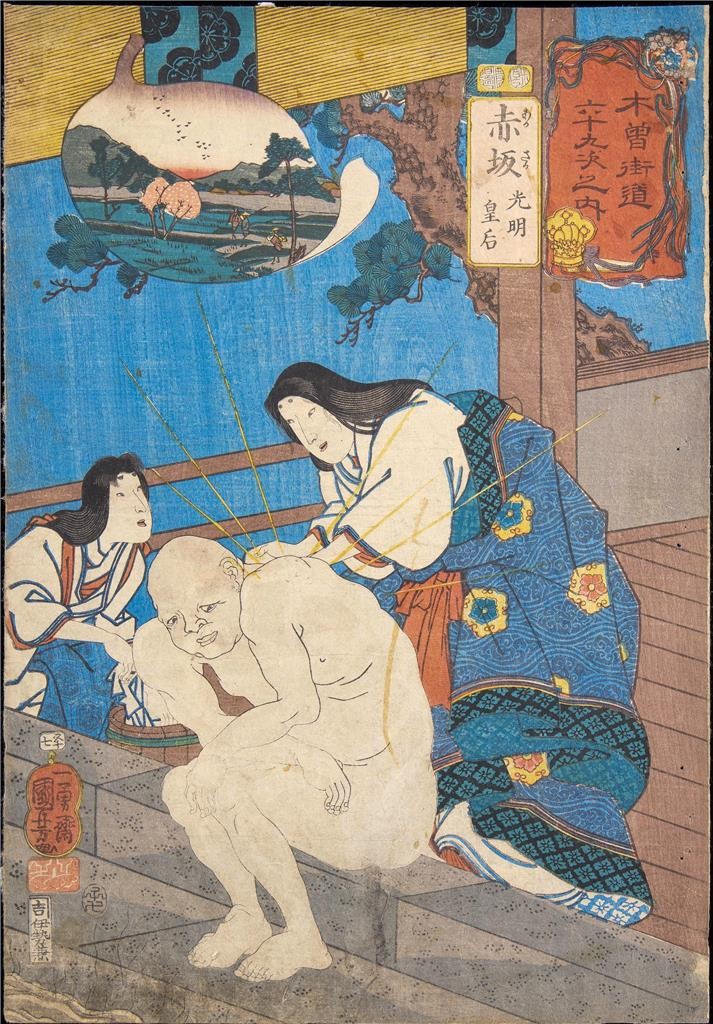
Presented is a beautiful Japanese full oban-size woodblock print created by the renowned artist of the late Edo period, Utagawa Kuniyoshi (1798 - 1861).
The print was created as part of the series of prints "Kisokaidō rokujūkyū-tsugi no uchi" (The Sixty-nine Stations of the Kisokaidō). It is No. 57 in the series. In this series, Kuniyoshi used the theme of 69 postal stations along the road from Edo/Tokyo to Kyoto as a pretext for creating portraits and images of the historic and legendary figures and events associated with those locations. The station's views were drawn within the medallions in the upper-left corner.
This print portrays Empress Komyo, consort of Japanese Emperor Shōmu (701–756), during the Nara Period. She is washing a deformed beggar, who happened to be the incarnation of Buddha. According to legend, the empress vowed to wash a thousand beggars at the Horyuji Temple bath. The Empress's maid kneels at left, dipping a cloth in a bucket of water.
This is a very interesting and unusual subject. Kuniyoshi was a master of unconventional, fantastic subject matter. His extraordinary prints were quite popular at the time and remain popular today.
Kuniyoshi was born in Edo (present-day Tokyo) and is known for his dynamic and imaginative prints. Kuniyoshi's works covered a wide range of subjects, including historical scenes, landscapes, kabuki actors, and mythical creatures. He was particularly skilled at depicting warriors and samurai, often creating dramatic, action-packed compositions.
His style was characterized by bold lines, vibrant colors, and intricate details. He had a unique ability to capture the essence of his subjects, infusing them with energy and personality. Kuniyoshi's prints were highly popular during his lifetime and continue to be admired for their technical skill and storytelling abilities.
In addition to his artistic achievements, Kuniyoshi also played a significant role in the development of ukiyo-e as a medium. He was known for his experimentation with new techniques and his willingness to push the boundaries of traditional woodblock printing. Overall, Utagawa Kuniyoshi is considered one of the most innovative and influential ukiyo-e artists of his time, leaving a lasting impact on the genre and inspiring future generations of artists.
Many museums in the world have Kuniyoshi works:
British Museum
Metropolitan Museum of Art in NY
Museum of Fine Arts in Boston
Tokyo National Museum
Museum of Fine Arts in Houston
Honolulu Museum of Art
and many others.
The print was made using the Japanese woodblock technique during the artist's lifetime.
It shows his signature "Ichiyusai Kuniyoshi ga".
AUTHOR: Utagawa Kuniyoshi
TITLE: Station 57 Akasaka. (Empress Komyo Washing Buddha - descriptive)
SERIES: "Kisokaidō rokujūkyū-tsugi no uchi" (The Sixty-nine Stations of the Kisokaidō)
PUBLISHER: Iseya Kanekichi
CREATED: 1852
PAPER: washi paper
METHOD OF PRINTING: Woodblock printing
PRINTED: Lifetime printing circa 1850s
PRINT SIZE: 14" X 9.75"
Condition: Great condition, nice colors, strong impression, no damages, losses, or repairs. pinholes at the right edge from binding. See the pictures for the details.Pictures sell!
Auctiva offers Free Image Hosting and Editing.
The complete Selling Solution.
Track Page Views With
Auctiva's Counter