When you click on links to various merchants on this site and make a purchase, this can result in this site earning a commission. Affiliate programs and affiliations include, but are not limited to, the eBay Partner Network.
A Thunderous Serve, a Flash of White—and Pancho Is Already at the Net
Imagine an early-1960s tennis crowd falling quiet as PANCHO GONZALES steps to the baseline. He stretches upward, the wooden racket sweeps behind his shoulder, and then comes that effortless, devastating serve. Before the receiver can recover, Gonzales is closing on the net—long reach, quick feet, and a volley that leaves the ball beyond pursuit. The crowd erupts. Across the court stands a player who has just discovered why Pancho’s reputation arrived before he did.
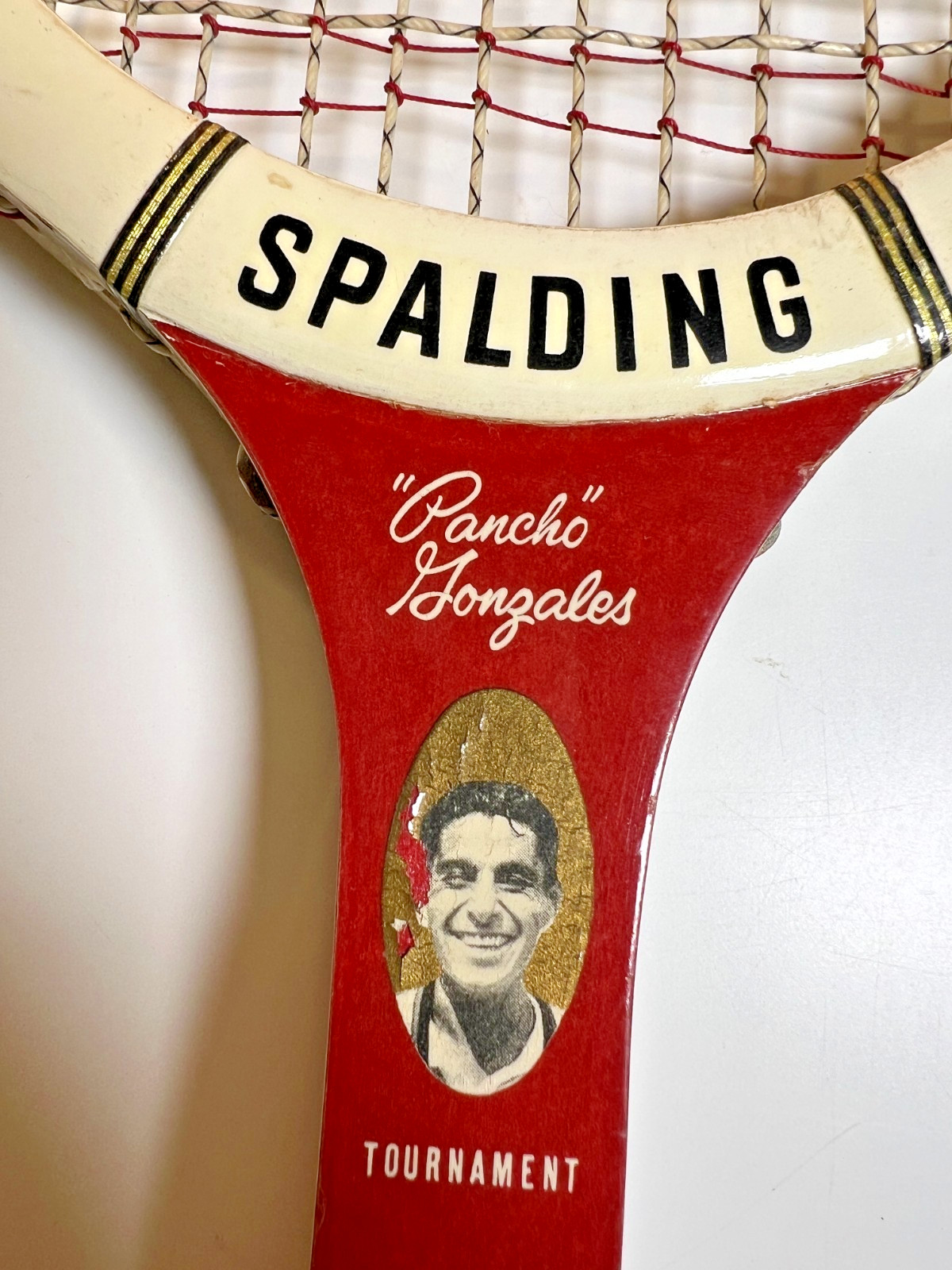
This handsome circa-1962 Spalding “Pancho” Gonzales Tournament racket brings that world into the present: warm laminated wood, cream-painted shoulders, a rich red throat, black-and-gold decorative bands, and a smiling portrait of one of tennis’s most formidable champions.
The surviving gold decoration around the portrait catches the light beautifully, giving this sporting collectible an unusually elegant appearance—a small portrait of tennis royalty framed directly into the equipment.
The Racket and Its Date
The throat carries the facsimile signature “Pancho” Gonzales, his photographic portrait, and the designation TOURNAMENT. Bold SPALDING lettering crosses the lower head, while the shaft carries Spalding’s distinctive wreathed “S” emblem.
The inner frame is stamped 52-261 JAPAN.
Circa 1962 is the best-supported approximate date: Tennis Australia catalogs a closely matching Spalding Tournament portrait model to that year. An exact manufacturing year for this individual racket has not been established.
Its combination of natural wood, cream, red, black, and gold makes this a particularly attractive display piece for a tennis collection, sporting room, office, or clubhouse.
This is a commercially produced player-endorsed model. The signature is factory decoration; no personal ownership or match use by Gonzales is claimed.
PANCHO GONZALES: The Champion Behind the Portrait
Born in Los Angeles in 1928 to Mexican immigrant parents, Richard “Pancho” Gonzales developed his game largely through his own efforts. He rose through a tennis establishment in which his background often made him an outsider, answering exclusion with extraordinary competitive determination.
At just twenty, he won the 1948 U.S. National singles championship at Forest Hills. He successfully defended his title in 1949, then turned professional. His first major professional tour brought a punishing lesson: Jack Kramer beat him in 96 of their 123 matches. Gonzales absorbed that experience and eventually became the dominant force on the professional circuit.
His achievements included eight U.S. Pro singles championships—1953 through 1959, and again in 1961—plus four Wembley Pro titles. He also won the Wimbledon and French doubles championships in 1949. His serve was famous, but his success depended equally on athleticism, anticipation, touch, and the ability to deliver under pressure.
Much of his prime unfolded outside the Grand Slam tournaments because professionals were barred from entering. When Open tennis arrived in 1968, Gonzales was nearly forty, yet he reached that year’s French Open semifinals and US Open quarterfinals.
Then came an astonishing late-career performance. At Wimbledon in 1969, forty-one-year-old Gonzales defeated twenty-five-year-old Charlie Pasarell in a 112-game match lasting five hours and twelve minutes across two days. The score—22–24, 1–6, 16–14, 6–3, 11–9—reads almost like a printing error. It was endurance, nerve, and experience made visible.
Inducted into the International Tennis Hall of Fame in 1968 while still competing, he continued winning into his forties, taking the Des Moines title in 1972 shortly before his forty-fourth birthday. Later a teaching professional in Las Vegas, he died in 1995. His career bridged the amateur establishment, the touring professional circuit, and the modern Open era.
Tennis in the 1960s—A Remarkably Different Game
The decade began with tennis divided between amateurs competing in the traditional championships and professionals earning their living on a separate circuit. It ended with those worlds finally joining. Wooden rackets still defined the game, while new materials and new tournament arrangements were beginning to transform it.
A few striking differences:
Being paid could keep a great champion out of Wimbledon. Before the Open era began in 1968, professionals such as Gonzales were excluded from the Grand Slam events.
A single set could last forty-six games. Gonzales lost the opening set against Pasarell at Wimbledon in 1969 by 22–24. There was no tiebreak to bring that set to a quick conclusion.
The balls were white. Yellow balls entered the rules in 1972 to improve television visibility; Wimbledon retained white balls until 1986.
Three of the four majors were played on grass. During the 1960s, Wimbledon, the Australian Championships, and the U.S. Championships all used grass courts. The US tournament did not move to hard courts until 1978.
The equipment was undergoing a revolution. Wooden frames remained common, but metal rackets were gaining ground. Oversized heads followed in the 1970s, changing the proportions and possibilities of racket attractive vintage example with honest age-related wear:
Frame is flat and not warped.
Leather grip remains tight and in great condition.
Portrait decoration has flaking and losses on both sides; one side is better preserved than the other.
Beautiful gold decoration remains visible around the portrait.
Some discoloration at the butt end.
Scattered surface marks and finish wear consistent with age.
Strings remain present, with contrasting red decorative stringing near the top and bottom of the head.
Please examine the photographs for the surviving graphics and finish details.
A beautifully styled reminder of the wooden-racket era, carrying the image of a champion whose competitive life stretched across some of the most consequential changes in tennis history.