When you click on links to various merchants on this site and make a purchase, this can result in this site earning a commission. Affiliate programs and affiliations include, but are not limited to, the eBay Partner Network.
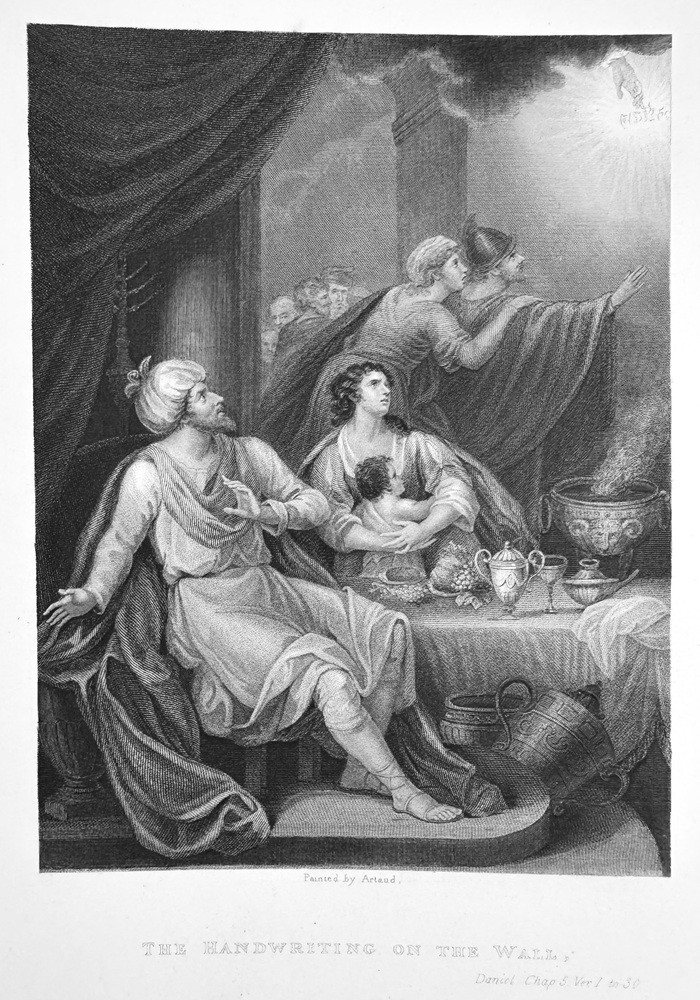
THE HANDWRITING ON THE WALL
Artist: Painted by Artaud
PRINT DATE:This engraving was printed in 1847.
PRINT SIZE: Overall print size is 9 x 12 inches, image size is 6 1/4 by 8 1/4 inches.
PRINT CONDITION: Condition is excellent. Bright and clean. Blank on reverse. Paper is quality woven rag stock paper.
SHIPPING: Buyer to pay shipping, domestic orders receive priority mail, international orders receive regular air mail unless otherwise asked for.
We pack properly to protect your item!
PRINT DESCRIPTION: King Belshazzar holds a great feast for a thousand of his lords and commands that the Temple vessels from Jerusalem be brought in so that they can drink from them, but as the Babylonians drink, a hand appears and writes on the wall. Belshazzar calls for his magicians and diviners to interpret the writing, but they cannot even read it. The queen advises Belshazzar to send for Daniel, renowned for his wisdom. Daniel is brought in, and the king offers to make him third in rank in the kingdom if he can interpret the writing.Daniel declines the honour, but agrees to the request. He reminds Belshazzar that his father Nebuchadnezzar\'s greatness was the gift of God and that when he became arrogant, God threw him down until he learned humility: \"The Most High God has sovereignty over the kingdom of mortals, and sets over it whomever He will.\" Belshazzar has drunk from the vessels of God\'s Temple and praised his idols, but he has not given honour to God, and so God sent this hand and wrote these words: מנא מנא תקל ופרסיןDaniel reads the words \"MENE, MENE, TEKEL, UPHARSIN\" and interprets them for the king: \"MENE, God has numbered the days of your kingdom and brought it to an end; TEKEL, you have been weighed ... and found wanting;\" and \"UPHARSIN\", your kingdom is divided and given to the Medes and Persians. Then Belshazzar gave the command, and Daniel was clothed in purple, a chain of gold was put around his neck, and a proclamation was made… that he should rank third in the kingdom; [and] that very night Belshazzar the Chaldean (Babylonian) king was killed, and Darius the Mede received the kingdom\".None of the Chaldean wise men can even read, let alone interpret, the writing on the wall, but Daniel does so by supplying vowels in two different ways: first, the words are read as nouns, then as verbs. The nouns are monetary weights: a mənê, equivalent to a Jewish mina or sixty shekels (several ancient versions have only one mənê instead of two); a təqêl, equivalent to a shekel; and p̄arsîn, meaning \"half-pieces\". The last involves a word-play on the name of the Persians (pārās in Hebrew), suggesting not only that they are to inherit Belshazzar\'s kingdom, but that they are two peoples, Medes and Persians. Daniel then interprets the words as verbs based on their roots: mənê is interpreted as meaning \"numbered\"; təqêl, from a root meaning to weigh, as meaning \"weighed\" (and found wanting); and pərês (פְּרַס), the singular form of p̄arsîn, from a root meaning \"to divide\", denoting that the kingdom is to be \"divided\" and given to the Medes and Persians. If the \"half-pieces\" means two half-shekels, then the various weights—a mənê or sixty shekels, another shekel, and two half-shekels—add up to 62, which the tale gives as the age of Darius the Mede, indicating that God\'s will is being worked out. The phrase \"writing on the wall\" has grown to be a popular idiomatic expression referring to the foreshadowing of any impending doom, misfortune, or end. A person who does not or refuses to \"see the writing on the wall\" is being described as ignorant of the signs of a cataclysmic event that will likely occur soon.i
A RARE ANTIQUE PRINT! VERY HARD TO FIND!