When you click on links to various merchants on this site and make a purchase, this can result in this site earning a commission. Affiliate programs and affiliations include, but are not limited to, the eBay Partner Network.
✦ ROMAN PHOENICIA ✦ CARACALLA Sidon, Phoenicia c. 215–217 AD | Billon Tetradrachm Marble portrait of Emperor Caracalla, early third century AD, National Roman Museum. A substantial provincial tetradrachm from Sidon in Phoenicia, combining the portrait of a Roman emperor with one of the city's most enduring mythological traditions. ✦ ✦ ✦ ✦ Coin Details Region Phoenicia City / Mint Sidon Emperor Caracalla Reign 198–217 AD Issue c. 215–217 AD Denomination Tetradrachm Metal Billon Diameter Approximately 27 mm Die Axis 11h Reference Prieur 1357 The Design Obverse ΑΥΤ ΚΑΙ ΑΝΤΩΝΙΝΟϹ ϹΕ
Laureate, draped, and cuirassed bust of Emperor Caracalla facing right, seen from behind. Reverse ΔΗΜΑΡΧ ΕΞ ΥΠΑΤΟϹ Δ
Eagle standing facing with wings spread, head and tail left, holding a wreath in its beak. Beneath the eagle, Europa rides the bull to the right. ✦ Europa & the Bull
The small scene beneath the eagle has a particularly strong connection with Sidon.
In Greek mythology, Europa was a Phoenician princess. Zeus became enamored of her and approached in the form of a bull. Europa climbed onto the animal, and Zeus carried her across the sea to Crete.
Ancient writers specifically connected the legend with Sidon, and the image of Europa riding the bull appeared repeatedly on Sidonian coinage over centuries.
Sidon Under Roman Rule An Ancient Phoenician Maritime City
Sidon was one of the great ancient cities of Phoenicia, located on the eastern Mediterranean coast in what is now Lebanon.
By Caracalla's reign, Sidon had already passed through centuries of Phoenician, Persian, Hellenistic, and Roman rule. Under Rome it remained an important city with its own strong civic identity and local coinage.
This tetradrachm illustrates that combination particularly well: the dominant eagle represents Roman imperial authority, while the much older local story of Europa and the bull survives beneath it.
✦ Emperor Caracalla
Caracalla was born Lucius Septimius Bassianus in 188 AD, the elder son of Emperor Septimius Severus and Julia Domna.
He was elevated to the rank of Augustus in 198 AD, while still a child, and formally shared imperial authority first with his father and later with his younger brother Geta.
The name by which history remembers him came from the caracalla, a hooded Gallic garment that he was said to favor and popularize.
Caracalla & Geta
When Septimius Severus died in 211 AD, Caracalla and Geta inherited the empire together. Their relationship quickly deteriorated.
Later that year, Geta was killed by members of the Praetorian Guard loyal to Caracalla during a meeting arranged in the apartments of their mother, Julia Domna.
Caracalla emerged as sole emperor and ordered a damnatio memoriae against Geta, attempting to erase his brother's public memory.
✦ The Edict of Caracalla
In 212 AD, Caracalla issued one of the most consequential legal measures of the Roman imperial period: the Constitutio Antoniniana.
The edict extended Roman citizenship to nearly all free inhabitants of the empire, dramatically broadening the legal meaning of Roman citizenship across the provinces.
The Final Years — 215–217 AD
This tetradrachm belongs to the final years of Caracalla's reign. During this period the emperor was increasingly focused on the eastern provinces and on military expansion.
In 216 AD, Caracalla opened a campaign against the Parthian Empire, attacking territory east of the Tigris.
He never completed the campaign. On 8 April 217 AD, while traveling between Edessa and Carrhae, Caracalla was assassinated by a Roman soldier. The praetorian prefect Macrinus was proclaimed emperor only days later.
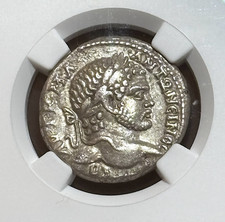
✦ NGC Grade NGC Choice VF
This coin has been encapsulated and graded by NGC. Please review all listing photographs and video carefully for the exact coin, holder, label, strike, surfaces, toning, deposits, and overall appearance.
The Baths of Caracalla
One of Caracalla's most visible surviving legacies is the enormous bathing complex in Rome that bears his name. Partially inaugurated in 216 AD, the Baths of Caracalla were among the largest public bath complexes constructed in the Roman world.
The Baths of Caracalla, Rome. ✦ Rome & Phoenicia on One Coin
Struck at Sidon during Caracalla's final years, this tetradrachm combines the emperor's portrait and Rome's imperial eagle with a distinctly Sidonian image beneath it: Europa riding the bull. It preserves both the political world of the Roman Empire and the older Phoenician and Greek traditions that continued to give Sidon its local identity.
Julius Caesar — 49–44 BC — Dictator of the Roman Republic; not an emperorAugustus — 27 BC–14 ADTiberius — 14–37 ADCaligula — 37–41 ADClaudius — 41–54 ADNero — 54–68 ADGalba — 68–69 ADOtho — 69 ADVitellius — 69 ADVespasian — 69–79 ADTitus — 79–81 ADDomitian — 81–96 ADNerva — 96–98 ADTrajan — 98–117 ADHadrian — 117–138 ADAntoninus Pius — 138–161 ADMarcus Aurelius — 161–180 ADLucius Verus — 161–169 AD — co-emperor with Marcus AureliusCommodus — 177–192 AD — co-emperor from 177; sole emperor from 180Pertinax — 193 ADDidius Julianus — 193 ADSeptimius Severus — 193–211 ADCaracalla — 198–217 AD — co-emperor before becoming sole emperorGeta — 209–211 AD — co-emperor with Septimius Severus and Caracalla WESTBRIDGE COIN ✦ ✦ ✦ Historical images are included for educational and historical context and are not part of the item offered. Caracalla portrait photograph: Folegandros, CC BY-SA 3.0.
Baths of Caracalla photograph: Pascal Reusch, CC BY-SA 3.0.