When you click on links to various merchants on this site and make a purchase, this can result in this site earning a commission. Affiliate programs and affiliations include, but are not limited to, the eBay Partner Network.
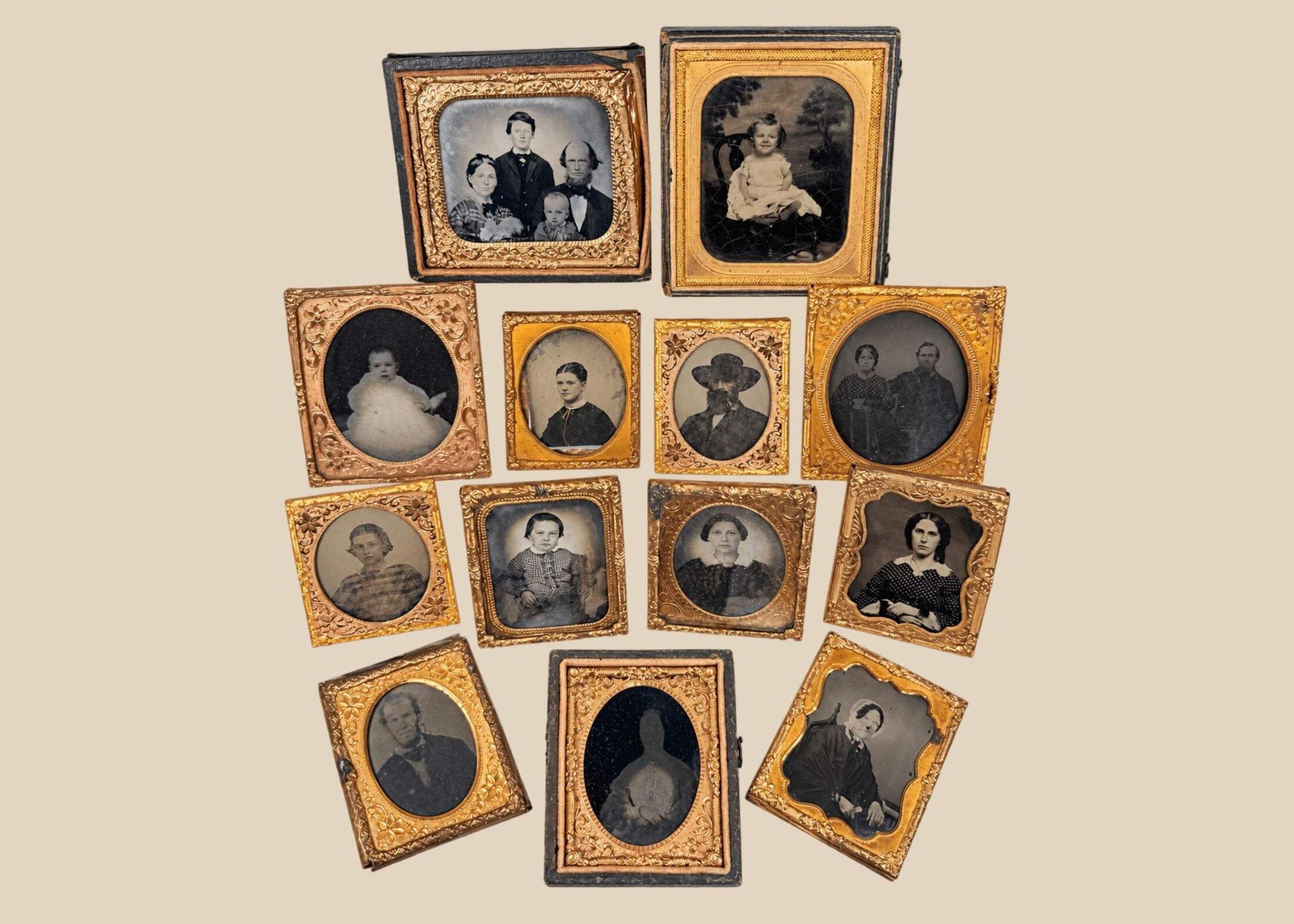
Collection of 13 Victorian Cased Ambrotype & Tintype Portraits | Circa 1855–1870Historical Context & Origin Region: North America, likely United StatesMaterial: Mixed early photographic media, likely including ambrotypes and tintypes, with glass, gilt-brass mats and preservers, and period leather-, wood-, or composition-covered casesPeriod: Mid-19th Century, circa 1855–1870 Description An evocative collection of 13 original mid-19th-century cased portrait photographs, preserving a remarkable cross-section of Victorian-era individuals and families. The group includes portraits of men, women, children, infants, couples, and a family group, each presented within decorative gilt-metal mats or surviving period cases. Based on the visible characteristics, this appears to be a mixed collection of ambrotypes and tintypes/ferrotypes, although individual photographic processes have not been conclusively determined without removing the images from their mounts. Ambrotypes and tintypes emerged during the 1850s and became particularly important forms of portrait photography during the Civil War era. Ambrotypes used a collodion image on glass viewed against a dark backing, while tintypes produced the image directly on a dark-coated iron support. Both were frequently housed in decorative cases and could be difficult to distinguish while still assembled. The portraits are particularly compelling for the details they preserve. Sitters appear in formal mid-19th-century clothing, including patterned dresses, broad white collars, jackets, bow ties, jewelry, and period hairstyles. Among the most striking images is a bearded gentleman wearing a broad-brimmed hat, several finely composed female portraits, portraits of infants and young children, a seated couple, and a larger family portrait showing parents and children together. Many retain ornate embossed gilt-brass mats and decorative preservers, principally with floral and scroll motifs characteristic of cased photography of the period. Several examples remain housed within portions of their original protective cases. These decorative housings were an important component of early photography, both protecting the fragile image and transforming the portrait into an intimate personal keepsake. Together, the collection offers a visually powerful record of ordinary people during photography\'s formative decades—a period in which photographic portraiture became increasingly accessible and allowed families to preserve likenesses with an immediacy impossible in earlier painted portraiture. Features - Likely mixed group of ambrotypes and tintypes/ferrotypes - Includes men, women, infants, children, couples, and a family group - Numerous original embossed gilt-brass mats and preservers - Several retain portions of their original protective cases - Wide variety of period clothing, hairstyles, and portrait compositions - Some examples display subtle period hand-coloring or tonal enhancement - Likely includes individually camera-exposed ambrotype and tintype images rather than later paper prints - Strong Civil War-era and Victorian social-history appeal Cultural Significance The introduction of wet-collodion photography during the 1850s produced the ambrotype and tintype, two formats that made photographic portraiture faster and less expensive than the earlier daguerreotype. They became especially prolific forms of personal portraiture during the mid-19th century, and large institutional collections today preserve thousands of similar images of otherwise unidentified individuals and families. Collections such as this are valuable not simply as photographic objects, but as surviving documents of dress, family relationships, social customs, material culture, and the rapid democratization of portraiture in Victorian North America. Condition Good antique condition overall considering age, with each image displaying its own degree of preservation. Expected age-related wear includes oxidation, fading, spotting, surface abrasions, scratches, tarnishing, discoloration, and losses or distortion to some gilt-metal mats and preservers. Certain images exhibit cracking or deterioration to the photographic surface or protective glass. Period cases show varying degrees of wear, separation, edge loss, and missing or detached components. All age-related surface characteristics have been retained as part of the historical integrity of the collection. Dimensions (Approximate) Various sizes, ranging from 2.25 × 2.75 in to 3.5 × 3.25 in overall. Age (Approximate) 155–170 years old Provenance Formerly held in a private collection in Massachusetts. Subsequently handled by White’s sales, Middleborough, Massachusetts. Established in 1993, White’s sales is an independent, privately owned Massachusetts sale house specializing in antiques, fine art, decorative arts, and historical material. The firm conducts catalogued estate and collection sales and has served collectors, dealers, galleries, and consignors for more than three decades. Learn More Learn more about ambrotypes and their glass-plate photographic process through Museum of New Zealand Te Papa Tongarewa Browse our Collection of Victorian Artifacts & Historic Relics Collection of 13 Victorian Cased Ambrotype & Tintype Portraits | Circa 1855–1870
Historical Context & Origin
Region: North America, likely United States
Material: Mixed early photographic media, likely including ambrotypes and tintypes, with glass, gilt-brass mats and preservers, and period leather-, wood-, or composition-covered cases
Period: Mid-19th Century, circa 1855–1870
Description
An evocative collection of 13 original mid-19th-century cased portrait photographs, preserving a remarkable cross-section of Victorian-era individuals and families. The group includes portraits of men, women, children, infants, couples, and a family group, each presented within decorative gilt-metal mats or surviving period cases.
Based on the visible characteristics, this appears to be a mixed collection of ambrotypes and tintypes/ferrotypes, although individual photographic processes have not been conclusively determined without removing the images from their mounts. Ambrotypes and tintypes emerged during the 1850s and became particularly important forms of portrait photography during the Civil War era. Ambrotypes uséd a collodion image on glass viewed against a dark backing, while tintypes produced the image directly on a dark-coated iron support. Both were frequently houséd in decorative cases and could be difficult to distinguish while still assembled.
The portraits are particularly compelling for the details they preserve. Sitters appear in formal mid-19th-century clothing, including patterned dresses, broad white collars, jackets, bow ties, jewelry, and period hairstyles. Among the most striking images is a bearded gentleman wearing a broad-brimmed hat, several finely composed female portraits, portraits of infants and young children, a seated couple, and a larger family portrait showing parents and children together.
Many retain ornate embossed gilt-brass mats and decorative preservers, principally with floral and scroll motifs characteristic of cased photography of the period. Several examples remain houséd within portions of their original protective cases. These decorative housings were an important component of early photography, both protecting the fragile image and transforming the portrait into an intimate personal keepsake.
Together, the collection offers a visually powerful record of ordinary people during photography\'s formative decades—a period in which photographic portraiture became increasingly accessible and allowed families to preserve likenesses with an immediacy impossible in earlier painted portraiture.
Features
- Likely mixed group of ambrotypes and tintypes/ferrotypes
- Includes men, women, infants, children, couples, and a family group
- Numerous original embossed gilt-brass mats and preservers
- Several retain portions of their original protective cases
- Wide variety of period clothing, hairstyles, and portrait compositions
- Some examples display subtle period hand-coloring or tonal enhancement
- Likely includes individually camera-exposed ambrotype and tintype images rather than later paper prints
- Strong Civil War-era and Victorian social-history appeal
Cultural Significance
The introduction of wet-collodion photography during the 1850s produced the ambrotype and tintype, two formats that made photographic portraiture faster and less expensive than the earlier daguerreotype. They became especially prolific forms of personal portraiture during the mid-19th century, and large institutional collections today preserve thousands of similar images of otherwise unidentified individuals and families.
Collections such as this are valuable not simply as photographic objects, but as surviving documents of dress, family relationships, social customs, material culture, and the rapid democratization of portraiture in Victorian North America.
Condition
Good antique condition overall considering age, with each image displaying its own degree of preservation. Expected age-related wear includes oxidation, fading, spotting, surface abrasions, scratches, tarnishing, discoloration, and losses or distortion to some gilt-metal mats and preservers. Certain images exhibit cracking or deterioration to the photographic surface or protective glass. Period cases show varying degrees of wear, separation, edge loss, and missing or detached components.
All age-related surface characteristics have been retained as part of the historical integrity of the collection.
Dimensions (Approximate)
Various sizes, ranging from 2.25 × 2.75 in to 3.5 × 3.25 in overall.
Age (Approximate)
155–170 years old
Provenance
Formerly held in a private collection in Massachusetts.
Subsequently handled by White’s sales, Middleborough, Massachusetts. Established in 1993, White’s sales is an independent, privately owned Massachusetts sale house specializing in antiques, fine art, decorative arts, and historical material. The firm conducts catalogued estate and collection sales and has served collectors, dealers, galleries, and consignors for more than three decades.
Learn More
Learn more about ambrotypes and their glass-plate photographic process through Museum of New Zealand Te Papa Tongarewa
Browse our Collection of Victorian Artifacts & Historic Relics
× × × × × × × × × × × × × × × × ×
Buy now and save! Shipping info
Click the Shipping & Payments tab above the listing description for more info
FREE Shipping
See more... Standard Shipping - $0.00 Standard Int\'l Shipping - $0.00
Click the Shipping & Payments tab above the listing description for more info!
Additional delivery notes
PICK UP OPTION
Sorry, our items are NOT available for pick-up.
PAYMENT
Immediate payment is required upon selecting \"Buy It Now\" or upon checking out through the cart.
We accept payment via All Major Credit Cards (Visa, Mastercard, AMEX, Discover), Google Pay, PayPal, & Apple Pay (on mobile & App).
Thank you for shopping with us on !
Additional Information
No additional information at this time
Ask seller a question
Contact
To contact our Customer Service Team, simply click the button here and our Customer Service team will be happy to assist.
Ask seller a question
© Relic and Rarity
Shipping & Payments
Shipping is FREE for this item
Payment
Accepted Payment Methods
Immediate payment is required upon selecting \"Buy It Now\" or upon checking out through the cart.
We accept payment via All Major Credit Cards (Visa, Mastercard, AMEX, Discover), Google Pay, PayPal, & Apple Pay (on mobile & App).
Thank you for shopping with us on !
Returns
Returns are accepted
Items must be returned within 7 days of the purchase
Buyer will pay for return shipping.
If you are not fully satisfied, items may be returned in their original condition within seven days for a full store credit toward any other item in our collection at its listed retail price. Store credits are non-transferable and non-assignable.
integration by




![[Lot of 10] Franklin Half DolIar - 90% SiIver - Choose How Many Lots of 10 picture](/store/img/g/DTEAAOSwRQNkaVxQ/s-l225/-Lot-of-10-Franklin-Half-DolIar-90-SiIver-Choose-H.jpg)