When you click on links to various merchants on this site and make a purchase, this can result in this site earning a commission. Affiliate programs and affiliations include, but are not limited to, the eBay Partner Network.
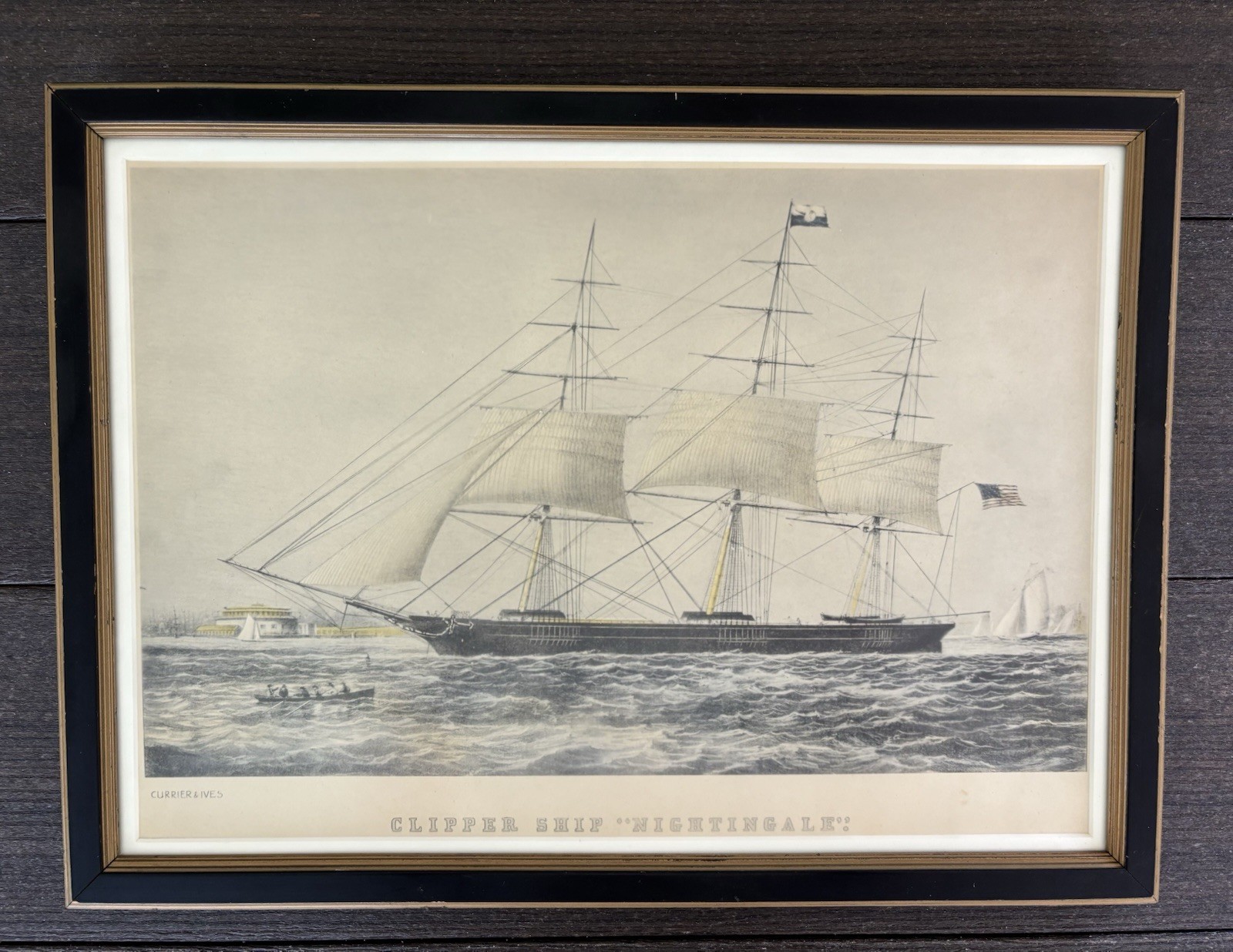
Currier & Ives “Clippership Nightingale” hand colored 1854 lithograph in original frame from the personal collection of Curtis L. CarterLithograph with hand applied watercolor paint
Publisher: Currier & Ives (American, active 1834-1907)Clipper Ship \"Nightingale\" getting under weigh off the Battery, New YorkArtist: After James E. Buttersworth (American (born England), Isle of Wight 1817-1894 West Hoboken, New Jersey)
Artist: Charles Parsons (American (born England), Hampshire 1821-1910 New York)
Publisher: Lithographed and published by Nathaniel Currier (American, Roxbury, Massachusetts 1813-1888 New York)Date: 1854
Medium: Hand-colored lithographMeasurements in frame are 12”H x 16”W x .75”D.
Approximate measurements of the image exclusive of margins are 10”H x 14”W (medium folio size). The art is beneath glass with white matte in the original black with gold trim frame. The back of the frame is wired and ready for display. The artwork has not been removed from the frame for examination. The condition is very good. This is an antique and may have imperfections.The Currier & Ives hand-colored lithograph depicting the clipper ship Nightingale was produced in 1854.
The print was originally published by N. Currier (Nathaniel Currier), just a few years before the firm formally adopted the name Currier & Ives in 1857.
The clipper ship \"Nightingale,\" beautifully designed by Samuel Hanscomb, Jr., was named for the popular Swedish soprano Jenny Lind, nicknamed the \"Swedish Nightingale,\" who had a successful two-year concert tour throughout the United States starting in September 1850. The ship was launched at the Hanscomb Shipyard in Portsmouth, New Hampshire in 1851. Shortly after the ship was sold in Boston, it sailed with passengers \"infected with gold fever\" to Sydney, Australia, and thereafter it speedily sailed with cargos of tea from Shanghai, China, to London, England -- dubbed \"tea and silk\" voyages -- often racing other ships to make that journey between 94 and 113 days, which was an impressive record.Sticker on the back of the frame reads: MACELWEE\'S PORTLAND, MAINE. MacElwee\'s operated in the Portland area during the early to mid-20th century. It was a well-known local destination for custom framing, art restoration, and selling antique prints. The shop is frequently mentioned by antique collectors and in historical ledgers as having been the framer for classic Maine lithographs, historical maps, and vintage portraiture.Currier & Ives\'s approach to coloring was conservative. Whereas firms such as Louis Prang\'s exploited the new technology of chromolithography, using multiple stones to print a variety of colors, Currier & Ives relied primarily on skilled manual labor to create fairly standardized but essentially unique prints.
Once the black ink had dried on a set of prints, they would be transported to the building\'s fifth floor, where a team of mostly German immigrant girls applied watercolor washes to each individual impression. Sitting at a long bench, these female colorists worked from a model print, usually colored by one of the firm\'s resident artists. Each worker was responsible for an individual color in each print. You can explore examples of these preserved works in the Metropolitan Museum of Art Collection.Provenance: I purchased this lithograph from the personal collection of Dr. Curtis L. Carter. Curtis L. Carter is a professor of Philosophy at Marquette University, focusing on aesthetics. He received a PhD from the University of Boston. His greatest accomplishment at Marquette was the creation of the Patrick and Beatrice Haggerty Museum of Art. Carter was the founding director from 1984-2007. He teaches several classes on the philosophy of art. Carter serves as an associate professor at Marquette University\'s Les Aspin Center in Washington DC. At the Aspin Center, Carter teaches a class titled \"Arts in a Democratic Society\". Carter currently serves as vice president of the International Association for Aesthetics.