When you click on links to various merchants on this site and make a purchase, this can result in this site earning a commission. Affiliate programs and affiliations include, but are not limited to, the eBay Partner Network.

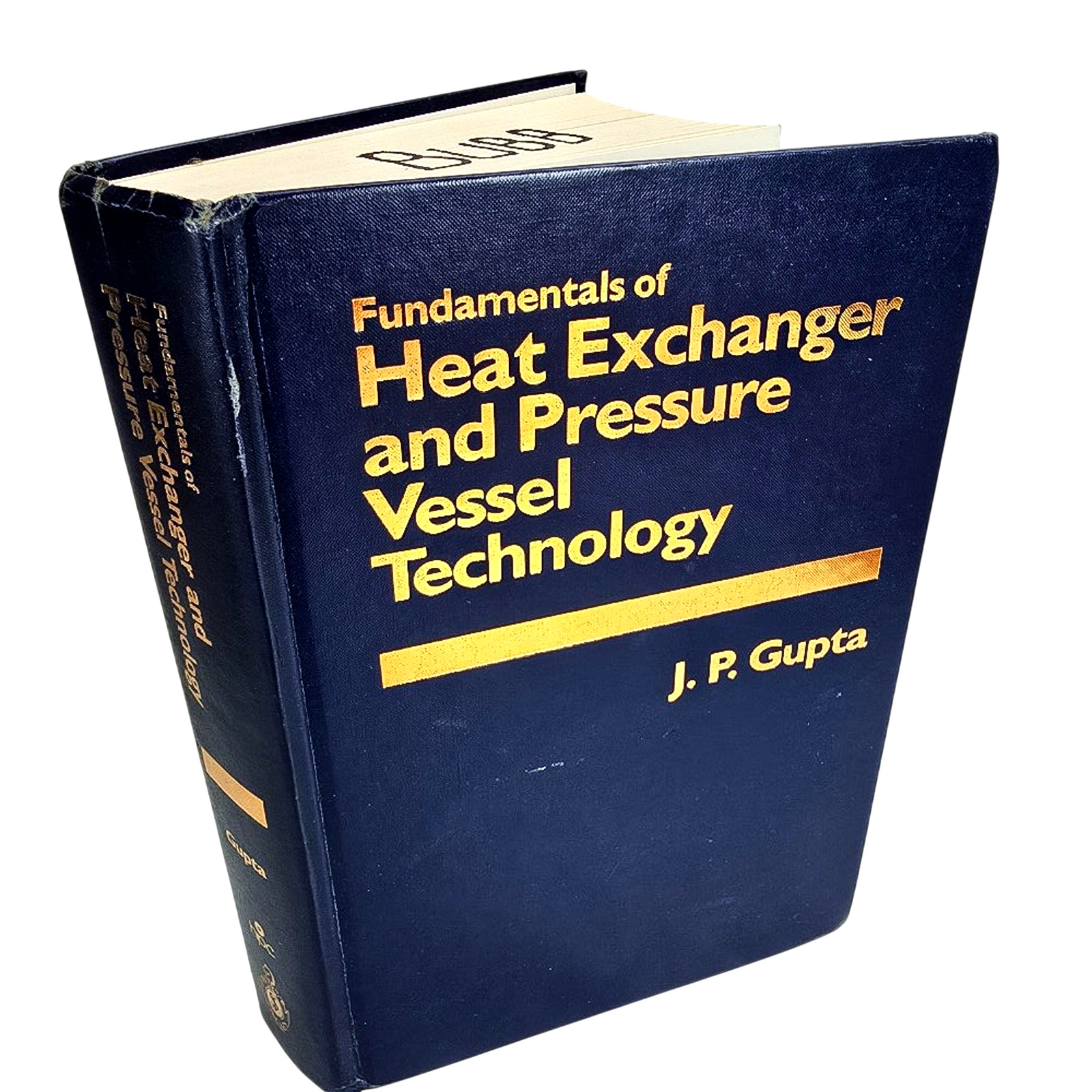
Fundamentals Heat Exchanger Pressure Vessel Tech J P Gupta HC 1986 Textbook Book:
$53.88
- This listing is for Fundamentals of Heat Exchanger and Pressure Vessel Technology by J. P. Gupta, a hardcover technical textbook in English for adult and further education in bioengineering, chemical engineering, and related process engineering fields.
- This volume demonstrates times long ago when textbook makers respected their audience\'s ability to learn well-presented information without watering down the materials as is done so much today.
- Gupta, of the Chemical Engineering Department at the Indian Institute of Technology, Kanpur, presents a comprehensive treatment of the design, operation, and analysis of industrial heat exchangers and pressure vessels used in chemical, fertilizer, petrochemical, petroleum, power, refrigeration, and other process industries.
- Published in 1986 in the United States by Hemisphere Publishing Corporation, with distribution outside North America by Springer-Verlag, the volume is designed as a professional-level reference and advanced engineering course text.
- Initial chapters focus on shell-and-tube heat exchangers, covering nomenclature and parts, principal construction types, tube materials and thicknesses, tube layout and pitch, baffles and baffle spacing, uses of multi-pass units, tubesheets and double tubesheets, tie-rods and spacers, seal strips, nozzles, flanges, expansion joints, packing glands and gaskets, vents and drains, pressure relief devices, supports and lifting lugs, insulation, and preparation of heat exchanger specification sheets.
- Process design without phase change is treated through discussions of flow through shell and tubes, overall heat-transfer coefficients, log-mean temperature difference and correction factors, average and wall temperatures, allocation of shell-side and tube-side fluids, allowable pressure drop, and the effects of geometric and process parameters on exchanger performance, along with coverage of liquid–liquid, liquid–gas, and gas–gas exchangers, coolers and cooling water, closed feedwater heaters, double-pipe exchangers, and bayonet tube heat exchangers.
- Subsequent chapters address process design with phase change for condensers, reboilers, evaporators, vaporizers, and related equipment; augmented surface heat exchangers such as extended or finned surfaces, turbulators and static mixers, air-fin coolers, enhanced surfaces, and compact heat exchangers; and heat exchangers for special services including high-temperature, cryogenic, corrosive-service, nuclear power plant, liquid-metal, and molten-salt applications.
- Further coverage includes plate and spiral plate heat exchangers; heat exchanger dynamics and optimization, including parametric studies and network optimization; and industry codes and standards with attention to TEMA, API, and HEI requirements.
- Mechanical design topics span stress analysis, seismic analysis, and failure analysis for heat exchangers and pressure vessels, followed by detailed chapters on material selection, fabrication, and welding; quality assurance, quality control, inspection, and testing; and the design, fabrication, and testing of high-pressure and ultra-high-pressure vessels.
- Additional sections explore corrosion, erosion, fouling, and water treatment; installation, operation, maintenance, and repair of exchangers and vessels; and flow-induced vibrations, including factors causing vibration, shell-side flow effects, resonance, tube vibration phenomena in single- and two-phase systems, vibration analysis, prevention strategies, and areas for further research.
- The text adopts a question-and-answer approach developed from the author\'s teaching experience, focusing the reader on specific design and operating issues while presenting explanations, derivations, and examples closely tied to real industrial problems; both SI and British engineering units are used throughout following ASME recommendations, with appropriate conversions and equivalent dimensions.
- Physical features include a navy blue cloth hardcover binding with gilt titles on the front board and spine, black-and-white diagrams, schematics, graphs, and specification sheets throughout, fifteen chapters plus author and subject indexes, and extensive references for further study; bibliographic identifiers include Library of Congress call number TJ263.G86 1985, classification 621.402\'5, and ISBN: 0-89116-344-1 and ISBN: 3-540-15619-4.
• Condition: This giant navy blue hardcover engineering textbook shows only light signs of handling with mild rubs, color nicks, and small bumped corners and spine ends. Page edges are lightly age-toned/foxed, and the top text block carries a large black marker name inscription. Interior pages are intact, fully legible, and free of writing or highlighting, and the binding remains tight and square. Dust jacket absent. • Ships from a Pet-Free and Smoke-Free Home. • Shipping Note: We refuse to profit from your shipping, and we will include multiple options so you can select the mailing method that works best for you and costs you the least. We refund any excess shipping costs you pay if you order more than one item and pay for all of them in one cart. Note: We cannot combine outside-the-USA orders. Finally, we are not allowed to ship via UPS or FedEx to P.O. Boxes. • Yes! We wrap extremely well and ship every single weekday (except the rare times when our listings disclose that we are away)!
|