When you click on links to various merchants on this site and make a purchase, this can result in this site earning a commission. Affiliate programs and affiliations include, but are not limited to, the eBay Partner Network.
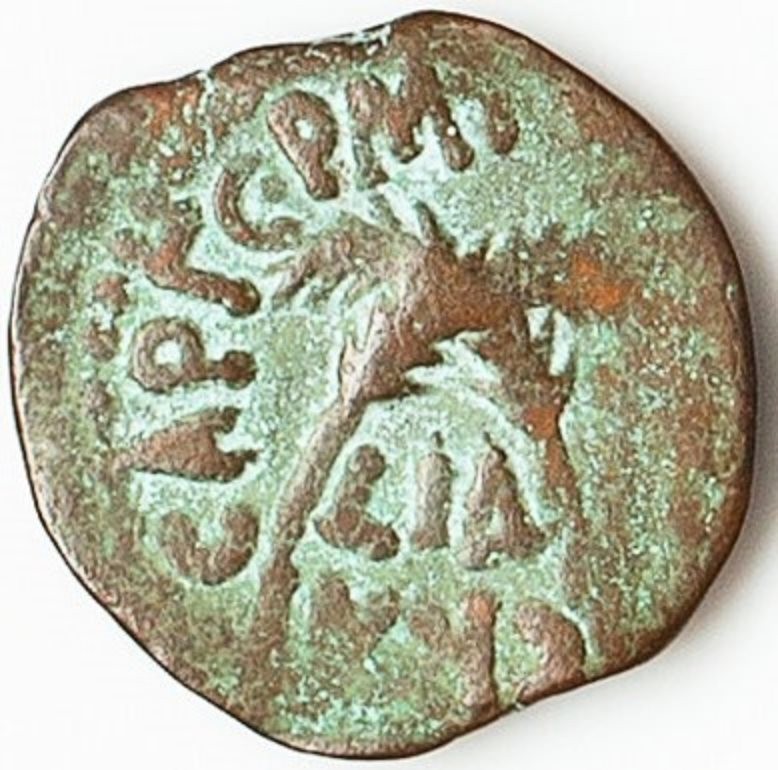
AncientJewish Coin of JUDAEA
Procurators: Antonius Felix (52 AD - 60 AD) of Judaea
Roman Procurator under Claudius and NeroBronze AE Prutah
Struck at the mint of Jerusalem, Dated Year 14 (54 CE - 55 CE)
18 mm, 3.00 grams
Reference:Hendin 1351;Meshorer TJC 342; BMC Palestine p. 261, 1; Sofaer pl. 220, 62; RPC I 4970
Obverse:IOY/ΛIA AΓ/PIΠΠI/NA, Inscription(Julia Agrippina [wife of Claudius])in four lines within a wreath tied at the bottom with an X
Reverse:TI KΛAY∆IOC KAICAP ΓEPML I∆,Inscription (Tiberius Claudius Caesar Germanicus), two crossed palm fronds, (Year 14) below
Arrives with specifications page for your reference.
See theGenuine HistoryCollection
Antonius Felix (possibly Tiberius Claudius Antonius Felix, in Greek: ὁ Φῆλιξ; born c. 5–10) was the fourth Roman procurator of Judea Province in 52–60, in succession to Ventidius Cumanus. He appears in the New Testament in Acts 23 and 24, where the Apostle Paul is brought before him for a trial.
Felix was the younger brother of Greek freedman Marcus Antonius Pallas who served as a secretary of the treasury during the reign of Emperor Claudius. According to Tacitus, Pallas and Felix descended from the Greek Kings of Arcadia.
Felix became the procurator by the petition of his brother. Felix\'s cruelty and his accessibility to bribes (see Book of Acts 24:26) led to a great increase of crime in Judaea. The period of his rule was marked by internal feuds and disturbances, which he put down with severity.
In 58, Felix hired assassins to murder Jonathan the High Priest, shortly after Jonathan took office. Jonathan had often criticized Felix about governing Jewish affairs, and he threatened to report to Caesar if Felix did not do well. Felix persuaded Doras, one of Jonathan\'s most trusted friends and a citizen of Jerusalem, to hire robbers to kill Jonathan by promising to give him a large sum of money. Doras arranged for some hired men to mingle with the worshippers in the Temple in Jerusalem with daggers hidden under their garments. These assassins killed Jonathan during a Jewish festival and were never caught.
The Apostle Paul was arrested in Jerusalem and rescued from a plot against his life, and Claudius Lysias transferred him to Caesarea, where he stood trial before Felix. Felix and his wife Drusilla heard Paul\'s discourse and sent for him to talk with him. However, Felix\'s actual desire was to receive a bribe from Paul, which Paul refused to do (Acts 24:24–26). Felix was succeeded as procurator after detaining Paul for two years, but he left him imprisoned as a favor to the Jews (Acts 24:27).
Upon returning to Rome, Felix was accused of using a dispute between the Jews and the Syrians of Caesarea as a pretext to slay and plunder the inhabitants, but he escaped unpunished through the intercession of his brother Pallas, who had great influence with Emperor Nero.
Porcius Festus succeeded him as procurator of Judea.
Felix married three times. His first wife was Drusilla of Mauretania, probably the daughter of Ptolemy of Mauretania and Julia Urania. Felix\'s second wife was the Judean Drusilla of Judea, daughter of Herod Agrippa I and Cypros. Drusilla of Judea divorced Gaius Julius Azizus, King of Emesa to marry Felix. The couple had a son, Marcus Antonius Agrippa, who died, along with many of the inhabitants of Pompeii and Herculaneum, in the eruption of Mount Vesuvius on 24 August 79. Antonia Agrippina (whose name was found in graffiti in a Royal Tomb in Egypt) may have been a granddaughter from Agrippa. His third wife\'s name is not attested. A man named Lucius Anneius Domitius Proculus is described in an inscription as the great-grandson of Felix, his grandmother is named as Antonia Clementiana, presumably Felix\'s daughter. Another inscription names a Tiberius Claudius (with a missing cognomen) who was in some way associated with a Titus Mucius Clemens.
Marcus Antonius Fronto Salvianus (a quaestor) and his son Marcus Antonius Felix Magnus (a high priest in 225) are possible descendants as well.Antonius Felix from Guillaume Rouillé\'s Promptuarii Iconum Insigniorum
Nero Claudius Caesar Augustus Germanicus(born Lucius Domitius Ahenobarbus; 15 December AD 37 – 9 June AD 68) was a Roman emperor and the final emperor of the Julio-Claudian dynasty, reigning from AD 54 until his death in AD 68.
Nero was born at Antium in AD 37, the son of Gnaeus Domitius Ahenobarbus and Agrippina the Younger (great-granddaughter of the emperor Augustus). Nero was three when his father died. By the time Nero turned eleven, his mother married Emperor Claudius, who then adopted Nero as his heir. Upon Claudius\' death in AD 54, Nero ascended to the throne with the backing of the Praetorian Guard and the Senate. In the early years of his reign, Nero was advised and guided by his mother Agrippina, his tutor Seneca the Younger, and his praetorian prefect Sextus Afranius Burrus, but sought to rule independently and rid himself of restraining influences. The power struggle between Nero and his mother reached its climax when he orchestrated her murder. Roman sources also implicate Nero in the deaths of both his wife Claudia Octavia – supposedly so he could marry Poppaea Sabina – and his stepbrother Britannicus.
Nero\'s practical contributions to Rome\'s governance focused on diplomacy, trade, and culture. He ordered the construction of amphitheaters, and promoted athletic games and contests. He made public appearances as an actor, poet, musician, and charioteer, which scandalized his aristocratic contemporaries as these occupations were usually the domain of slaves, public entertainers, and infamous persons. However, the provision of such entertainments made Nero popular among lower-class citizens. The costs involved were borne by local elites either directly or through taxation, and were much resented by the Roman aristocracy.
During Nero\'s reign, the general Corbulo fought the Roman–Parthian War of 58–63, and made peace with the hostile Parthian Empire. The Roman general Suetonius Paulinus quashed a major revolt in Britain led by queen Boudica. The Bosporan Kingdom was briefly annexed to the empire, and the First Jewish–Roman War began. When the Roman senator Vindex rebelled, with support from the eventual Roman emperor Galba, Nero was declared a public enemy and condemned to death in absentia. He fled Rome, and on 9 June AD 68 committed suicide. His death sparked a brief period of civil war known as the Year of the Four Emperors.
Most Roman sources offer overwhelmingly negative assessments of his personality and reign. Most contemporary sources describe him as tyrannical, self-indulgent, and debauched. The historian Tacitus claims the Roman people thought him compulsive and corrupt. Suetonius tells that many Romans believed the Great Fire of Rome was instigated by Nero to clear land for his planned \"Golden House\". Tacitus claims Nero seized Christians as scapegoats for the fire and had them burned alive, seemingly motivated not by public justice, but personal cruelty. Some modern historians question the reliability of ancient sources on Nero\'s tyrannical acts, considering his popularity among the Roman commoners. In the eastern provinces of the Empire, a popular legend arose that Nero had not died and would return. After his death, at least three leaders of short-lived, failed rebellions presented themselves as \"Nero reborn\" to gain popular support.
Head of Nero from an oversized statue. Glyptothek, Munich
Tiberius Claudius Caesar Augustus Germanicus(1 August 10 BC – 13 October AD 54), or Claudius, was a Roman emperor, ruling from AD 41 to 54. A member of the Julio-Claudian dynasty, Claudius was born to Drusus and Antonia Minor at Lugdunum in Roman Gaul, where his father was stationed as a military legate. He was the first Roman emperor to be born outside Italy.
As he had a limp and slight deafness due to an illness he suffered when young, he was ostracized by his family and was excluded from public office until his consulship (which was shared with his nephew, Caligula, in 37). Claudius\'s infirmity probably saved him from the fate of many other nobles during the purges throughout the reigns of Tiberius and Caligula, as potential enemies did not see him as a serious threat. His survival led to him being declared emperor by the Praetorian Guard after Caligula\'s assassination, at which point he was the last adult male of his family.
Despite his lack of experience, Claudius was an able and efficient administrator. He expanded the imperial bureaucracy to include freedmen, and helped restore the empire\'s finances after the excesses of Caligula\'s reign. He was also an ambitious builder, constructing new roads, aqueducts, and canals across the Empire. During his reign, the Empire started its successful conquest of Britain. Having a personal interest in law, he presided at public trials, and issued edicts daily. He was seen as vulnerable throughout his reign, particularly by elements of the nobility. Claudius was constantly forced to shore up his position, which resulted in the deaths of many senators. Those events damaged his reputation among the ancient writers, though more recent historians have revised that opinion. Many authors contend that he was murdered by his own wife, Agrippina the Younger. After his death at the age of 63, his grandnephew and legally adopted step-son, Nero, succeeded him as emperor.
Bust of Claudius, Naples National Archaeological Museum