When you click on links to various merchants on this site and make a purchase, this can result in this site earning a commission. Affiliate programs and affiliations include, but are not limited to, the eBay Partner Network.
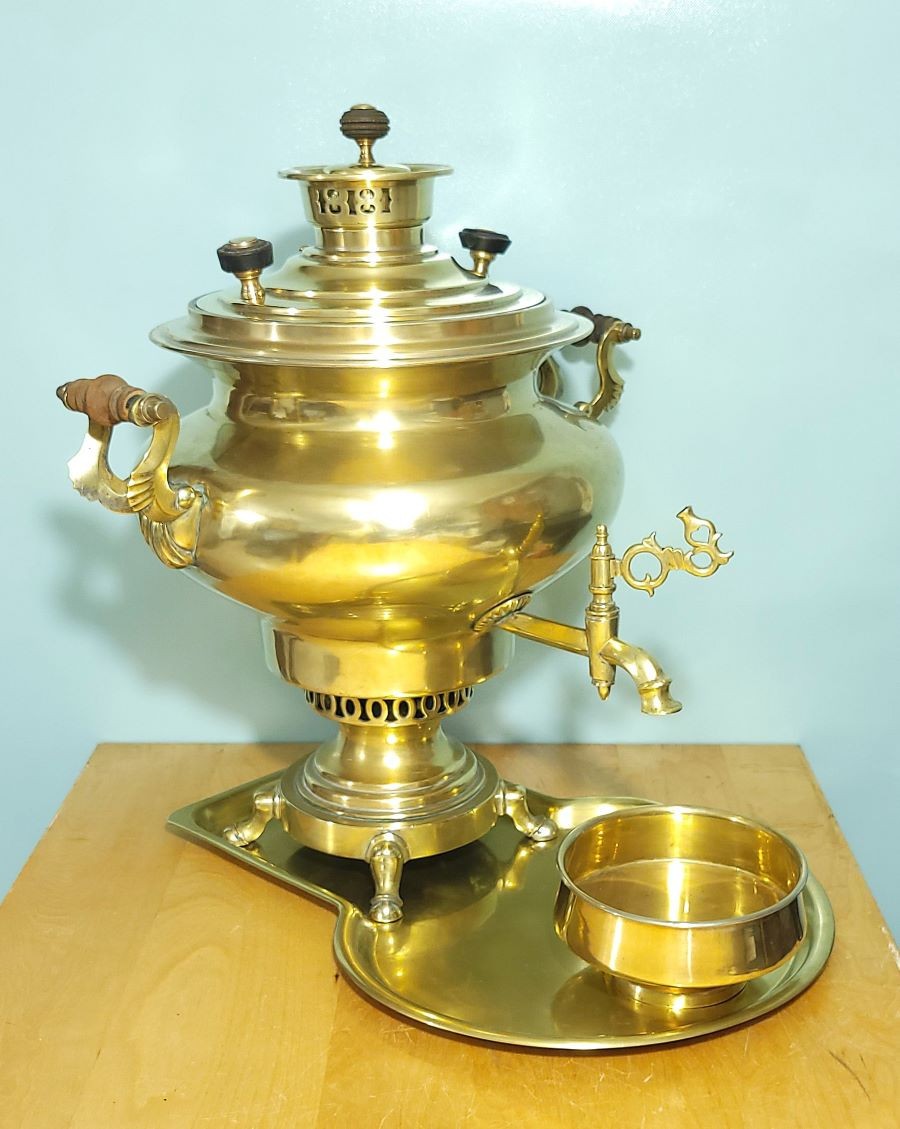
Large Antique Turnip-Shaped Russian Brass Samovar
Moscow · circa 1900 / early 20th century · approximately 20 inches high · approximately 20 pounds
Straight frontal view with the associated brass tray and drip bowl.
A large and unusually substantial Moscow-marked Russian samovar, made for charcoal firing and distinguished by its turnip-shaped body, elaborate cast fittings, pierced faucet key, turned wooden grips, stepped lid assembly, and raised four-footed base.
Front three-quarter view, showing the substantial proportions and both handle assemblies in perspective.
Description
This imposing antique brass samovar belongs to the traditional Russian charcoal-fired type and has the generously rounded, tapering profile commonly described as turnip-shaped. It retains its central fire tube, ventilated lower firebox, and grate at the bottom of the chimney. Its approximately 20-inch height and approximately 20-pound weight give it a physical presence well beyond that of a lightweight decorative example.
The turnip-shaped reservoir is balanced by a deeply stepped shoulder and lid, a comparatively narrow firebox section, and a broad circular base supported on four cast feet. Particularly notable are the substantial scrolling handle mounts, wooden heat-isolating grips, and decorative openwork faucet key. The piece has been polished and presents attractively, while retaining surface evidence of age and use.
Straight frontal view without the associated tray or bowl.
Side profile, with one cast handle assembly nearly face-on and the faucet extending left.
Close view of the brass spout and unusually elaborate pierced faucet key.
Mark, origin, and date
The samovar bears a worn oval Russian maker's or commercial stamp. Its lower line reads МОСКВА (Moscow). The upper inscription appears to begin АЛЕ… and end …ОВЪ, using the pre-revolutionary terminal hard sign. It may represent the surname Aleksandrov (Александровъ), but the intervening letters are too worn for that reading to be presented as a definitive maker attribution.
The worn oval stamp on the samovar, ending МОСКВА (Moscow).
Alternate close-up showing the surviving АЛЕ…ОВЪ / МОСКВА lettering.
On the evidence of its form, construction, workmanship, substantial weight, and Moscow mark, the samovar is catalogued as Russian, Moscow, circa 1900 / early 20th century. The separate tray's dated stamps are not used to date or identify the samovar.
Associated tray and bowl
The samovar is accompanied by an unmarked brass drip bowl and a keyhole-form brass tray. These are associated pieces and are not original to the samovar. The bowl has a minor dent visible in the photographs.
Front of the associated keyhole-form brass tray.
Reverse of the associated tray, showing age-related wear.
The tray bears its own clearly legible Russian factory mark: ТОВАРИЩЕСТВО КОЛЬЧУГИНА (Tovarishchestvo Kolchugina), translated as “The Kolchugin Partnership” or, more literally, “The Partnership of Kolchugin.” This abbreviated name refers to the enterprise formally known as the Partnership of the Brass and Copper-Rolling Works of A. Kolchugin.
Two Imperial double-headed eagles appear beneath the company name, with the dates 1882 and 1896, followed by the stamped number 30. The dates refer to distinctions claimed by the manufacturer and are not, by themselves, dates of manufacture. Because the latest distinction shown is 1896, the tray is reasonably catalogued as a late Imperial Russian Kolchugin Partnership tray, after 1896 and probably circa 1896–1917. This attribution and date apply only to the associated tray and not to the samovar or bowl.
The tray's independent ТОВАРИЩЕСТВО КОЛЬЧУГИНА (Kolchugin Partnership) stamp, with two Imperial eagles, the dates 1882 and 1896, and the number 30. This mark does not belong to the samovar.
Associated unmarked brass drip bowl; a minor dent is visible.
Underside of the associated unmarked bowl, showing age, surface discoloration, and the minor dent.
MeasurementsHeight to top of capApproximately 20 inches (50.8 cm)WeightApproximately 20 pounds (9.1 kg)Associated trayApproximately 19 × 13 inches (48.3 × 33 cm)Fuel typeCharcoal / solid fuelPrimary materialBrass, with wooden handle gripsCondition and completeness
Overall, and apart from the specific functional and completeness issues listed below, the samovar is in very good antique condition. It remains a visually distinctive and highly decorative example, with wear, patina, polish marks, oxidation, staining, minor surface irregularities, and evidence of use consistent with its age. Combustion residue and corrosion are visible beneath and within the lower firebox area.
Lower firebox area showing combustion residue, corrosion, and the surviving grate; the hinged ash/coal-catch cover is absent.
Interior view showing the reservoir, central chimney/fire tube, and surviving original plating or tin lining beneath light-brown mineral residue.
The original nickel plating or tin lining of the interior remains intact. Its present light-brown tint is caused by a coating of residual hard-water minerals rather than loss of the lining itself. It can be dissolved with solution of vinegar overnight.
- The faucet drips.
- A small leak is present at one side-handle attachment.
- The bottom hinged coal/ash-catch cover is missing.
- The grate at the bottom of the chimney is present.
- The original interior nickel plating or tin lining remains intact beneath light-brown hard-water mineral residue.
- The unmarked brass bowl and tray are associated and not original to the samovar; the bowl has a minor dent visible in the photographs.
Despite the disclosed condition points, the samovar presents impressively as a substantial, visually distinctive, and decorative antique Russian metalwork object.
The samovar is offered as an antique collectible and display object. It has not been represented as watertight or ready for heating or beverage service. Please examine all photographs, which form an integral part of the condition description.
Seller's note
The seller is the author of Samovars: The Art of the Russian Metal Workers (ISBN 0-9629138-0-4), a reference work devoted to Russian samovar manufacture and metalworking traditions. The partially legible maker's mark above is described conservatively and has not been used to claim an unverified attribution.
Why Collectors Trust Us
Ranked#12 of 7,174 sellersby sales value(top 1%)in Middle Eastern Antiques on — report dated09.21.2026—100% positive response.
Ranking source: Listing Quality Report, Asian Antiques > Middle East, category-and-condition comparison group.
Every piece is researched, authenticated, and curated with specialized expertise in the field since 1976.
International Buyers — Please Note:
International buyers are responsible for knowing their own customs & importation rules with respect to the item(s) being purchased and pay for the customs fees imposed. All invoices will show the full purchase price of the item(s) being shipped.
Please click here to see our other offerings
© All images and descriptions copyrighted
© Indicates that Euro Products Antiques is the creator of the images and descriptions and retains the exclusive legal rights to control their use, distribution, and reproduction, and that any unauthorized use is a violation of copyright law.
Русский антикварный латунный угольный самовар, Москва, около 1900 года / начало XX века; крупный тяжёлый самовар с клеймом «МОСКВА», отдельными подносом и чашей.
Großer antiker russischer Messing-Holzkohle-Samowar, Moskau, um 1900 / frühes 20. Jahrhundert, mit separat zugeordnetem Tablett und Tropfschale.
Grand samovar russe ancien en laiton à charbon, marqué Moscou, vers 1900 / début du XXe siècle, avec plateau et bol rapportés.
Gran samovar ruso antiguo de latón para carbón, marcado Moscú, hacia 1900 / principios del siglo XX, con bandeja y cuenco asociados.
Grande samovar russo antico in ottone a carbone, marcato Mosca, circa 1900 / inizi del XX secolo, con vassoio e ciotola associati.
Duży zabytkowy rosyjski samowar mosiężny na węgiel drzewny, znakowany Moskwa, około 1900 / początek XX wieku, z później dobraną tacą i miseczką.
Moskova damgalı, yaklaşık 1900 / 20. yüzyıl başlarına ait büyük antika Rus pirinç kömürlü semaver; sonradan eşleştirilmiş tepsi ve kase ile.
모스크바 각인이 있는 대형 러시아 앤티크 황동 숯 사모바르. 1900년경 또는 20세기 초 제작으로 추정되며 별도 구성의 트레이와 받침 그릇이 포함됩니다.