When you click on links to various merchants on this site and make a purchase, this can result in this site earning a commission. Affiliate programs and affiliations include, but are not limited to, the eBay Partner Network.
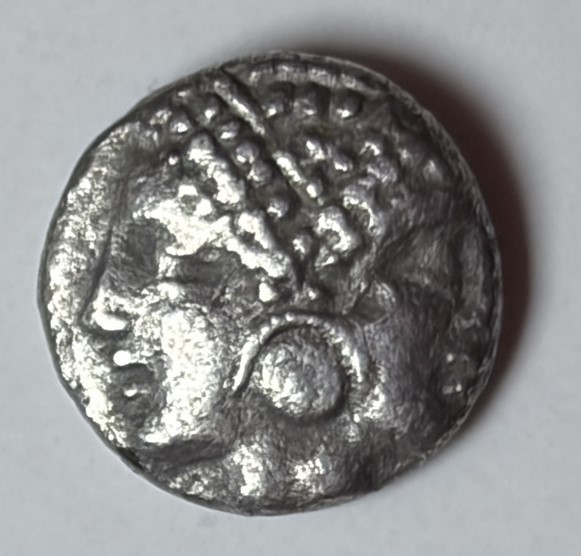
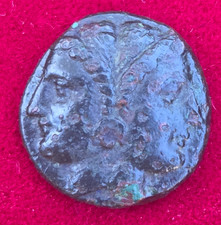
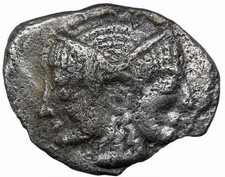
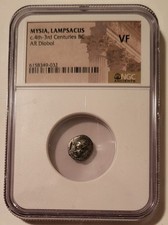
Greek Coin of Mysia, LampsakosStruck circa 390-330 BC at mint of Lampsakos in Mysia
AR Silver Diobol (10mm - 1.1 grams)
Reference:SNG France 1190
Obverse: Janiform female head, wearing circular earring
Reverse: ΛΑ-Μ, Helmeted head of Athena facing right; fly in right field
Coin Notes:
Rare example
Arrives with specifications page for your reference.
See theGenuine HistoryCollection
Lampsacus (Ancient Greek: Λάμψακος, romanized: Lampsakos) was an ancient Greek city located in modern day Turkey, strategically situated on the eastern side of the Hellespont in the northern Troad. An inhabitant of Lampsacus was called a Lampsacene. The name has been transmitted in the nearby modern town of Lapseki.
Originally known as Pityusa or Pityussa (Ancient Greek: Πιτυούσ(σ)α), it was colonized from Phocaea and Miletus. In the 6th century BC Lampsacus was attacked by Miltiades the Elder and Stesagoras, the Athenian tyrants of the nearby Thracian Chersonese. During the 6th and 5th centuries BC, Lampsacus was successively dominated by Lydia, Persia, Athens, and Sparta. The Greek tyrants Hippoclus and later his son Acantides ruled under Darius I. Artaxerxes I assigned it to Themistocles with the expectation that the city supply the Persian king with its famous wine. When Lampsacus joined the Delian League after the battle of Mycale (479 BC), it paid a tribute of twelve talents, a testimony to its wealth; it had a gold coinage in the 4th century, an activity only available to the more prosperous cities.
A revolt against the Athenians in 411 BC was put down by force. In 196 BC, the Romans defended the town against Antiochus the Great, and it became an ally of Rome; Cicero and Strabo attest its continuing prosperity under Roman rule. Lampsacus was also notable for its worship of Priapus, who was said to have been born there.
The philosopher Anaxagoras was forced to retire to Lampsacus after a trial in Athens around 434–433 BC. The citizens of Lampsacus erected an altar to Mind and Truth in his honor, and observed the anniversary of his death for many years. Additionally, in his honor, the annual celebration known as the Anaxagoreia was established.
The people of Lampsacus were pro-Persian, or were suspected of doing so, and Alexander the Great was furiously angry, threatening them with massive harm. They sent Anaximenes of Lampsacus to intercede. Alexander, bound by his oath, was tricked into pardoning the people by a clever request to do the opposite of what Anaximenes actually meant.
Lampsacus produced a series of notable historians and philosophers. Charon of Lampsacus (c. 500 BC) composed histories of Persia, Libya, and Ethiopia, and annals of his native town. Metrodorus of Lampsacus (the elder) (5th century BC) was a philosopher from the school of Anaxagoras. Strato of Lampsacus (c. 335 – c. 269 BC) was a Peripatetic philosopher and the third director of Aristotle\'s Lyceum at Athens. Euaeon of Lampsacus was one of Plato\'s students. A group of Lampsacenes were in the circle of Epicurus, including Polyaenus of Lampsacus (c. 340 – 278 BC), Idomeneus of Lampsacus, Colotes the satirist, Leonteus of Lampsacus, and Batis of Lampsacus. Anaximenes of Lampsacus, a rhetorician and historian, and his nephew, also named Anaximenes, were historians. Aristocles of Lampsacus was a Stoic philosopher. Xenophon of Lampsacus was a geographer. The people of Lampsacus dedicated a statue of Anaximenes of Lampsacus at Olympia, Greece. According to legend, St Tryphon was buried at Lampsacus after his martyrdom at Nicaea in 250.
The first known bishop in Lampsacus was Parthenius, under Constantine I. Part of the Hellespont, Lampsacus was subject to the metropolis of Cyzicus. In 364, the see was occupied by Marcian and a council of bishops was held at Lampsacus. Marcian was summoned to the First Council of Constantinople of Constantinople in 381, but refused to retract his adherence to the Macedonian Christian sect. Other known bishops of Lampsacus include Daniel (451), Harmonius (458), Constantine (680), John (787), and St. Euschemon. The See of Lampsacus is mentioned in the \"Notitiae Episcopatuum\" until about the 12th or 13th century. The famous Lampsacus Treasure, now in the British Museum, dates from this period. The bishopric remains a vacant and titular see.
Part of the Lampsacus Treasure as currently displayed in the British Museum
Athenaor Athene, often given the epithet Pallas, is an ancient Greek goddess associated with wisdom, warfare, and handicraft who was later syncretized with the Roman goddess Minerva. Athena was regarded as the patron and protectress of various cities across Greece, particularly the city of Athens, from which she most likely received her name. The Parthenon on the Acropolis of Athens is dedicated to her. Her major symbols include owls, olive trees, snakes, and the gorgoneion. In art, she is generally depicted wearing a helmet and holding a spear.
From her origin as an Aegean palace goddess, Athena was closely associated with the city. She was known as Polias and Poliouchos (both derived from polis, meaning \"city-state\"), and her temples were usually located atop the fortified acropolis in the central part of the city. The Parthenon on the Athenian Acropolis is dedicated to her, along with numerous other temples and monuments. As the patron of craft and weaving, Athena was known as Ergane. She was also a warrior goddess, and was believed to lead soldiers into battle as Athena Promachos. Her main festival in Athens was the Panathenaia, which was celebrated during the month of Hekatombaion in midsummer and was the most important festival on the Athenian calendar.
In Greek mythology, Athena was born from the forehead of her father Zeus; in Hesiod\'s Theogony, this occurred after Zeus swallowed his consort Metis while she was pregnant with Athena. In the founding myth of Athens, Athena bested Poseidon in a competition over patronage of the city by creating the first olive tree. She was known as Athena Parthenos \"Athena the Virgin\". In one archaic Attic myth, Hephaestus tried and failed to rape her, resulting in Gaia giving birth to Erichthonius, an important Athenian founding hero whom Athena raised. She was the patron goddess of heroic endeavor; she was believed to have aided the heroes Perseus, Heracles, Bellerophon, and Jason. Along with Aphrodite and Hera, Athena was one of the three goddesses whose feud resulted in the Trojan War. She plays an active role in the Iliad, in which she assists the Achaeans and, in the Odyssey, she is the tutelary deity to Odysseus.
In the later writings of the Roman poet Ovid, Athena was said to have competed against the mortal Arachne in a weaving competition, afterward transforming Arachne into the first spider, and to have transformed Medusa into the Gorgon after witnessing the young woman being raped by Poseidon in the goddess\'s temple. Ovid also says that Athena saved the mortal maiden Corone from the same god by transforming her into a crow. Since the Renaissance, Athena has become an international symbol of wisdom, the arts, and classical learning. Western artists and allegorists have often used Athena as a symbol of freedom and democracy.Mattei Athena at Louvre. Roman copy from the 1st century BC/AD after the Greek original
Piraeus Athena of the 4th century BC attributed to Cephisodotos or Euphranor