When you click on links to various merchants on this site and make a purchase, this can result in this site earning a commission. Affiliate programs and affiliations include, but are not limited to, the eBay Partner Network.
Thank you forlooking. Please visit my other listings of contemporary and antique Japaneseart.
Buy several and save – please feel free to inquire.
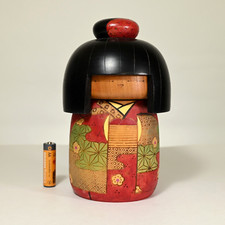
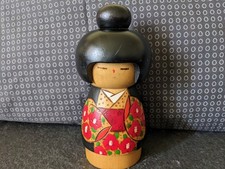
Master Kazuo Takamizawa (1927- )Kan-Tsubakikokeshi, Enju wood. Signed. Gunma Prefecture,Japan, circa the 1960s.
Kan-Tsubaki(Winter Camellia) kokeshi by the revered sosaku master Kazuo Takamizawa.The Camellia is a symbol of perfection and humility inJapan.Its symmetrical form represents the ideal of beauty, while itsunassuming nature embodies the virtue of humility.The red camellia isoften associated with love and passion.
This gorgeous kokeshi is made of the valuable Enju wood (Pagoda tree), which was Takamizawa-san\'s preferred material during the earlier decades of his career. This wood species is dense and heavy and possesses a gorgeous wood grain - the density and beauty can only be fully appreciated by holding the kokeshi in one\'s hands.
Height: 6.8 inches
Weight: 1.0 lbs (466 g)
Kazuo Takamizawa
Takamizawa-san began making Sosaku Kokeshi in 1948, openinghis studio in Takasaki City, Gunma Prefecture, the center of sosaku kokeshimaking. His early works were mostly unpainted, except for minimal wood burningand incising of camellia blossoms on Enju wood (Pagoda tree), which he dearlyloved for its gorgeous wood graining that gave his dolls an extra dimension aswell as a rich, deep color. He began creating more colorful painted kokeshi inthe 1970’s.
His works have received numerous awards including the PrimeMinister’s Award, the highest prize bestowed on a kokeshi artist, for his work Akane.In 1983, Takamizawa-san was elected into the Gunma Kokeshi Artistic Hall ofFame.
K240