When you click on links to various merchants on this site and make a purchase, this can result in this site earning a commission. Affiliate programs and affiliations include, but are not limited to, the eBay Partner Network.
HIS STORY TREASURES PRESENTS
NGC-Certified Byzantine Anonymous Follis
Christ Pantocrator — “Jesus Christ, King of Kings”
Class A2–A3, circa AD 975–1035
NGC Certification No. 8559613-027
THE COIN THAT PLACED CHRIST ABOVE THE EMPEROR
For centuries, Roman and Byzantine coins proclaimed the authority of earthly rulers. Their portraits appeared beside titles declaring them victorious, eternal and chosen by God.
Then, near the end of the tenth century, something remarkable happened.
The emperor’s name disappeared.
In its place appeared the image of Jesus Christ.
This substantial Byzantine bronze follis belongs to the celebrated series known as the “Anonymous Folles.” Issued at Constantinople during the height of the medieval Byzantine Empire, these coins did not identify the reigning emperor. Instead, they presented Christ as the ultimate sovereign—the King who stood above every earthly throne.
It is not merely an ancient coin. It is a surviving declaration of Byzantine faith, imperial ideology and the civilization that preserved the legacy of Rome for another thousand years.
THE FACE OF CHRIST ON BYZANTINE MONEY
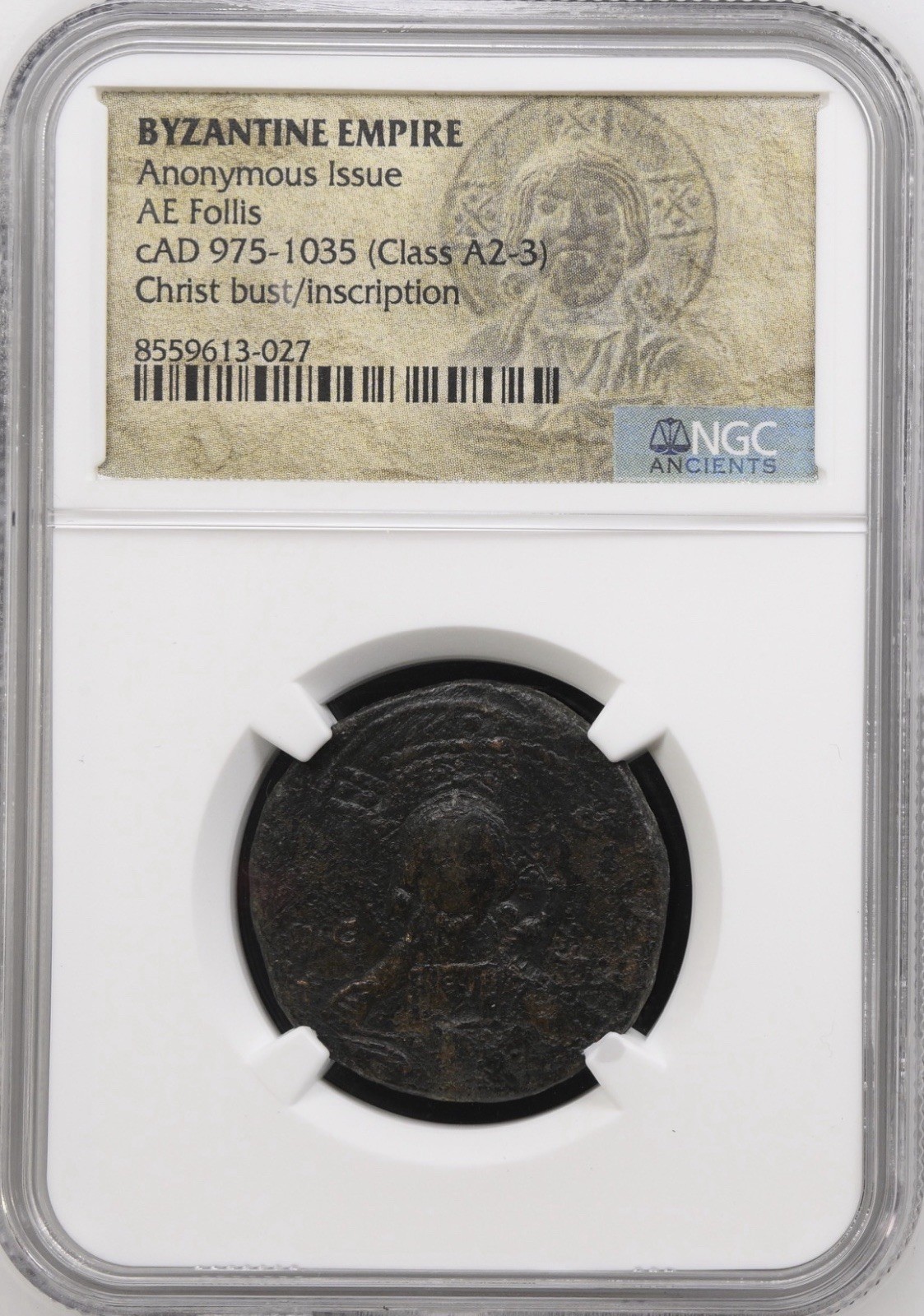
The obverse depicts Christ Pantocrator—the image of Christ as the all-ruling Lord.
Christ is shown facing forward with a cross behind His head. He holds the Book of the Gospels, while the traditional abbreviation “IC XC,” representing the Greek name of Jesus Christ, appears beside the sacred portrait.
This was far more than decoration.
To the people of Byzantium, the emperor governed the Christian Roman Empire, but Christ was its true and eternal ruler. By removing the emperor’s portrait and placing Christ at the center of the coin, the anonymous follis transformed an object of everyday commerce into a statement of faith.
A merchant receiving this coin, a soldier carrying it, or a family using it in the marketplace would encounter the same message: political rulers would come and go, but the kingship of Christ endured.
“JESUS CHRIST, KING OF KINGS”
The reverse carries a monumental inscription arranged across several lines:
* IhSUS
XRISTUS
bASILEU
bASILE
The inscription proclaims:
“Jesus Christ, King of Kings”
The wording reflects the Greek title Basileus Basileon—a declaration that Christ reigns above all earthly sovereigns.
Although worn from centuries of circulation and age, the block-like structure of the reverse inscription remains visible. Its powerful design resembles the façade of a sacred monument: words of faith cast permanently into bronze.
THE AGE OF BASIL II
Class A2 and A3 anonymous folles are generally associated with the period from approximately AD 975 to 1035, spanning the reigns of several Byzantine emperors. Much of this era was dominated by Basil II, one of the most formidable rulers in Byzantine history.
Basil II reigned from AD 976 to 1025. He spent decades strengthening imperial authority, confronting rebellions and expanding Byzantine power across the Balkans and the eastern frontier.
His prolonged wars against the Bulgarian Empire eventually brought much of the Balkans under Byzantine control. Later generations remembered him by the formidable title “Bulgar-Slayer.”
Yet Basil’s reign was not defined only by warfare. Under his rule, the Byzantine state reached a level of military strength, territorial reach and financial stability not seen for generations. Imperial authority stretched from southern Italy across Greece and Anatolia toward Armenia, Syria and the Caucasus.
Constantinople stood at the center of this revived empire—a city of palaces, monasteries, markets and immense churches, protected by the great Theodosian Walls and enriched by trade between Europe and Asia.
THE CHRISTIANIZATION OF THE RUS’
This coin also belongs to the era in which Byzantine Christianity profoundly influenced Eastern Europe.
In AD 988, Vladimir the Great of Kyiv accepted Christianity and formed a close political and religious relationship with Constantinople. Byzantine clergy, sacred art, architecture and religious traditions traveled northward into the lands of the Rus’.
That conversion helped shape the religious and cultural development of Ukraine, Russia, Belarus and other parts of Eastern Europe for centuries.
An anonymous follis like this one therefore represents more than Byzantine monetary history. It comes from the age when Constantinople’s spiritual and cultural influence extended far beyond the empire’s political borders.
ROME’S EMPIRE IN THE MIDDLE AGES
The people who issued and used this coin did not call themselves “Byzantines.” They called themselves Romans—Rhomaioi—and regarded their empire as the uninterrupted continuation of the Roman Empire.
Their capital was Constantinople, the “New Rome” founded by Constantine the Great in AD 330. Their government preserved Roman law and imperial institutions, while Greek became the dominant language and Orthodox Christianity stood at the heart of public life.
This follis is therefore both a Byzantine coin and a medieval Roman coin: a tangible link between the world of the ancient Caesars and the Christian civilization of the Middle Ages.
A COIN OF EVERYDAY FAITH
Bronze folles were practical currency. They circulated among ordinary people rather than remaining confined to imperial treasuries.
This coin may once have passed through the markets of Constantinople, paid for food near a harbor, accompanied a soldier on campaign or traveled with a pilgrim approaching one of the empire’s sacred churches.
Every mark upon its dark surface is part of that journey.
Unlike a gold coin reserved for imperial payments and international commerce, the follis belonged to daily life. It carried the image and message of Christ directly into the hands of the Byzantine population.
NGC CERTIFICATION
This coin has been authenticated, attributed and encapsulated by NGC Ancients, one of the world’s best-known independent numismatic certification services.
NGC Certification Number: 8559613-027
NGC Attribution:
• Byzantine Empire
• Anonymous Issue
• AE Follis
• Circa AD 975–1035
• Class A2–A3
• Christ bust / inscription
The holder does not assign a numerical grade, strike rating or surface rating. Please assess the coin’s preservation and appearance through the photographs provided.
ITEM DETAILS
• Empire: Byzantine Empire
• Historical identity: Medieval Eastern Roman Empire
• Issue: Anonymous Christian coinage
• Date: Circa AD 975–1035
• Classification: Class A2–A3
• Denomination: AE Follis
• Metal: Bronze
• Obverse: Facing bust of Christ Pantocrator holding the Gospels
• Reverse: Multi-line inscription proclaiming Jesus Christ as King of Kings
• Certification: NGC Ancients
• Certification Number: 8559613-027
• Age: Approximately 1,000 years old
• Quantity: One coin—the exact certified example shown
CONDITION
This authentic medieval coin exhibits substantial circulation wear, dark toning, deposits, surface texture and areas of weakness consistent with its age and long history.
The facing image of Christ remains identifiable on the obverse, while the distinctive multi-line inscription remains discernible on the reverse. The coin’s large bronze fabric gives it a powerful physical presence despite the wear.
Ancient and medieval coins were individually struck by hand. Irregular shape, imperfect centering, uneven strike, patina and surface variations are normal characteristics of genuine historical coinage.
Please examine every photograph carefully. The photographs form an important part of the description. Lighting and individual screen settings may affect the coin’s apparent color.
WHY THIS COIN MATTERS
This anonymous follis represents an extraordinary moment in monetary history:
• The portrait of an earthly emperor was replaced by the image of Christ
• The reverse proclaimed “Jesus Christ, King of Kings”
• Constantinople stood at the heart of the medieval Roman world
• Basil II led Byzantium through an era of military resurgence
• Byzantine Christianity spread its influence into the lands of the Rus’
• Roman imperial tradition and Christian faith were united in one everyday object
Few coins communicate the worldview of an entire civilization as directly as the Byzantine anonymous follis.
It would make a meaningful addition to a collection centered on Byzantine history, ancient Christianity, Orthodox heritage, biblical themes, medieval Europe, Roman continuity or historically important religious artifacts.
You will receive the exact NGC-certified coin shown in the photographs.
PRESERVING HISTORY, SHARING ITS STORY
At His Story Treasures, we believe every authentic historical object is a witness to the human journey. Our purpose is not simply to offer old coins, but to preserve and share the stories they have carried across centuries.
A portion of our net profit is dedicated to charitable causes, allowing each preserved piece of history to contribute to a better future.
Hold a genuine survivor from medieval Constantinople—a coin that entered the marketplace without the name of an emperor and proclaimed instead:
“Jesus Christ, King of Kings.”