Heat.net Store Home
|
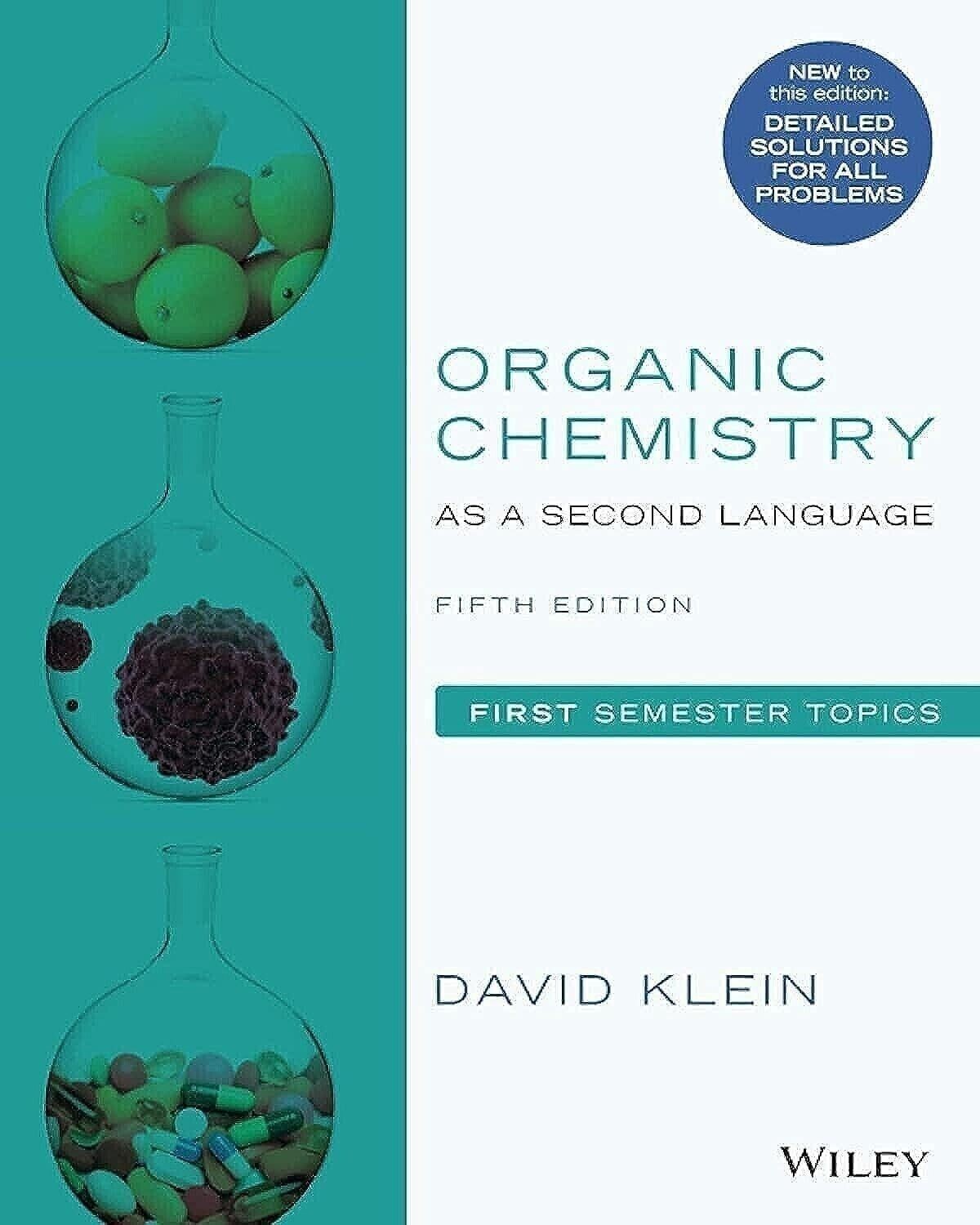
Organic Chemistry as a Second Language: First Semester Topics Paperback For Sale

When you click on links to various merchants on this site and make a purchase, this can result in this site earning a commission. Affiliate programs and affiliations include, but are not limited to, the eBay Partner Network.

Organic Chemistry as a Second Language: First Semester Topics Paperback:
$32.49
Organic Chemistry as a Second Language: First Semester Topics Paperback Organic Chemistry as a Second Language\" by David R. Klein is a widely used textbook for students learning organic chemistry. In the first semester, it typically covers fundamental topics that serve as a foundation for understanding more complex organic chemistry concepts. Some of the key topics covered in the first semester may include: Structure and Bonding: Introduction to the structure of organic molecules, including the concept of hybridization, bond angles, bond lengths, and the different types of bonds (sigma bonds, pi bonds). Functional Groups: Identification and classification of functional groups such as alkyl halides, alcohols, ethers, aldehydes, ketones, carboxylic acids, esters, amines, and amides. Nomenclature: Learning the systematic rules for naming organic compounds according to IUPAC (International Union of Pure and Applied Chemistry) nomenclature. Acids and Bases: Understanding acids and bases in the context of organic chemistry, including definitions, acid-base reactions, and factors affecting acid and base strength. Isomerism: Introduction to structural isomerism, including constitutional isomers, stereoisomers (such as geometric isomers and optical isomers), and the concept of chirality. Introduction to Reaction Mechanisms: Basic understanding of reaction mechanisms, including concepts such as nucleophiles, electrophiles, leaving groups, reaction intermediates, and reaction arrows. Substitution and Elimination Reactions: Learning about substitution and elimination reactions, including SN1, SN2, E1, and E2 reactions, their mechanisms, and factors affecting reaction pathways. Addition Reactions: Introduction to addition reactions, including electrophilic addition to alkenes and alkynes, Markovnikov\'s rule, anti-Markovnikov addition, and reactions of alkenes with halogens and halogen acids. Aromaticity and Aromatic Compounds: Understanding the concept of aromaticity, aromatic compounds, and reactions specific to aromatic systems, such as electrophilic aromatic substitution. Conformational Analysis: Introduction to conformational analysis, including Newman projections, chair conformations of cyclohexane, and factors affecting stability of conformations.
These topics provide a solid foundation in organic chemistry and serve as the basis for more advanced concepts covered in subsequent courses. \"Organic Chemistry as a Second Language\" aims to present these topics in a clear and concise manner to aid students in understanding and mastering the fundamentals of organic chemistry
|
|
Other Related Items:
Related Items:
Organic Chemistry as a Second Language, Volume 1 - Paperback - VERY GOOD $63.88
Organic Chemistry student study guide by David Klein, 4th edition, loose leaf $79.95
OpenStax Organic Chemistry 10th Edition Hardcover Textbook John McMurry 2012 $50.00
|