When you click on links to various merchants on this site and make a purchase, this can result in this site earning a commission. Affiliate programs and affiliations include, but are not limited to, the eBay Partner Network.
His Story Collections PresentsChinese Three-Footed Bronze Incense Censer三足铜香炉 | Pierced Cover | 清 Mark | Certified 极美88
Carry History With You
It was made to hold something that could never be preserved.
Fragrance.
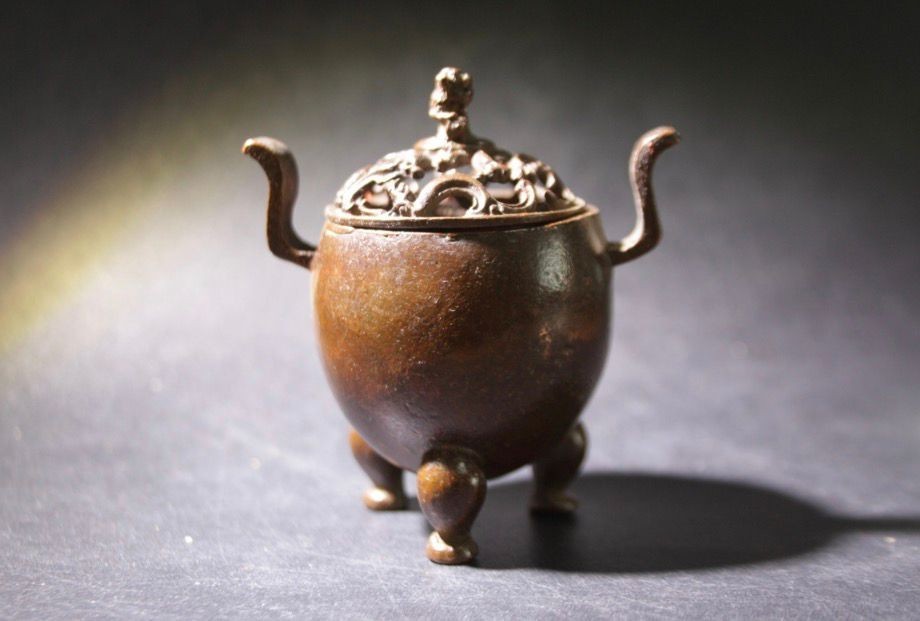
Three small feet raise a rounded bronze vessel from the surface below.
Two elegant handles rise dramatically from its sides.
Above them sits an intricate pierced cover, crowned by a small sculptural finial.
And underneath the vessel appears a single character:
清
This diminutive incense burner represents a tradition extending across centuries of Chinese history—the transformation of incense from fragrance into ritual, atmosphere and art.
The Story — When Bronze Held Fragrance
The accompanying certification identifies this object as:
三足铜香炉
Three-Footed Copper/Bronze Incense Burner
At approximately 60.4 mm high, it is remarkably compact.
But its form belongs to a much older artistic tradition.
Long before this particular object was made, Chinese craftsmen looked backward toward the great ritual bronzes of antiquity for inspiration.
The Metropolitan Museum of Art explains that ancient Chinese ritual bronzes became prototypes for later metalwork and that the ancient three-legged ding vessel was among the forms subsequently adapted into incense burners. The Metropolitan Museum of Art
An ancient vessel once associated with offerings could therefore be transformed by later generations into something different:
a vessel for fragrance.
Three Feet
The three-legged construction is one of the defining characteristics of the object.
Rather than resting directly upon its rounded body, the censer is elevated by three short feet.
This creates both physical and visual balance.
Three points naturally stabilize the vessel.
But aesthetically, they also connect the censer with China's extraordinarily long tradition of tripod vessel forms.
That connection with antiquity became an important part of later Chinese decorative art.
The Saint Louis Art Museum notes that later Chinese bronzes frequently recalled much earlier vessel shapes and designs. Its own 17th-century bronze tripod censer combines a substantial vessel body with an openwork cover and sculptural finial. Slam
Your censer is far smaller and should not be considered a direct comparison.
But the artistic vocabulary is unmistakably related.
The Pierced Cover
Perhaps the most attractive feature is the removable lid.
Look carefully at its construction.
Rather than being cast as a solid cover, it is pierced with an elaborate openwork pattern.
This was both decorative and functional.
When aromatic material burned inside the vessel, the openings allowed fragrant smoke to escape upward.
The solid bronze body concealed the source.
The pierced cover transformed the smoke into part of the visual experience.
Comparable Chinese bronze censers are specifically catalogued with pierced or reticulated covers, sometimes incorporating floral scrolls, dragons, phoenixes or auspicious creatures. Sellingantiques
In other words, the holes in the lid were not simply decoration.
They were part of the object's purpose.
Incense in Chinese Culture
Incense could inhabit many different environments.
It appeared within religious practice.
It accompanied ritual.
It could perfume interiors.
And it became closely connected with the cultivated environment of the Chinese scholar.
A censer therefore occupies an interesting position between functional object and decorative art.
It was something to be used.
Something to be seen.
And something to be experienced through another sense entirely:
smell.
That makes the survival of an old incense burner particularly evocative.
The incense itself disappeared centuries ago.
The vessel remains.
The Character Beneath
Turn the censer upside down and a single character appears within a circular reserve:
清
Qīng
It is, of course, the character associated with the Qing dynasty, which ruled China from 1644 until 1912.
But this requires careful interpretation.
A mark on an antique Chinese object is not automatically proof of when that object was manufactured.
Historical Chinese bronzes were frequently inspired by earlier objects, and marks themselves were also reproduced. A useful parallel is the extremely common appearance of Xuande marks on much later bronze censers; dealers and sale houses consequently distinguish between the mark and the actual period of manufacture. Sellingantiques
His Story Collections therefore describes exactly what is physically present:
The underside bears a 清 mark.
We do not independently claim that the mark alone establishes Qing Dynasty manufacture.
A Miniature Work of Metal Art
Its scale is one of the most charming aspects of this particular piece.
At approximately:
Height: 60.4 mm
Weight: 111.0 g
the entire vessel can essentially rest in the palm of a hand.
Yet it retains all of the architectural elements of a much larger censer:
the rounded body,
the three feet,
the paired rising handles,
the removable cover,
the pierced decoration,
and the crowning finial.
It is almost a miniature monument to the Chinese incense-burning tradition.
Certification & Specifications
Object: Three-Footed Copper/Bronze Incense Burner
Chinese: 三足铜香炉
Grade: 极美88
Height: approximately 60.4 mm
Weight: approximately 111.0 g
Form: Rounded tripod censer
Feet: Three
Handles: Two raised side handles
Cover: Removable pierced/openwork cover with finial
Base: Circular reserve containing the character 清
Certification No.: B002060294
Attribution Notice
The object identification, measurements and grade above follow the accompanying third-party certification.
The 清 character on the underside is described as a physical feature of the artifact.
Unless separately confirmed by the certification record, His Story Collections does not independently represent the 清 mark as proof that the object was manufactured during the Qing Dynasty.
No independent metallurgical or scientific dating has been performed by His Story Collections.
Condition
The censer displays brown surface patination and coloration with lighter wear visible across raised and exposed areas.
Surface irregularities, oxidation and other age/use-related characteristics may be present.
The removable pierced cover appears with the vessel as photographed.
Please examine all photographs carefully, as they form an integral part of the description.
The photographs show the exact artifact offered for sale.
Why His Story Collections Chose This Piece
Many historical artifacts preserve an image.
Others preserve words.
This one preserves the memory of something much harder to capture.
A scent.
Imagine incense placed inside.
Smoke begins to rise.
It searches for the openings in the pierced bronze cover.
Thin streams emerge between the decorative forms before disappearing into the room.
The smoke is gone within seconds.
The fragrance eventually disappears too.
Perhaps that is why the survival of the vessel itself feels so compelling.
The experience for which it was created was temporary.
The object was not.
Centuries—or perhaps generations—later, its three feet still support it.
Its lid can still be lifted.
Its handles still rise from either side.
And underneath remains that enigmatic character:
清.
Carry History With You.
His Story Collections