When you click on links to various merchants on this site and make a purchase, this can result in this site earning a commission. Affiliate programs and affiliations include, but are not limited to, the eBay Partner Network.
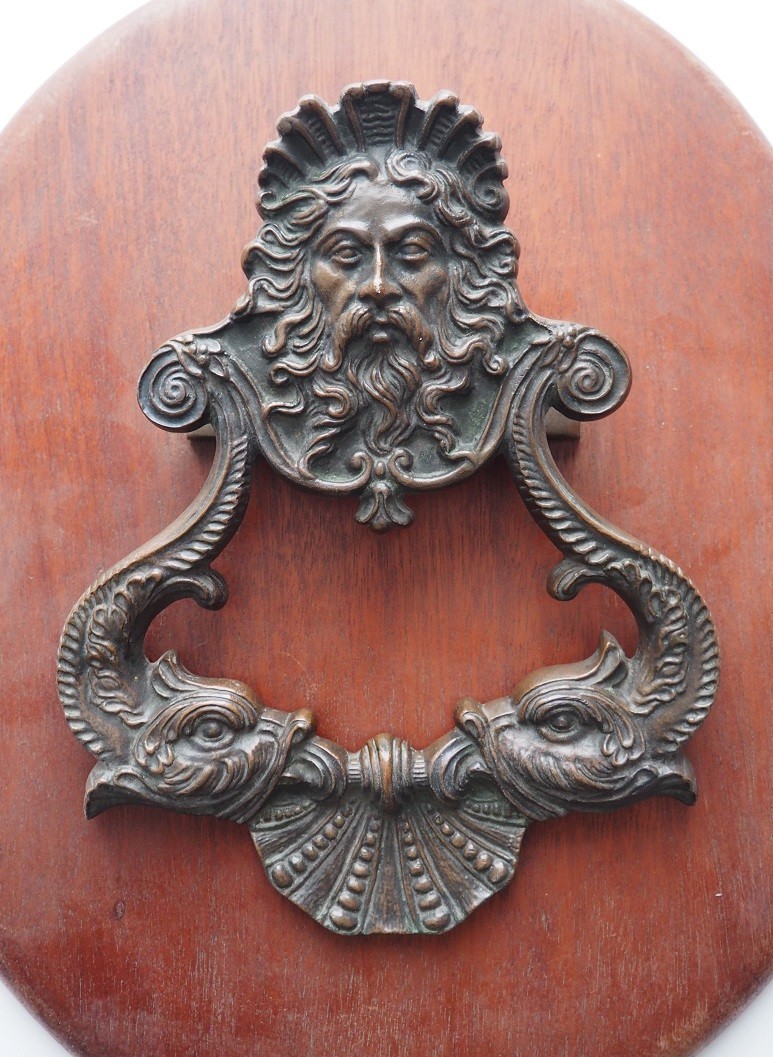
RARE 1930\'s Antique,Vintage Pure Bronze Unique andextremely rareMAX LE VERRIER Monster Original Door Knocker Est.$3500
Poseidon\'s head with a Dolphins
This item is a decorative door knocker featuring intricate details inspired by Greek mythology, specifically Poseidon, the god of the sea. It adds a touch of vintage charm and character to any door.
This beautiful door knocker is attached to a wooden emblem. So it can be displayed as is (with the emblem) in your home collection or it can be removed from the wooden emblem and mounted directly to your door.The choice is yours.
Bought from a prominent estate in Paris, France. EST. of $3500, making this a rare opportunity to own a luxury piece at a fraction of the cost.
Biography (Wikipedia):
MAX LE VERRIER– (1891-1973) born in Neuilly-sur-Seine, France. One of the finest sculptors of the Art Deco period. His mother was Belgian, and his father was a Parisian goldsmith and jeweler.
An absolute genius. Even as a child, he excelled at the College de Verneuil sur Aare.
Even as a child, he also showed a great interest in drawing and sculpture.
He carved wooden kings, miniature houses, churches, and more.These interests were not approved by his parents. Max began studying agriculture at Sever St. and La Reole for his parents. However, against his father\'s wishes, he continued his passion for sculpture. In 1909, at the age of 18, he left for England. As a foreigner, finding work was extremely difficult. Despite this, he refused to return to France and admit defeat. During this period, he lived in poverty and deprivation. After some time, he met a Frenchman named Jameson, who bought a plane on credit. Together they opened a flying school. Max Le Verrier learned to fly and then earned his pilot\'s license in 1913. He was then drafted into military service as a pilot. On May 25, 1915, during an air battle, he was shot down by a German fighter. His partner was killed instantly. Fortunately, Le Verrier escaped unharmed. He managed to land behind enemy lines and was listed as \"missing in action.\" For this action, he received a military medal after the war. In 1914/18, he was sent to a prisoner of war camp in Muster, Westphalia, Germany. As a pilot and non-commissioned officer, he was not forced to work. In this free time, he returned to his beloved sculpture. In the camp, he met other sculptors, including Bardin. They organized exhibitions of professional and amateur artists within the camp.
After serving during the war, he studied at the Académie Beaux Arts in Geneva, where he developed his remarkable talent. He studied alongside great sculptors such as Pierre Le Faguays and Marcel Bouraine, who became his lifelong friends. Together, they opened their studio in Paris, where he created his first commercial sculpture, \"The Pelican,\" which is now known and appreciated worldwide. Max Le Verrier\'s foundries also produced works by artists such as Fayral and Guerbe (pseudonyms used by Le Faygays), Le Faguays, Dogren and Brand (pseudonyms used by Bouraine), Bouraine, Masson, Charles, Becquerel, Janle, Denis, De Marco, and Garcia.
Max Le Verrier placed great emphasis on detail. This is why his own sculptures, like all his others, were cast with exceptional quality.
Max Le Verrier\'s sculptures were highly versatile (representing human and animal figures—lions, panthers, monkeys, horses, squirrels, hippos, dogs, and birds) and masterfully depicted movement. In addition to sculptures, Max Le Verrier also created lighting - lamps, wall lamps, and car mascots.
Condition: Nice condition with a light patina, reflecting its age and authenticity. Please review the photos for detailed views. Includes mounting Bronze
Weight: very heavy
Wooden emblem dimensions : 38 x 32 cm
Knocker dimensions: 24 x 19 cm
Oryginal: yes
This is a rare collector\'s item. This makes them a good investment.We have a variety of original Art Deco items (as like photos) for sale. If you\'re looking for something, please contact us. Thank you. Have a nice day.
Shipping is handled professionally. All items are very well protected for travel.
WORLDWIDE SHIPPING!