When you click on links to various merchants on this site and make a purchase, this can result in this site earning a commission. Affiliate programs and affiliations include, but are not limited to, the eBay Partner Network.
7.75\" X 6.25\" X 5.25\" / BOX 6.125\" X 8\" X 11.5\"
Era: Han Dynasty (202 BCE – 220 CE).
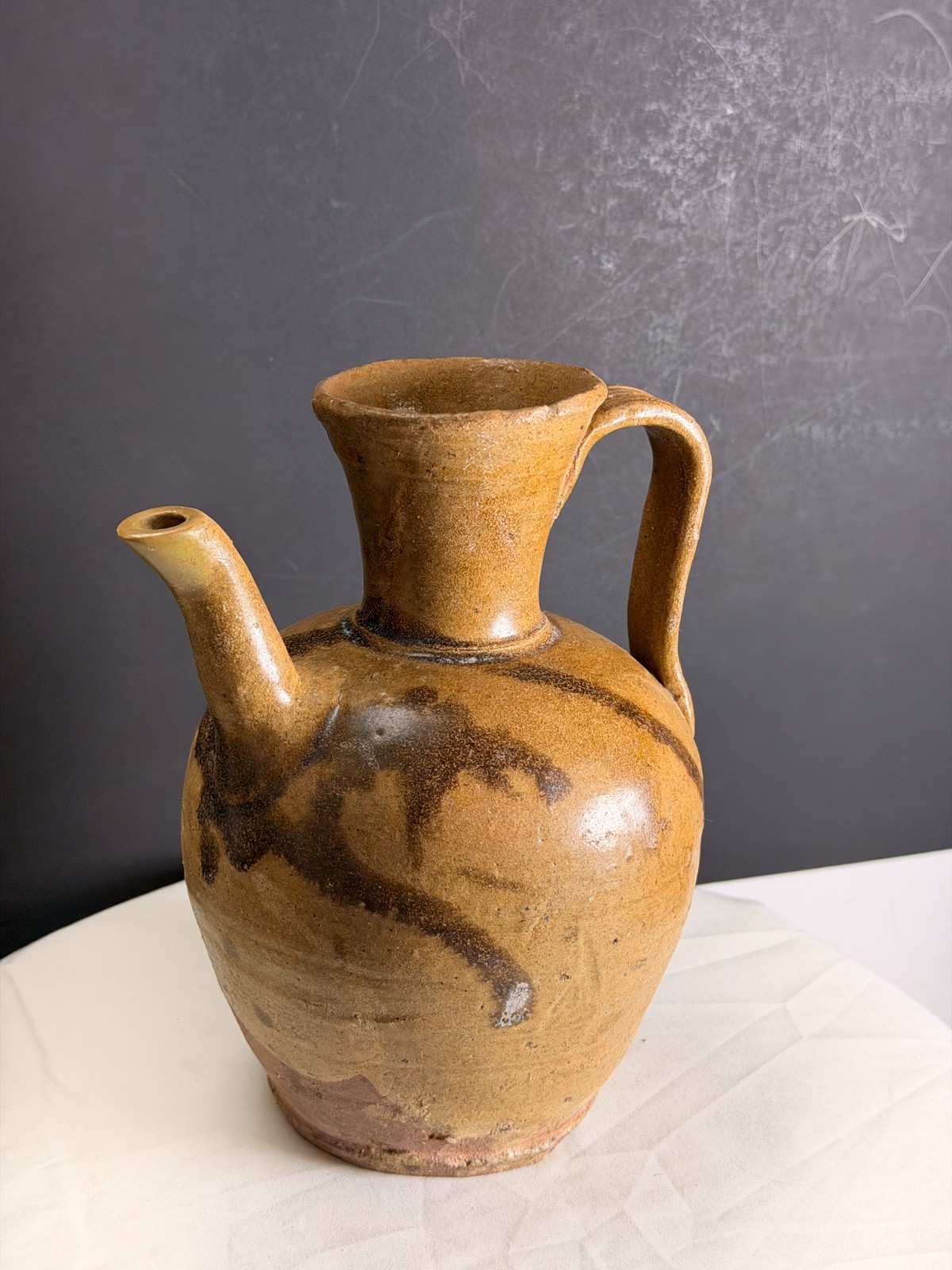
History: During the Han Dynasty, pottery production expanded significantly to meet the demand for mingqi—vessels made specifically for burial to serve the deceased in the afterlife. While high-fired celadons were developing in the south, lead-glazed earthenwares were common in northern and central China. This specific shape, with a stout body and an angled \"chicken-spout\" style (though this example is more utilitarian), became a precursor to the more elaborate ewers of the Tang Dynasty.
Context: These vessels were often used for serving wine or water. The inclusion of a handle and a functional spout marks a transition from simple storage jars to more specialized pouring vessels in Chinese ceramic history.
Form: A globular body with a flared neck and a prominent looped handle. The spout is positioned high on the shoulder, which is characteristic of early Chinese spouted vessels.
Glaze: The vessel features a thin, ochre-colored glaze that stops short of the base ( Ochre-colored glaze is a ceramic finish, often in warm yellow to caramel brown tones, achieved by adding natural iron-rich earth pigments (ochre) or iron oxide to a glaze base. It is primarily made by blending iron oxide/hydroxide with silica and clay,) revealing the reddish-buff clay underneath. The dark, mottled \"splashes\" or drips on the shoulder may be intentional decorative elements or the result of ash falling on the piece during firing (ash-glaze).
Dimensions: At 7.75” x 6.25” x 5.25”, it is a compact, well-proportioned \"cabinet size\" piece that would have been a standard utilitarian size for the period.
Condition: The visible wear and the unglazed foot showing the earthen core are typical of excavated antiquities. The minor glaze loss and surface abrasions are consistent with its age.The \"Time Capsule\" Effect (Tombs)
The vast majority of Han Dynasty pottery found today was not kept above ground in homes; it was found in sealed tombs.
Purpose: These items were mingqi (spirit goods), meant to serve the deceased in the afterlife.
Environment: Once a tomb was sealed, the items were protected from the primary causes of decay: UV light, oxygen, and fluctuating weather.
Stability: In many Chinese regions, the deep burial and the construction of brick or stone tomb chambers created a stable micro-climate. This prevented the clay from becoming brittle or the glaze from flaking off due to moisture cycles.
2. Material Science: Lead Glazes
The Han Dynasty was a pioneer in using lead-based glazes.
Durability: Lead glaze melts at a low temperature but creates a very hard, glass-like coating. This coating acts as a protective shield for the porous earthenware underneath.
Chemical Change: Over centuries underground, these glazes often develop a \"silvery\" or \"iridescent\" sheen (called patination). While your piece has a more earthy, ochre finish, that layer of glaze is what kept the liquid and dirt from staining or degrading the core of the pot.
3. High-Quality Clay Preparation
The Han potters were experts at levigation—a process where they mixed clay with water and let the heavy impurities settle out.
This resulted in a very fine, homogenous material that was less likely to crack during the firing process or over time.
Because the clay was so well-refined, the body of the piece remains structurally sound even after two millennia.
4. Professional Restoration
It is very common in the antiquities market for pieces to have undergone professional \"sympathetic\" restoration.
Many items are found in fragments (due to tomb collapses) and are meticulously pieced back together.
High-level restoration can be nearly invisible to the naked eye, making a piece look like it was never broken.
Where were they found?
Most of these items originate from archaeological sites or construction projects in the Henan, Shaanxi, and Jiangsu provinces of China. These areas were the heart of the Han Empire (near ancient capitals like Luoyang and Chang\'an). During China’s rapid urbanization over the last few decades, many of these \"lost\" tombs were uncovered during the building of roads and foundations, leading to a significant amount of this pottery entering the market.old small chip at rim, werar consistent with age.Although we do our best to research and present information and data accurately on all of these collectible estate items we are not appraisers curators or authenticators. Please offer accordingly; All estate items are non returnable non refundable sold as-is where-is with no warranties expressed or implied.