When you click on links to various merchants on this site and make a purchase, this can result in this site earning a commission. Affiliate programs and affiliations include, but are not limited to, the eBay Partner Network.
Greek Coin of the SELEUCID KINGDOM
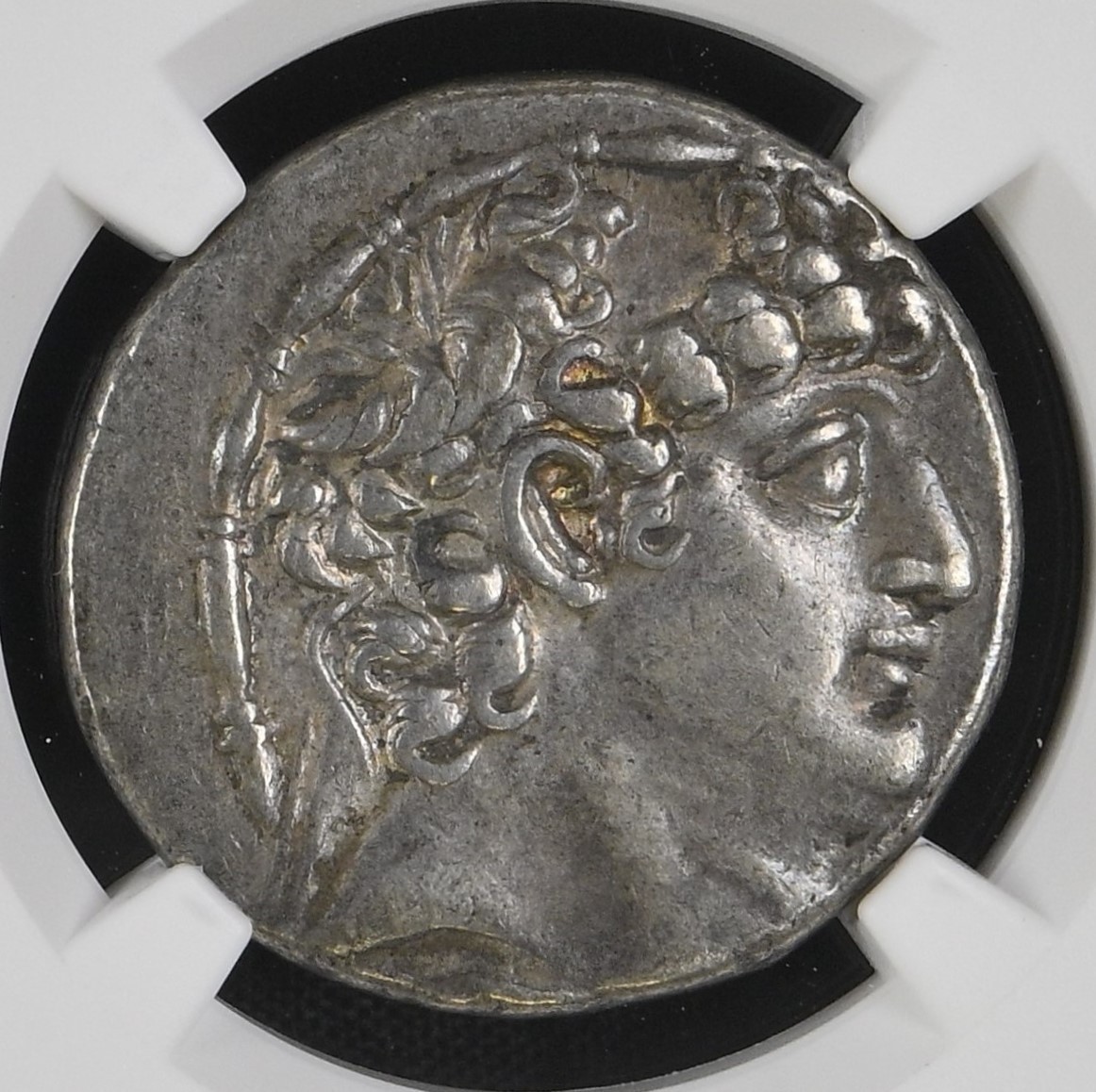
Philip I Philadelphus (Circa 95/94 BC - 76/75 BC)Struck 95 BC - 75 BC as a Lifetime or Posthumous issue of Antioch on the Orontes or an Eastern mint
Silver AR Tetradrachm (26mm, ~16 grams, 11h)
Reference:SC 2464
NGC Certification: Choice VF6828912-004
Obverse:Diademed head of Philip I facing right, with bulging eyes and pouting lips, diadem ties falling straight behind; bead-and-reel borderReverse:ΒΑΣΙΛΕΩΣ / ΦΙΛΙΠΠΟΥ / ΕΠΙΦΑΝΟΥΣ / ΦΙΛΑΔΕΛΦΟΥ, Zeus enthroned left, right leg drawn back, Nike right in outstretched right hand, grounded scepter in left; frozen ΛI monogram under throne, Π(?) in exergue, all in laurel borderArrives with specifications page for your reference
See theGenuine HistoryCollection
Philip I Epiphanes Philadelphus(Ancient Greek: Φίλιππος Ἐπιφανής Φιλάδελφος; between 124 and 109 BC–83 or 75 BC)was a Hellenistic Seleucid monarch who reigned as the king of Syria from 94 to either 83 or 75 BC. The son of Antiochus VIII and his wife Tryphaena, he spent his early life in a period of civil war between his father and his uncle Antiochus IX. The conflict ended with the assassination of Antiochus VIII; Antiochus IX took power in the Syrian capital Antioch, but soon fell in battle with Antiochus VIII's eldest son Seleucus VI.
After the murder of Seleucus VI in 94 BC, Philip I became king with his twin brother Antiochus XI, and planned to avenge Seleucus VI. In 93 BC Antiochus XI took Antioch from Antiochus IX's son Antiochus X. Antiochus XI became the senior king, and Philip I remained in a base in Cilicia. Antiochus X returned and killed Antiochus XI that year. Philip I then allied with his younger brother Demetrius III, who was based in Damascus. Antiochus X was probably killed in 88 BC. Demetrius III took the capital and besieged Philip I in Beroea, but the latter prevailed and took Antioch; their youngest brother Antiochus XII took Damascus.
Philip I tried unsuccessfully to take Damascus for himself, after which he disappears from the historical record; there is no information about when or how he died. The Antiochenes, apparently refusing to accept Philip I's minor son Philip II as his successor, invited Tigranes II of Armenia to take the city. While the invasion of Tigranes II is traditionally dated to 83 BC, the year most scholars agree on for Philip I's death, the conflict may have taken place in 74 BC. Numismatic evidence and clues in ancient contemporary literature indicate that Philip I might have died in 75 BC, giving Antiochus X's widow Cleopatra Selene and her son Antiochus XIII, who probably took control of the south following the death of Antiochus XII in 82 BC, a year of claiming the whole kingdom. Philip I initiated monetary reforms, and his coins remained in circulation until the Romans conquered Syria in 64 BC. Thereafter, Roman authorities in Syria continued to issue coins modeled on Philip I's coins, including his portrait, until 13 BC.
The Seleucid dynasty which ruled Syria following the death of Alexander the Great was plagued by dynastic feuds during the 2nd century BC, exacerbated by Ptolemaic and Roman interference. Dynastic marriage was used to maintain a degree of peace between Ptolemaic Egypt and Syria; Ptolemaic princess Cleopatra Thea became the consort of three successive Syrian kings in 150, 145 and 138 BC. Syria gradually disintegrated due to constant civil wars, as the Seleucid kings and their heirs fought for power, tearing the country apart. This lasted until about 123 BC, when Antiochus VIII provided a degree of stability which lasted for a decade until his brother Antiochus IX declared himself king.
With his Ptolemaic wife Tryphaena, whom he married in 124 BC, Antiochus VIII fathered five sons: Seleucus VI, the eldest; Antiochus XI and Philip I, who were apparently twins; their younger brother, Demetrius III; and the youngest, Antiochus XII. The name Philip means “lover of horses”. Seleucid kings were mostly named Seleucus and Antiochus; “Philip” was used by the Antigonid dynasty as a royal name, and its use by the Seleucids, who were descended from the Antigonids through Queen Stratonice, was probably meant to signify that they were heirs of the latter. The war with Antiochus IX claimed Tryphaena’s life in 109 BC. Following Antiochus VIII’s assassination in 96 BC, his second wife, Tryphaena’s sister Cleopatra Selene, married Antiochus IX, who took Antioch. Antiochus VIII’s sons did not submit to their uncle; Seleucus VI took Antioch in 95 BC after killing Antiochus IX, while Demetrius III seized and ruled Damascus. Antiochus IX’s son Antiochus X married Cleopatra Selene and defeated Seleucus VI, who escaped to Mopsuestia, where he was killed by rebels in 94 BC.
Philip I and Antiochus XI probably resided in Cilicia during Seleucus VI’s reign. In 94 BC, shortly after their brother’s death, Philip I and Antiochus XI minted jugate coins with their portraits on the obverse. The historian Alfred Bellinger suggested that their base of operations was a coastal city north of Antioch, but according to the numismatist Arthur Houghton, Beroea is a stronger candidate because the city’s rulers were Philip I’s allies. All the jugate coins were minted in Cilicia; the series with the most numerous surviving specimens was probably issued in Tarsus, making it the likely base of operations. Antiochus XI was portrayed in front of his brother, indicating that he was the senior king. Deriving their legitimacy from Antiochus VIII, the brothers were depicted on the coins with exaggerated aquiline noses similar to their father. Hellenistic kings did not use regnal numbers, which is a modern practise; instead, they used epithets to distinguish themselves from similarly named monarchs. On his coins, Philip I used the epithets Philadelphus and Epiphanes. The brothers intended to avenge Seleucus VI; according to Eusebius, they sacked Mopsuestia and destroyed it.
While Philip I remained in Cilicia, Antiochus XI advanced on Antioch and drove Antiochus X from the city in the beginning of 93 BC. Philip I did not live in the Syrian metropolis and left Antiochus XI as master of the capital. By autumn 93 BC, Antiochus X regrouped and defeated Antiochus XI, who drowned in the Orontes. Josephus mentioned only Antiochus XI in the battle, but Eusebius wrote that Philip I was also present. Bellinger believed that Philip I’s troops participated, but that he remained behind at his base, since only Antiochus XI was killed. Following the defeat, Philip I is thought to have retreated to his capital, which was probably the same base from which he and his brother operated when they first prepared to avenge Seleucus VI. Antiochus X eventually controlled Cilicia, and Philip I probably took Beroea as his base.
Demetrius III may have marched north to support Antiochus XI in the battle of 93 BC, and he certainly supported Philip I in the struggle against Antiochus X. Eusebius wrote that Philip I defeated Antiochus X and replaced him in the capital in 93/92 BC. However, Eusebius does not note the reign of Antiochus XI or mention Demetrius III. The account contradicts archaeological evidence, represented in a market weight belonging to Antiochus X from 92 BC, and contains factual mistakes. Edgar Rogers believed that Philip I ruled Antioch immediately after Antiochus XI, but suggestions that Philip I controlled Antioch before the demise of Antiochus X and Demetrius III can be dismissed; they contradict the numismatic evidence, and no ancient source claimed that Demetrius III, who actually succeeded Antiochus X in Antioch, had to push Philip I out of the city.
In any case, Antiochus X disappeared from the record after 92 BC, but could have remained in power until 89/88 BC; he probably died fighting against Parthia. Taking advantage of Antiochus X’s death, Demetrius III rushed to the capital and occupied it; this led Philip I to break his alliance with his brother. With most of Syria in the hands of Demetrius III, Philip I retreated to his base. In 88 BC, Demetrius III marched on Beroea for the final battle with Philip I. To raise the siege, Philip I’s ally Straton, the ruler of Beroea, called on the Arab phylarch Aziz and the Parthian governor Mithridates Sinaces for help. The allies defeated Demetrius III, who was sent into captivity in Parthia. Any captive who was a citizen of Antioch was released without a ransom, a gesture which must have eased Philip I’s occupation of Antioch.
Shortly after the battle, in late 88 BC or early 87 BC, Philip I entered the Syrian capital, and had Cilicia under his authority. He was faced with the need to replenish the empty treasury to rebuild a country destroyed after years of civil war, and in case a new pretender to the throne arose. Those factors, combined with the low estimates of annual coin dies used by Philip I’s immediate predecessors in Antioch—Antiochus X and Demetrius III—compared with the general die estimates of late Seleucid kings, led numismatist Oliver D. Hoover to propose that Philip I simply re-coined his predecessors’ coins and skewed their dies. This resulted in currency bearing Philip I’s image, reduced in weight from the standard 1,600 g to 1,565 g. This yielded a profit of half an obol on each older coin which was re-struck. Profit was, however, not the main aim of Philip I; it is more probable that he wanted to pay his troops with coins bearing his own image instead of that of his rivals. The recoinage was also necessary since Philip I’s coins were reduced in weight and the king needed to enforce the use of his currency by removing his rivals’ heavier coins out of circulation. Philip I may have adopted the New Seleucid era dating, which have the return of Antiochus VIII from his exile in Aspendos in 113/112 BC as a starting point; the traditional Seleucid era started in 312/311 BC.
Philip I’s position on the throne was insecure: Cleopatra Selene hid in Syria with Antiochus XIII, her son by Antiochus X, waiting for an opportunity to regain the throne, while Antiochus XII replaced Demetrius III in Damascus, but there is no evidence that he sought to compete with his brother for Antioch. According to Josephus, Philip I took advantage of Antiochus XII’s absence in a campaign against Nabataea to seize Damascus. The governor of the city—Milesius, who opened the gates for Philip I—was not given a suitable reward by his new master, leading him to wait until Philip I left the city; he then closed the gates, locking the king out until Antiochus XII returned. In the Seleucid dynasty, currency struck during campaigns against a rival showed the king with a beard. Antiochus XII was shown beardless for the first two years of his reign; in 85/84 BC, he appeared with a beard, possibly related to Philip I’s attack on Damascus. But since Antiochus XII did not march north against his brother, the hypothesis about a connection between Antiochus XII’s beard and Philip I’s attempt to take Damascus weakens; no coins of Philip I were struck in Damascus, indicating that his occupation of the city was brief.
After the attack on Damascus, Philip I disappeared from ancient literature. Without proof, 83 BC is commonly accepted as Philip I’s year of death by most scholars; he could have been buried in the Nikatoreion Mausoleum, Seleucia Pieria. Traditionally, Philip I is considered by most scholars to have been succeeded by Tigranes II of Armenia, who was invited by the people of Antioch despite the existence of Philip I’s probably-minor son Philip II. Appian assigned a fourteen-year reign to Tigranes II which ended in 69 BC, and most scholars accepted the ancient historian’s version, hence the date 83 BC. The fate of Philip I is a source of debate in academic circles, as no clues regarding how, where, and when his life ended exist.
An inscription of Philip II was found in Olba, the capital of a Cilician priestly principality. Auguste Bouché-Leclercq concluded that Philip I could not have returned to the capital following his defeat in Damascus because the populace became weary of the endless Seleucid dynastic quarrels. Bouché-Leclercq conjectured, based on the inscription of his son, that Philip I might have escaped to Cilicia and died in the chaos caused by the Second Mithridatic War between Mithridates VI of Pontus and Rome. Another possibility is that Philip I was preparing to take back his throne after the death of Antiochus XII, but was caught off guard by the arrival of Tigranes II and put to death in Cilicia. Theodora Stillwell MacKay suggested that Philip I fled to Olba following his confrontation with Antiochus XII. Josef Keil and Adolf Wilhelm suggested that Philip I stayed with the priest-prince of the city.
According to Bellinger, the silence of ancient literature might be an indication of a peaceful reign that was perhaps facilitated by Philip I’s alliance with Parthia; this would explain the massive amount of silver coinage produced by Philip I found as far as Dura-Europos, which was under Parthian rule. Appian’s account is flawed, and contradicts contemporary accounts, notably Cicero, who wrote in 75 BC that Cleopatra Selene sent Antiochus XIII to Rome to appeal for his right to the Egyptian throne; he did not have to appeal for his rights to Syria which, in the words of Cicero, he inherited from his ancestors. Cleopatra Selene and her son probably took advantage of Antiochus XII’s death in 82 BC to assume control of the south. The statement of Cicero indicates that in 75 BC, Tigranes II was still not in control of Syria, for if he were, Antiochus XIII would have asked the Roman Senate for support to regain Syria, since Tigranes II was the son-in-law of Rome’s enemy, Mithridates VI. Likewise, Philip I could not have been alive since Antiochus XIII went to Rome without having to assert his right to Syria.
The argument for a later Armenian invasion is corroborated by Josephus, who wrote that the Jews heard about the Armenian invasion and Tigranes II’s plans to attack Judea only during the reign of the Hasmonean queen Salome Alexandra, which began in 76 BC; it would be odd if Tigranes II took control of Syria in 83 BC and the Jews learned about it only after 76 BC. Another point of argument is the massive quantity of coinage left by Philip I, which could not have been produced if his reign was short and ended in 83 BC. In light of this, Hoover proposed 75 BC, or slightly earlier, as Philip I’s last year; this would be in line with Cicero’s statement about Antiochus XIII. Hoover suggested the year 74 BC as the date of Tigranes II’s invasion, giving Cleopatra Selene and her son time to claim the whole country.
Philip I Philadelphus' realm circa 87 BC