When you click on links to various merchants on this site and make a purchase, this can result in this site earning a commission. Affiliate programs and affiliations include, but are not limited to, the eBay Partner Network.
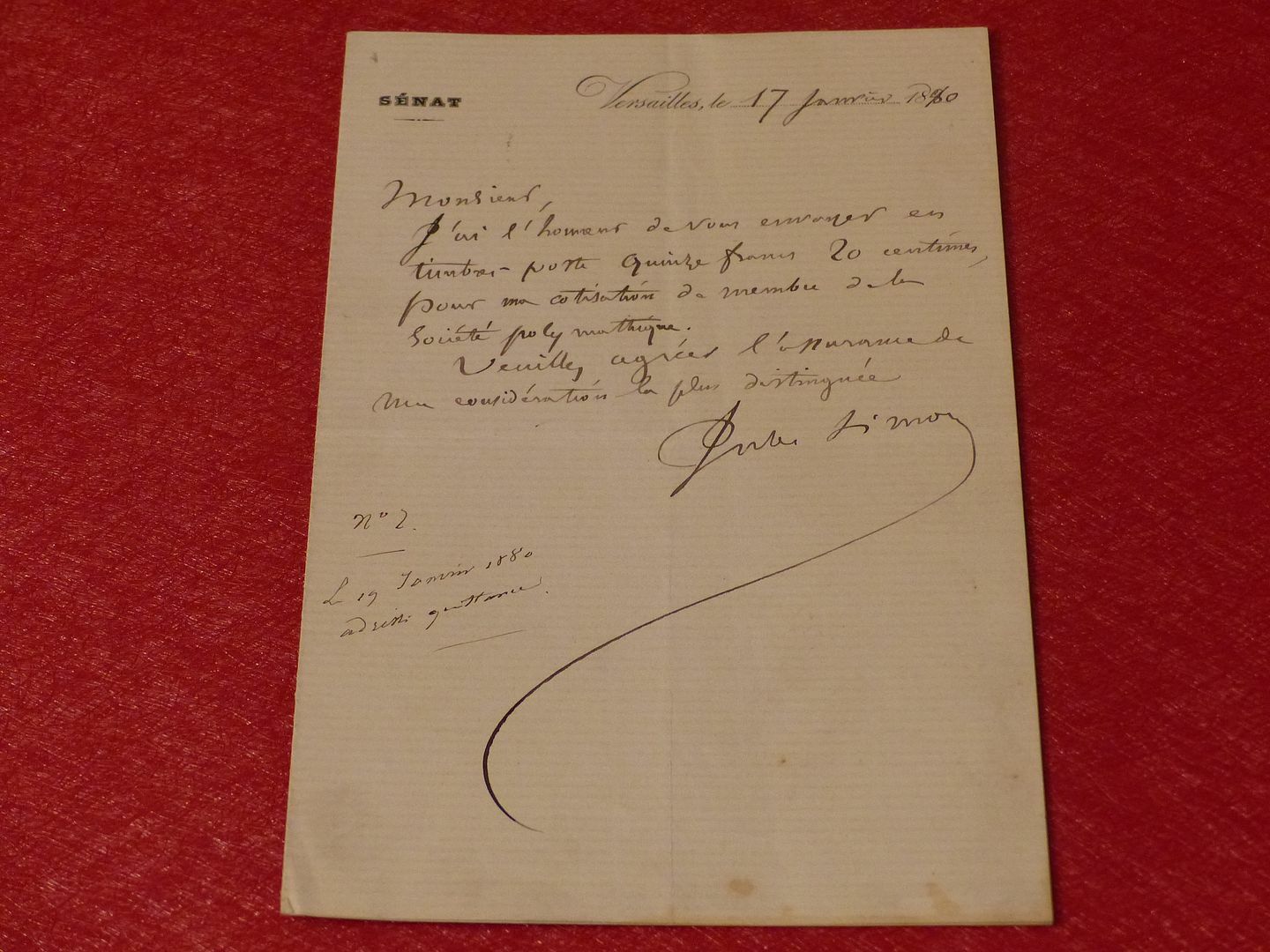
[SIGNED AUTOGRAPH LETTER - STATESMEN -POLICY FRENCH 20th century]
-
On white Senate letterhead
\"Renewal of the contribution of member of the Polymathic Society...\"
Without doubt the Polymathic Society of Morbihan (learned society located in Vannes), created in 1826 Initially limited to the collection of natural science samples until around 1850, the work of scholars then focused on archaeological excavations and led to the discovery of more than a hundred sites or monuments, from all periods combined. This resulted in the creation of an archaeological museum in 1853 and the constitution of an exceptional collection, made up of around 45,000 objects, specimens or samples, among the most beautiful in Brittany.This learned society was one of the main actors in the preservation of numerous archaeological sites such as for example the one which remains the most emblematic, the Carnac Site...
Jules SIMON1860-1937
Jules Simon President of the French Council of Ministersand Minister of the InteriorDecember 12, 1876 – May 17, 1877(5 months and 5 days)GovernmentSimon Immovable senatorDecember 13, 1875 – June 8, 1896(20 years, 5 months and 26 days) Jules-François-Simon Suisse, known as Jules Simon, is a French philosopher and statesman, born December 27, 1814 in Lorient (Morbihan) and died June 8, 1896 in the 8th arrondissement of Paris.
BiographyYouth and trainingJules Simon is the son of Alexandre-Simon Suisse, a cloth merchant from Loudrefing in Lorraine (1768-1843), first established in Lorient, then in Saint-Jean-Brévelay (1818) and finally in Uzel. A Protestant, he renounced his religion to marry for his second marriage a Catholic Breton, Marguerite Vincente Fontaine (1775-1845), who is the mother of Jules Simon.
After good studies at the colleges of Lorient and Vannes (today Jules-Simon college), he became a tutor at the Rennes high school. He began working at an early age on the Revue de Bretagne. He entered the École Normale in 1833 and became a professor of philosophy in Caen (1836) then in Versailles (1837). Agrégé then doctor in philosophy, he replaced Victor Cousin in his chair at the Sorbonne, where he gave a well-attended course on Greek philosophers, notably Plato and Aristotle.
Republican commitmentJules Simon collaborated with the Revue des Deux Mondes and founded, with his friend Amédée Jacques, Liberté de pensee (1847). Having thought about politics and, despite a most active electoral campaign, he failed in the legislative elections in Lannion in 1847 against the coalition of extreme right and extreme left parties. He took his revenge, and a brilliant revenge, on April 23, 1848. The Côtes-du-Nord department sent him to the Constituent Assembly where he sat among the moderates.
Republican deputy to the constituent assembly of 1848, he published studies on the university question and freedom of education.
Opponent of the Second Empire
On December 7, 1851, just a few days after the coup d\'état of December 2 establishing the Second Empire, Jules Simon went to his class at the Sorbonne and delivered the following speech, which became famous:“Gentlemen, I am giving you a moral lesson here. I owe you today not a lesson, but an example. France is summoned tomorrow to its elections to blame or approve of the events that have just happened. If there was only one vote of censure, I come to tell you publicly that it will be mine. »
He was dismissed the next day and consequently deprived of his lecture at the École Normale Supérieure. He first retired to Nantes where he used his leisure time in historical research. To mark his opposition to the Empire, he published Le Devoir (1854), which had an enormous impact. Soon followed The Natural Religion (1856), Freedom of Conscience (1857), Freedom (1859), and a series of conferences on questions of philosophy, law and finally political economy.
He is also the first liberal to be interested in the labor question, whose abuses he denounces. in a series of books that were very popular in their time.
Elected on June 1, 1863, deputy for the Seine department, Jules Simon joined the liberal opposition group in Parliament, then led by Jules Favre. His free trade convictions made him chosen by the inhabitants of Bordeaux to represent them in the deputation: on May 24, 1869, Jules Simon is elected deputy for Gironde.
Member of the Government of National DefenseDuring the war of 1870, he became minister of public education, religion and fine arts in the provisional government the day after September 4, 1870. “There is no neutral school,” he said, “because there is no teacher who does not have a religious or philosophical opinion.”
Parliamentary and ministerial career under the Third Republic
Jules Simon, knowing how to be authoritarian in gentle and friendly ways, restores order to the University and forces Francisque Bouillier and Octave Feuillet to resign. He submitted the compulsory primary education project and abruptly withdrew on April 17, 1873 following an official speech in which he attributed in Thiers alone the work of liberating the territory, a speech which arouses in the Assembly national debate of fairly lively controversies.
On December 16, 1875, he was elected permanent senator and on the same day a member of the French Academy.
On December 13, 1876, he took over the presidency of the council and the portfolio of the Interior. In the speech announcing his ministerial program, which he delivered to obtain the nomination of the Assembly, a sentence became historic, the one in which he declared himself “profoundly republican and resolutely conservative”.
In the difficult period that the country was going through at the time, Jules Simon represented a policy of conciliation between the right and the extreme left, very agitated by the religious question. He created the family record book in a circular of 1877. Simon cannot maintain the equal balance between the parties and his ministry for long ended following the crisis of May 16, 1877.
Jules Simon, in the Senate, continued to deal mainly with questions of education and fought the decrees on congregations. During his last official mission, of great brilliance, he represented France at the Berlin international conference on Labor on March 15, 1890.
-
1 sheet of paper, folded in the center forming 4pp.,1 handwritten page
(folded: about 21x13.5cm)
Versailles, January 17, 1880
-
[Provenance from Georges or Louis Boulay]
-
Good general condition, various minor usual defects
cf. visuals...
-
Beautiful rare document
As always, combined shipping costs in case of multiple purchases...
Initially limited to the collection of natural science samples until around 1850, the work of scholars then focused on archaeological excavations and led to the discovery of more than a hundred sites or monuments, from all periods combined. This resulted in the creation of an archaeological museum in 1853 and the constitution of an exceptional collection, made up of around 45,000 objects, specimens or samples, After good studies at the colleges of Lorient and Vannes (today Jules-Simon college), he became a tutor at the Rennes high school. He began working at an early age on the Revue de Bretagne. He entered the École Normale in 1833 and became a professor of philosophy in Caen (1836) then in Versailles (1837). Agrégé then doctor in philosophy, he replaced Victor Cousin in his chair at t Recommended products Provided by Signed Autograph Letter Henri Gouhier (Philosopher Historian) 1929 View product Signed Autograph Letter Jules Claretie (Comédie Française) 1892 2pp. View product Signed Letter Autographed Theodore Steeg (Politician) 1919 View product Signed Letter Autographed Auguste Ranson (Politician) 1919 View product Signed Letter Autographed Emmanuel Evain (Politician) 1920 View product Signed Letter Autographed By RAYMOND POINCARE (Politician Statesman) 1921 View product Signed Letter Autograph + Cdv Emile Maruejouls (Politician) 1895 View product Signed Letter Autograph Amaury-Duval (French Painter) Ca 1880 View product