When you click on links to various merchants on this site and make a purchase, this can result in this site earning a commission. Affiliate programs and affiliations include, but are not limited to, the eBay Partner Network.
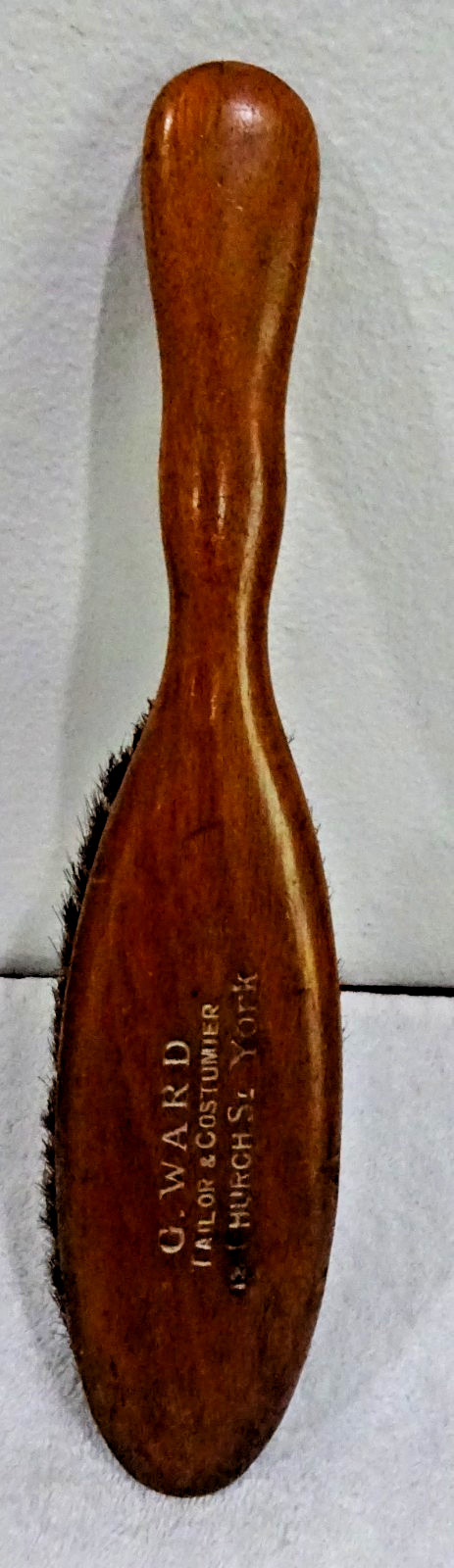
This is a late Victorian wooden clothes brush associated with G. Ward, Tailor & Costumier, at 12 Church Street, York (England).
History
Clothes brushes were standard grooming tools for Victorian and Edwardian gentlemen (and in tailoring shops). They removed dust, lint, hair, and debris from wool suits, overcoats, and other garments. Natural bristles (typically horsehair or similar animal hair) set into a polished wooden handle were common; some had dual sides or softer/harder sections.
This example is a promotional or shop-use brush stamped for G. Ward’s business at 12 Church Street, York. Church Street was rebuilt in the 1830s as part of York’s central shopping area (replacing the earlier Girdlergate). Nos. 12 and 12A form a Grade II listed pair of buildings dating to 1836–1839, with later shopfront alterations—typical for a tailor’s premises in a busy commercial street.
York has a long tailoring tradition (Merchant Taylors’ guild from medieval times; various high-street tailors and outfitters into the 20th century, including nearby examples like W. Mackinder on Church Street). G. Ward operated as a tailor and costumier (making or altering clothing, including possibly theatrical or formal wear) at this address. The brush was likely used in the shop to finish garments and/or given to customers as a branded advertising item—common practice for clothiers and tailors of the period.
The dense dark bristles and polished hardwood match typical British-made examples of the era. Exact operating dates for Ward’s business are not well-documented in readily available sources, but the style and address point firmly to the Victorian/Edwardian period.