When you click on links to various merchants on this site and make a purchase, this can result in this site earning a commission. Affiliate programs and affiliations include, but are not limited to, the eBay Partner Network.
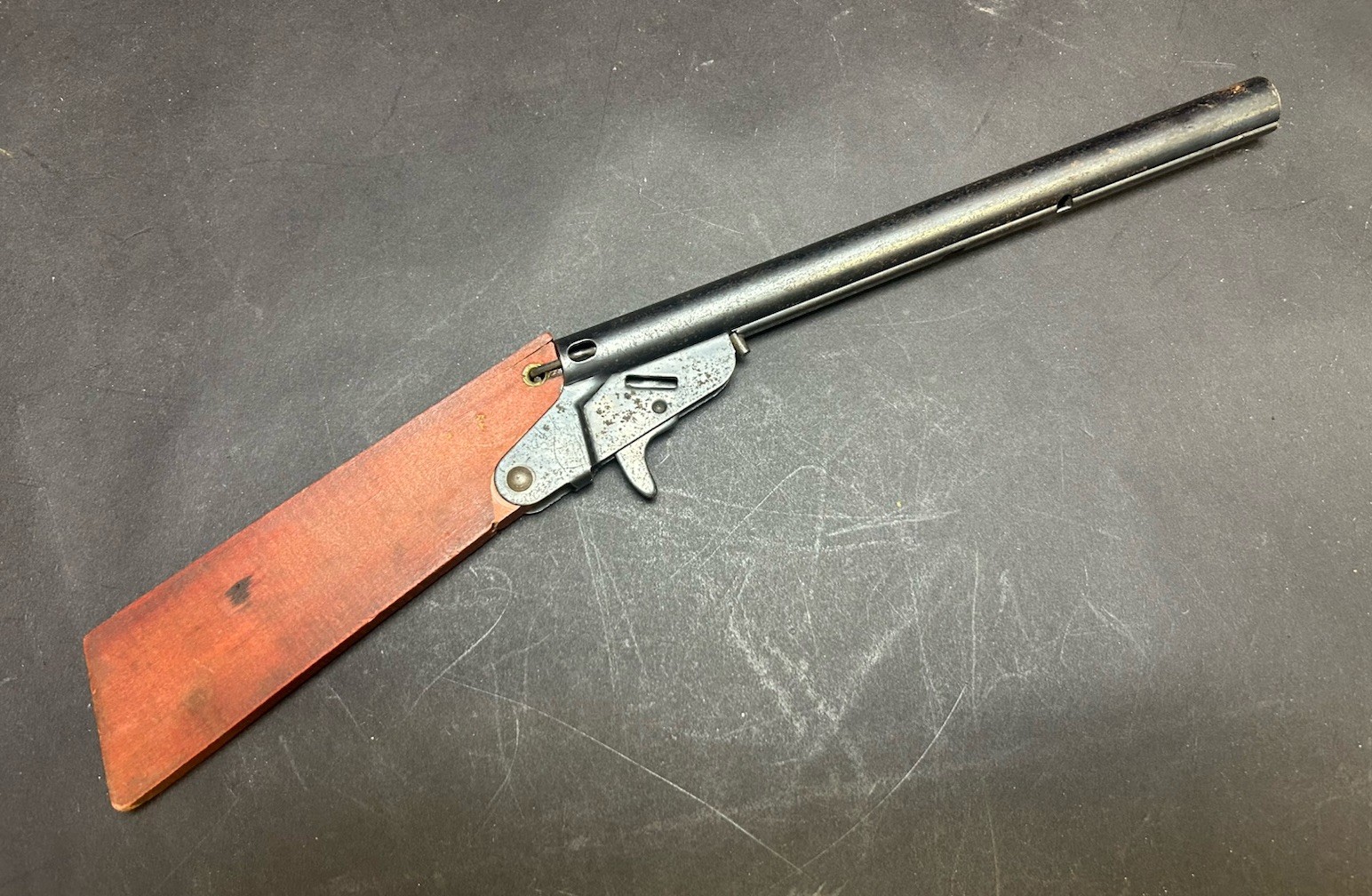
1930's Daisy Cork
This listing complies with ’s air gun guidelines found here and I will only sell and ship air guns to buyers in jurisdictions where permitted by applicable laws
Excellent condition. Powerful spring action. We found this on its original package backing but without the actual retail package. See photos and video for actual condition. Feel free to ask question.
Approximate dimensions:
13 1/4" long
Vintage break-action cork pistol/pop gun produced by the Daisy Manufacturing Company out of Plymouth, Michigan.
The Era and Design (1930s)
• The Patents: These small, break-action toy pistols feature the stamped U.S. Patent number 1,830,291, which was officially granted in 1931. They were actively produced through the 1930s.
• The "Flat" Wood Stock: Unlike the thick, rounded wood stocks found on standard BB guns, this toy was designed to be highly affordable during the Great Depression. It utilized a distinct flat, stamped piece of wood for the grip attached to a simple pressed-steel mechanism and barrel.
• The Mechanism: To cock the gun, the user bends the barrel downward at the hinge (break-action) until the internal spring catches. A cork ball or tethered cork was pushed into the muzzle. Pulling the trigger released the spring-loaded plunger, forcing air through the barrel to launch the cork with a loud "pop".
Context in Toy History
• The Rise of the Pop Gun: Commercial pop guns emerged in the mid-to-late 19th century as a safer, quieter alternative to paper-cap guns.
By the early 20th century, Michigan became a hub for this industry, led by companies like Daisy (Plymouth) and Wyandotte (All Metal Products Co.).
• Depression-Era Ingenuity: During the 1930s, toy makers had to strip down designs to keep costs to a minimum. This resulted in minimalist toys like this one, using fewer pieces of formed steel and flat, unfinished or minimally stained wood slabs instead of complex cast iron or carved wooden grips
We take GREAT PRIDE in our CUSTOMER SERVICE!
Please leave POSITIVE response - We will do the same!
Before leaving NEGATIVE or NEUTRAL response, PLEASE CONTACT US so we can address whatever issue you might have with your purchase.
WE WILL MAKE IT RIGHT!