When you click on links to various merchants on this site and make a purchase, this can result in this site earning a commission. Affiliate programs and affiliations include, but are not limited to, the eBay Partner Network.
Remember When Tampa Bay Baseball Was Brand New — and the Stingray on Your Fan Was Still a Devil? 🐟
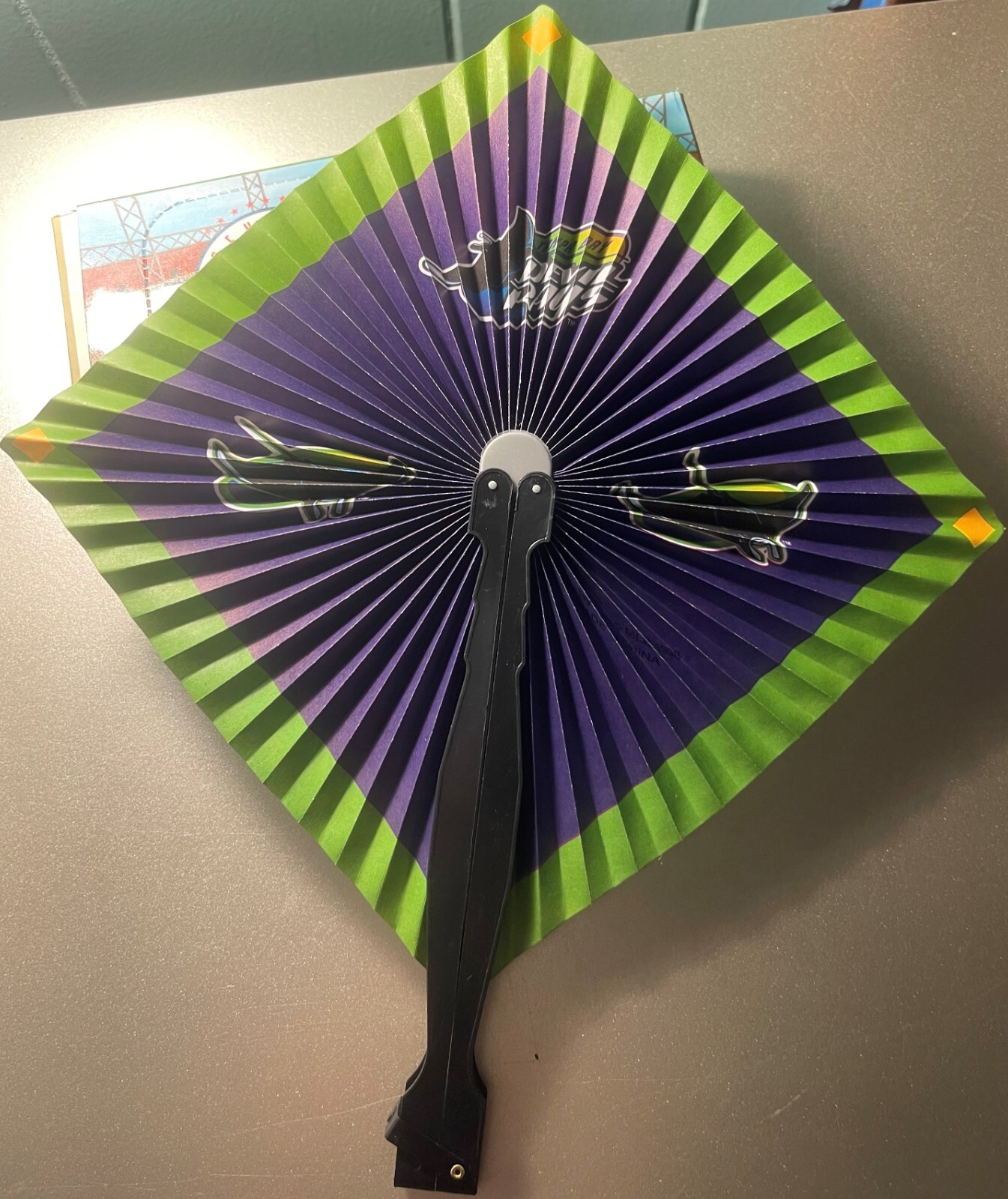
There is something genuinely electric about holding a piece of sports history from a team\'s earliest days — before the dynasty talk, before the rebranding, before anyone outside of Florida quite knew what a \"Devil Ray\" even was. This folding hand fan is exactly that: a vivid, color-saturated souvenir from the window in time when Tampa Bay introduced itself to Major League Baseball under a name it would carry for only a single decade. Purple and green, bold and unapologetic, with that original rainbow devil-ray logo fanning out across pleated paper — it is a snapshot of late-1990s to early-2000s Florida baseball culture that you simply cannot conjure from a box score or a highlight reel. I pulled these directly from the original dealer box, new old stock, unissued, and I grabbed them because I could not stand the thought of them disappearing. I hope you feel the same way.
Closed, the fan measures approximately 6¾ inches long. Fully opened it spreads to roughly 11 inches wide by 9½ inches tall — a proper, wave-it-through-nine-innings size. The paper body is lithographed in offset color printing: deep purple at the center, bright green at the pleated edges, with the Devil Rays\' original rainbow devil-ray logo and team name printed across the face. The handle is black plastic, sturdy and well-fitted, built to be used at real games rather than just admired on a shelf. It is New Old Stock (NOS), pulled from the original dealer box — the same box printed with the MLB \"Genuine Merchandise\" logo, a stadium scene, a baseball glove, and the product code JJ004 DVR (where \"DVR\" identifies the Devil Rays), with a secondary stock number of 77-710DR Dz. That \"Dz\" notation means the box shipped by the dozen — the standard packing format for the amusement-trade and sports-novelty distribution channels Play By Play served so well. The piece carries the MADE IN CHINA mark, consistent with the era\'s licensed sports novelty production.
⚾ The Name That Only Lasted a Decade: The Story of the Tampa Bay Devil Rays
Major League Baseball awarded Tampa Bay its franchise on March 9, 1995, and the team began play in the 1998 season. Despite carrying the \"Tampa Bay\" name, the club has always called St. Petersburg, Florida home, playing at the domed stadium now known as Tropicana Field — a geographic quirk that old-timers in the region will tell you reflected the political tug-of-war between the two cities over who got to claim the team.
The name itself came with its own founding drama. Majority owner Vince Naimoli initially wanted to call the franchise the Tampa Bay Sting Rays. The problem? A minor league baseball club in Maui, Hawaii — the Maui Stingrays — already held rights to that name and offered to sell those rights for $35,000. Naimoli declined the deal. Rather than pay, he pivoted to a different species entirely: the manta-style devil ray, and the Tampa Bay Devil Rays were born. Lore passed down among Florida baseball fans holds that the $35,000 Naimoli saved on naming rights became a minor footnote to history — because the name he chose instead became one of the most visually striking in the expansion era, and then vanished just as collectors were really paying attention.
That vanishing is the key to this fan\'s collectibility. Stuart Sternberg, who had purchased controlling interest in the team from Naimoli, changed the franchise name from the Devil Rays to simply the Rays following the 2007 season — a rebranding that swept away the purple-and-green color scheme, retired the devil-ray logos, and ended the \"Devil Rays\" era permanently after just ten seasons. The team\'s first decade was famously rough on the field: they finished in last place in the AL East in all but one of those years. But that underdog identity is precisely what makes early Devil Rays material so resonant to collectors now. This fan comes from the Devil Rays years that began in 1998, the only years this branding was ever in active use — and the combination of the original logo, the original colors, and the original name on a clean, unissued souvenir is something that grows harder to find with every passing season.
🏭 Play By Play Toys & Novelties, Inc. — The San Antonio Company That Dressed America\'s Ballparks
The \"Genuine Merchandise Major League\" mark on the box points directly to Play By Play Toys & Novelties, Inc., headquartered in San Antonio, Texas. By the late 1990s Play By Play was one of the largest suppliers of stuffed toys and novelties in the United States — a publicly traded company on the NASDAQ National Market (ticker: PBYP) that, two years after buying Ace Novelty for $44.7 million, reported about 736 employees and $178.1 million in sales for fiscal 1998. Its licensing portfolio was remarkable: Warner Bros., Paws (Garfield), Nintendo, Looney Tunes, Batman, Superman, Pokémon — and running alongside all of it, a robust line of professionally licensed sports team merchandise, the category this Devil Rays fan represents.
Play By Play\'s reach into ballparks and stadiums was driven by something most collectors don\'t think about: the carnival and amusement-trade prize market. The \"Dz\" (by-the-dozen) shipping notation on this fan\'s box is exactly the kind of packaging format that fed carnival midways, stadium souvenir stands, and prize-redemption counters across the country. Collectors of sports novelties from this era frequently note that Play By Play material turns up in the most unexpected places — not just at team stores, but at state fairs, boardwalk arcades, and minor league ballparks where bulk novelties were bought by the case and handed out game after game. Local legend in San Antonio holds that Play By Play\'s warehouse floors were a kind of unofficial museum of licensed Americana in the late 1990s, stacked floor to ceiling with every team, every character, every color.
👤 The Company Behind the Merchandise
Arturo Torres built Play By Play Toys as a vending-machine prize supplier (its 1998 annual report gives its Texas incorporation as 1992) — small novelties, bulk quantities, aimed at the coin-op and amusement trade he understood from the ground up.
Within a few years the company outgrew its origins. By May 1996 the company had grown large enough to acquire Ace Novelty Company of Bellevue, Washington for $44 million — a deal that vaulted Play By Play to the top of the American novelty industry virtually overnight. CFO Joe M. Guerra managed the company\'s public financials through its growth years and his name appears throughout the SEC filings of the period.
The decline came swiftly and coincides almost exactly with the era of this fan. On May 1, 2001, Play By Play received a NASDAQ Staff Determination notifying it that its securities would be delisted from the NASDAQ National Market, effective the following morning. By 2002 the brand had relocated its headquarters to Spain, and in 2006 the Spanish toy group FAMOSA acquired both Play By Play and the ride-on brand Feber. Since 2019 the Play By Play name has been part of the Famosa–Giochi Preziosi group, continuing in Europe. The San Antonio chapter — the chapter that made this fan — closed quietly in the early 2000s. What you hold is a product of that American company, that specific San Antonio operation, in its active years.
📰 Paper Fans, Baseball Summers, and a Promotion Era That Faded
Folding paper fans as baseball promotions belong to a tradition that stretches back to the hot, pre-air-conditioned days of open ballparks, when a giveaway that actually moved the air was considered a genuine service to the fan in the bleachers. By the time the Devil Rays era arrived in the late 1990s, the paper fan had become more nostalgia piece than practical necessity — but it retained a charm that plastic giveaways simply couldn\'t match. The pleated paper, the snap of it opening, the satisfying arc of the logo revealed as the folds spread out: there\'s a tactile and visual reward built into the object that no bobblehead or foam finger can replicate.
Collectors of vintage sports paper note that these items were never meant to survive. They were waved, bent, left under bleacher seats, rained on, folded into back pockets, and generally treated as disposable entertainment. An unissued example — genuinely new, from the original dealer case — is a different class of object. It represents the version of the item that never entered the wear-and-tear cycle of game day. The lithographed colors on this fan read exactly as they were printed, the folds are crisp, and the handle shows no friction wear from a summer afternoon\'s worth of waving. That\'s an excellent early example of licensed American sports Americana, and it\'s rarer than the original production numbers would suggest.
Lore passed down among Florida baseball memorabilia collectors holds that the early Devil Rays seasons produced a substantial wave of promotional merchandise — much of it now lost to the team\'s difficult first decade, when souvenirs from a last-place club didn\'t tend to be carefully preserved. The rebranding to \"Rays\" in 2008 drew a hard line: everything that said \"Devil Rays\" in the original purple-and-green became, retroactively, vintage. Dealers who had held NOS stock suddenly found themselves sitting on something worth keeping. I was fortunate enough to save these from Florida, and I\'m glad I did.
🔍 A Note on Codes and Dates
The box carries \"02 07\" on its illustrated scoreboard, but that is box art, not a date: Play By Play used the same box front for other teams\' fans, and a Red Sox dozen box shows the very same scoreboard. The fan itself dates it. It carries the Devil Rays\' original rainbow devil-ray logo, which the club used from its 1998 inaugural season until it was replaced in November 2000, so this fan was made between 1998 and 2000.
🖼️ Display Ideas
- 🏟️ Fully opened in a shadow box — mount the fan fully spread against a backing in the team\'s purple and green, framed with a photo of early Tropicana Field or the 1998 inaugural roster card for an instant shrine to that first season.
- 📚 Alongside your Devil Rays program and ticket stub collection — the fan\'s colors and logo are an exact match to the era\'s other printed materials, and it reads beautifully as a centerpiece for a display of 1998–2007 Tampa Bay memorabilia.
- 🐟 Closed in a display stand on a bookshelf — the folded profile of the fan shows the handle and the compressed pleats, a clean sculptural form that works well on a floating shelf between other signed or boxed pieces.
- 🎪 As part of a baseball paper-goods display — pair it with vintage pennants, scorecards, and promotional pamphlets from the expansion-era teams of the late 1990s; the fan adds dimension (literally) to a flat-goods wall.
- 🌴 In a Florida sports room or man cave — alongside Rays, Buccaneers, or Lightning material, it anchors the \"old Tampa Bay\" corner of a regional sports shrine and always draws a conversation about the name change.
🎁 Who Collects These
Tampa Bay Devil Rays fans who lived through that inaugural 1998 season and want to hold something tangible from the original era — before the rebrand, before the World Series runs, when it was all still new and purple and a little scrappy. MLB expansion-era collectors who focus on the franchises granted in the mid-1990s wave (Tampa Bay, Arizona, Colorado, Florida) and know how quickly early promotional material from those teams disappears. Vintage sports paper collectors who prize any clean, unissued licensed paper fan from the pre-digital promotion era. Play By Play Toys enthusiasts — and there is an active community of them — who collect the San Antonio company\'s sports-licensed output specifically, drawn to the company\'s remarkable rise and fall. And Florida sports history collectors more broadly: people who appreciate the St. Petersburg–Tampa Bay identity question, the Naimoli era, and the decade-long \"Devil Rays\" chapter as a distinct and fully documented piece of regional baseball lore.
❓ Frequently Asked Questions
Q: Is this the original \"Devil Rays\" branding or a later throwback design?
A: This is the original, period-correct Devil Rays branding — the original rainbow devil-ray logo and purple-and-green color scheme the club used from 1998 until November 2000. The team rebranded to the \"Rays\" after 2007 and retired this look entirely. This is not a throwback or a retro reissue; it is an original licensed product from that era.
Q: What does \"NOS\" mean, and does this fan come with the original box?
A: NOS stands for New Old Stock — meaning the fan was never issued to a consumer, sold from the case, or put in use. It comes from the original dealer box, shown in the photos for reference only — the box carried the MLB Genuine Merchandise branding, stadium artwork, product codes, and the Tampa Bay Devil Rays team logo, but the box itself is not part of this listing.
Q: What are the dimensions?
A: About 6¾ inches closed; roughly 11 inches wide by 9½ inches tall.
Q: Who made this fan — is it officially licensed?
A: Yes. It was produced by Play By Play Toys & Novelties, Inc. of San Antonio, Texas under an MLB license. Play By Play was one of the largest licensed novelty manufacturers in the United States during its active years and held licenses with multiple major sports leagues and entertainment properties.
Q: When was it made?
A: Between 1998 and 2000. The fan carries the Devil Rays\' original rainbow logo, used from the 1998 inaugural season until November 2000. The \"02 07\" on the box is part of its scoreboard artwork, not a date.
Q: Was this a stadium giveaway or a retail product?
A: The \"Dz\" (dozen) notation on the stock number strongly suggests it shipped through the amusement-trade, souvenir-stand, or sports-venue distribution channels that Play By Play served — meaning it was likely sold at games, concession areas, or sports retail rather than given away as a single-item promotion.
Q: Is the original box included?
A: No — this fan was saved from the original dealer case, and the box shown in the photos is where it came from, pictured for reference and provenance only. This listing is for one individual fan, not the box.