When you click on links to various merchants on this site and make a purchase, this can result in this site earning a commission. Affiliate programs and affiliations include, but are not limited to, the eBay Partner Network.
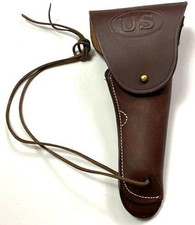
WWIIUSMC M1916 Holster
GRATON& KNIGHT MANUFACTURING CO.
1943
Worcester, Massachusetts
(forthe M1911A1 ACP)
U.S.M.C.,ARMY, AAF, U.S.N.
+This is a very handsome, “CombatServiceable,”mid-war, 1943-dated production Holster from G&K\'s first contract let in September 1943.
+ This Holster is legibly stamped on the reverse in san serif font:
U.S.
GRATON & KNIGHT CO.
1943
+ This one is in excellent structuralcondition! It shows evidence of very careful use and possesses the \"authenticating patina\" of actual use in theater.
+Sixteen contractors,combined, manufactureda wartime total of ofalmost two million (1,830,536)M1916Holsters ata per unit cost ranging between $1.55 and $1.68 each.
Itis known thatGRATON& KNIGHT MANUFACTURING COMPANYofWorcester,Massachusetts supplied 188,437pieces, approximately one-tenth of those made during the war which isless than one-half of those produced by Boyt. This particular holster was produced as part of the very first of two contract that were let to G&K in September 1943 for only83,062 units.
*****
This deeply embossed and datedM1916Holsterfrom the factory in Worcester, was what was issued to the ARMY,U.S. MARINE CORPS, andtheNAVYpersonnel duringWW2. It wasThisparticular Holster was produced contemporaneously with the Marines\'and the Army\'s earliest campaigns of the war, both inthe Mediterranean,European, CBI, and the Pacific theaters -- from the battles in Tunisia,North Africa, Sicily, Italy, Normandy, the Falaise Pocket,Anzio, the Po River Valley, the Battle of theBulge, Central Europe, Leyte andLuzon in the Philippines, Central Burma, as well as ALL of thePacific campaigns from Guadalcanal... and through the fighting onKwajalein, Truk, Eniwetok, Saipan, Guam, Tinian, Peleliu, Iwo Jima, and Okinawa.
Thisparticular Holster was produced contemporaneously with some of thebitterest fighting in all of the MarineCorps’ campaignsin the Pacific theater and the Army’soperationsin every theater, both SouthernFrance,Central Europe and the Pacific Campaigns --and, yes, the M1916Holster even wentaloft in the cockpits of USMC/USNaviators,AAFfighter pilots, and on the hips of bomber crewmen in every theater ofthe war.
NOTE:Therewere noM1916Holstersspecificallystamped on the Flap class=\"western\" align=\"left\">ThisM1916Holsterwasworn by MarineandArmyOfficers, NCOs,personnelwithcrew-servedweapons, armored personnel, aviatorsandpilots,manyof whom chose to carry a large frameM1911.45 ACPina belt holster such as this one. The M1916Holsterwas also worn by any Marine or Soldier who could lay his hands on aside arm!
*****
PARTICULARSof CONDITION:
+ Embossed with the \"U.S.\"surcharge on the Flap within the oval and again in san-serif font onthe reverse above the manufacturer\'s name....with a secondary “U.S.”surcharge above the contractors’ name!
U.S.
GRATON & KNIGHT CO.
1943
+FANTASTICwarm light-russetcolored, strong, flexible Cowhide! ZERO \"crazing,\" cracks, or dry rot.
+MINTcondition 48\" x 3/16\"RAWHIDELACEispresent!
+ZERO\'crazing’atthe fold of the Flap!
+ PERFECT finish on the blackened steel M1910 BELT HOOK
+ Virtually ZERO verdigris!
+The Leather at the point of attachment of theM1910 BELT HOOKisSTRONGand freeofcracks, wear or\'crazing\'!
+ZERObreaksin the\'Hole\'onthe Flap for the blackenedbrass STUD!
+ZEROcuts, personalized markings, scratches, cuts, orcrazing to the leather! This supple example has never been \'neatsfootoiled\' or \'saddle soaped,\' both of which tend to break down thefibers of the leather!
*TheFLAPSTUD,all four of the RIVETS, thetwoEYELETSfor leather lace TIE-DOWNarestillSECURELYSET!
*ZEROrust,bends, or damage to the period-correct blackened steelM1910 BELT HOOK otherthan slight wear to the finish.
*ZERObreaksin theCORRECTORANGE LINEN THREAD! NOTE:Current Holsters and reproductions are seen withWHITEPOLYESTERthread.
*The leather-covered woodenBLOCK nearthe trigger guard(to cant the pistol away from thewearer\'s body) is securely stitched in place. An the stacked leatherBLOCKat the toe of the Holster is also present.
*****
GRAFTON& KNIGHT MANUFACTURING CO.
Worcester, Massachusetts
GRAFTON& KNIGHT MANUFACTURING CO. was established in 1851 as \"OakLeather Tanners and Belt Makers.\" G&K manufacturedan extensive line of heavy leather industrial belting and otherleather goods during the late 19th and early 20th centuries.
G&Ktanned over 300,000 hides annually, employed 1400 with branchesthroughout United States and other countries. By the 1950s G-Kproduced a line of children\'s cowboy regalia, e.g. HolsterSets, Hair-on- Gauntlets, Hair-on-Vests, Belts, andHair-on- Chaps underthe name of \"GRAKO.The company isno longer in business in Worcester after 1962, likely as a result ofcompetition from plastics and synthetics.
*****
EXCEPTIONALresearch by Scott Meadows,“AWord on Holsters: Part 2” at“pre-98”
HISTORICALCONTEXT AND ACTUAL USE
\"Fromthe time that war broke out in late 1941 until sometime in late 1943almost all the holsters used by the American Forces in the field wereleftover from WW1 as were most of the pistols. It is very common tofind a vet brought back WW2Coltina WW1 era issued holster. From an historical context a holster was aholster, they used what was available in the supply chain. 70 yearslater we collectors like to tidy things up a bit and stick WW2 madepistols in WW2 made holsters.\"
WHAT’SRARE?
...Themost commonly seen were made by BOYTas well, dated 42 and 44. Because of how the contractswere awarded production dates of 1942 and 1944 are most commonlyencountered while 1943 dated holsters are scarce and 1945 markedholster are as well, primarilybecause many makers stopped dating holsters sometime in 1944. AllWW2 made holsters were constructed of russet tan oil finishedleather. There were 16 known US contractors for these holsters havingtheir maker marks stamped on the back of the holster.Some arevery common and some are rarely seen.
A.L.P. CO. (Atchison Leather Products Co., Atchison, Kansas)
BRAUER (Brauer Brothers Mfg. Co., St. Louis, Missouri)
BOYT (Boyt Harness Company, Des Moines, Iowa)
CRAIGHEAD (John R. Craighead Co., Inc., Denver, Colorado)
CRUMP (Benjamin T. Crump & Co., Richmond, Virginia)
ENGER-KRESS (Enger-Kress Company, West Bend, Wisconsin)
FINK (Fink Leather Shops, Kansas City, Missouri)
GRATON & KNIGHT CO. (Graton & Knight Manufacturing Co., Worcester, Mass.)
HARPHAM BROS. (Harpham Brothers Co., Lincoln, Nebraska)
MILWAUKEE SADDLERY CO. (Milwaukee Saddlery Co., Milwaukee, Wisconsin)
JOSEPH H. MOSSER (Joseph H. Mosser Co.)
S-B CO. (Straus-Bodenheimer Saddlery Co., Houston, Texas)
SEARS (Sears Saddlery Co., Davenport, Iowa)
TEXTAN (Texas Tanning & Manufacturing Co., Yoakum, Texas)
WALSH (Walsh Harness Co., Milwaukee, Wisconsin)
WARREN LEATHER GOODS CO. (Warren Leather Goods Co., Worcester, Mass.)
TheG.I. .45 in World War IIbyBruce Canfield, appearing inAmericanRifleman,April6, 2010\"...ahandgun was essentially a supplemental sidearm and was generallyemployed in actual combat action only when the more effective riflesand automatic arms were unavailable, out of ammunition or damaged. AnOct. 23, 1943, Marine Corps document titled “Reporton Infantry Weapons in Combat” gavea brief synopsis of the various arms used by a Marine RaiderBattalion on New Georgia Island. The section pertaining to the.45ACPsimplystated: \"Held up very well, but used very little.”
\"Aleather hip holster, theModelof 1912,wasstandardized soon after theM1911’sadoption.This holster had a swivel attachment to make it better adapted tocavalry use. Just before America’s entry into World War I,theModelof 1916holsterwas adopted, which differed from theM1912primarilyin the deletion of the swivel feature. Both were fitted with wirehooks that attached to the grommets on the bottom of the standardwebbed pistol belt or cartridge belt. There were sufficient numbersof World War I-vintageM1916holsterstomeet the demand until the U.S. became actively involved in World WarII. TheM1916holsterwasput back into production and almost 3 million were made by 16different commercial firms between 1941 and 1945. These holsters wereembossed with a large“U.S.”onthe cover flap, with the name of the maker and year of production onback.
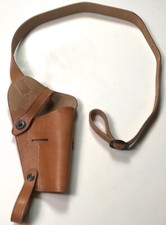
\"Aleathershoulder holster for the .45 pistol,designated as the“M3,”wasadopted in 1942 for use by aviators, tankers and others who preferredcarrying the pistol over the hip holster.Animproved shoulder holster design was standardized in 1944 as the\"M7.\" The pistol was secured in the shoulder holster bymeans of leather strap with a snap fastener. The shoulder holsterswere also embossed with a large “U.S” on the front, with theidentity of the manufacturer and year of production on the back.
\"...Itwas not uncommon for soldiers and Marines to be armed with bothcarbines and .45 pistols. Nevertheless, the desire to replace thepistol with the carbine continued throughout the war. This wasevidenced in a Jan. 26, 1943, Marine Corps document...
\"Despitethis official stance, pistols were issued in ever-increasing numbersduring the war. As an example, the U.S. Marine Corps’ TOE(Tableof Organization and Equipment)in1942 authorized 798 .45 pistols for a Division but, by 1945, theauthorized figure had been increased to 1,707. So much for efforts toget rid of the pistol. The situation was much the same in the U.S.Army where the carbines and .45s were procured and issued side byside in large numbers. The total number of M1911A1 pistolsmanufactured during World War II was 1,878,742. Clearly, the .45 wasan integral part of America’s World War II infantry small armsarsenal!\"