When you click on links to various merchants on this site and make a purchase, this can result in this site earning a commission. Affiliate programs and affiliations include, but are not limited to, the eBay Partner Network.
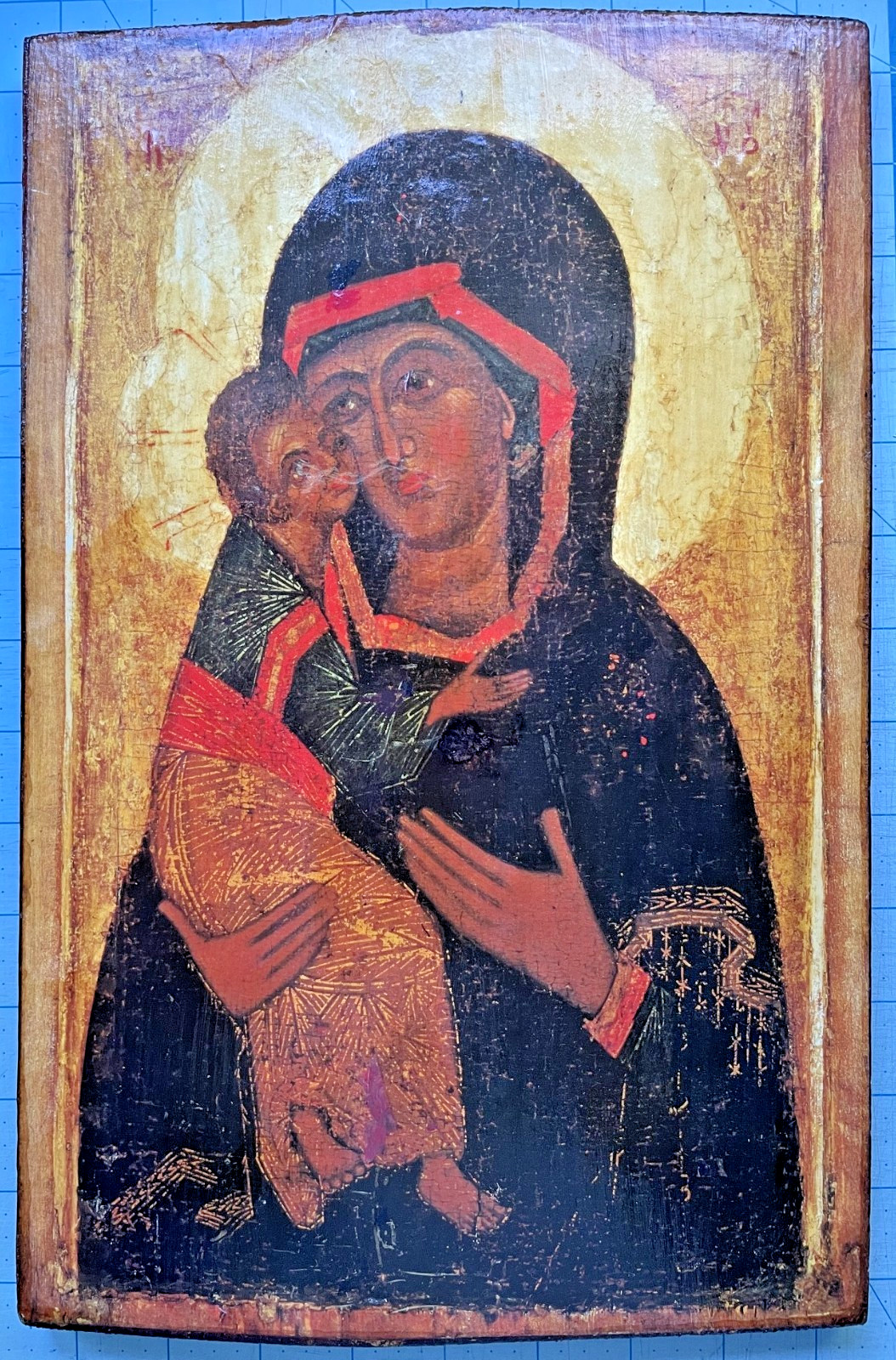
Authentic Wooden Icon Hand MadeReproduction of O. L. of Vladimir, Suzdal Made In Russia. The icon is Silkscreen / Lithograph mounted on a heavy, solid piece of bent wood that is well made. The wood itself has beautiful markings on the reverse side. The measurements are 13.50\" H X 8.75\" W X .50\" Thick.
Authentic Materials: It is mounted on a solid, beautiful piece of natural wood rather than cheap plastic or pressboard.Geographic Provenance: Having the specific Cyrillic stamping for Vladimir and Suzdal proves it was sourced directly from the historic heart of Russian iconographic history, making it a highly desirable piece for Orthodox collectors looking for true pilgrim art.Its substantial size, combined with the premium wood selection and the authentic bilingual regional stamps on the reverse, makes it a standout piece for collectors or anyone looking for a high-quality home devotional icon.Translation of Your Inscription- Владимирская (BnaAnmnpckar): This means \"Vladimirskaia\" (The Vladimir Mother of God), which explicitly names the style and title of the icon image.
- Суздаль (Cy3Aanb): This means \"Suzdal\", the famous ancient Russian town located right next to Vladimir.
The Our Lady of Vladimir (or Theotokos of Vladimir) is a12th-century Byzantine icon widely considered Russia\'s most sacred religiousrelic. It is the ultimate prototype of the Eleousa (Virgin of Tenderness)iconography, depicting Mary with the Christ Child pressing his cheek againsthers. Historical & Artistic Significance. Brought to Kyiv around 1131, theicon was famously transferred to the city of Vladimir in1155 by Prince AndreiBogolyubsky, cementing the region\'s spiritual and political power. Whilepainted in Constantinople, this transfer birthed the Vladimir-Suzdal school oficon painting. The Vladimir-Suzdal style is renowned for softening the rigidconventions of Byzantine art: Human Emotion: It introduced a poignant blend ofmotherly love and sorrow—often described as \"bright sadness\"—intoOrthodox art. Stylistic Nuances: The school prioritized fluid proportions,delicate linear brushwork, and expressive facial anatomy. Restoration: The iconhas been repainted and restored multiple times. Famous masters like AndreiRublev are believed to have restored the painting around 1408, giving the facestheir surviving emotional depth. Current Location today, the original bilateralicon is permanently housed in the Tretyakov Gallery in Moscow, specificallywithin the museum\'s church of St. Nicholas in Tolmachi.
The Virgin of Vladimir, also known as Vladimir Mother ofGod, Our Lady of Vladimir (Russian: Владимирская икона Божией Матери[a]), is a12th-century Byzantine icon depicting the Virgin and Child and an early exampleof the Eleusa iconographic type. It is one of the most culturally significantand celebrated pieces of art in Russian history. Many consider it a nationalpalladium with several miracles of historical importance to Russia beingattributed to the icon. Following its near destruction in the thirteenthcentury, the work has been restored at least five times.
The icon was painted by an unknown artist most likely inConstantinople. It was sent to Kiev as a gift before being transferred to theAssumption Cathedral in Vladimir. It is traditionally said that the icon didnot leave Vladimir until 1395, when it was brought to Moscow to protect thecity from an invasion by Timur, although the historical accuracy of this claimis uncertain. By at least the sixteenth century, it was in the DormitionCathedral in Moscow where it remained until it was moved to the State TretyakovGallery after the Russian Revolution.
It was subject to an ownership dispute in the 1990s betweenthe gallery and Moscow Patriarchate, which ended with its relocation to theChurch of St. Nicholas in Tolmachi. An arrangement was made to operate thechurch with dual status as a house church and part of the museum. The icon wasonly accessible via an underground passage from the gallery to the church,where liturgies are still held.
On 3 April 2026, the Vladimir icon was transferred to theCathedral of Christ the Saviour in Moscow; the Russian Orthodox Church has freeuse of the icon for forty-nine years.
The icon is dated to the earlier part of the 12th century,and arrived in Rus\' around 1131. This is consistent with accounts given in Rus\'chronicles.[3][4][5][6] Similar to other high quality Byzantine works of art,it is thought to have been painted in Constantinople. Only the faces areoriginal, with the clothes repainted after suffering damage when a metal coveror riza was placed over them and in a fire in 1195.
In about 1131, the Greek Patriarch of Constantinople sentthe icon as a gift to grand prince Yuri Dolgorukiy of Kiev. Academic SonaHoisington attributes this in part to a greater effort by Byzantines to convertand Christianize the Slavic peoples at the time. It was kept in a Vyshhorodnunnery until Yuri\'s son, Andrey of Bogolyubovo, brought it to Vladimir in1155.
In a traditional account the horses transporting the iconhad stopped near Vladimir and refused to go further. Accordingly, many peopleof Rus interpreted this as a sign that the Theotokos wanted the icon to staythere. The place was named Bogolyubovo, or \"the one loved by God\".Andrey placed it in his Bogolyubovo residence and built the AssumptionCathedral to legitimize his claim that Vladimir had replaced Kiev as theprincipal city of Rus. The icon was soon moved to the Assumption Cathedralafter its consecration in 1160.
Prince Andrew removing the icon from a convent in Vyshhorod.A miniature from the Illustrated Chronicle of Ivan the Terrible
Following the consecration of the Assumption Cathedral,which was soon followed by other churches dedicated to the Virgin, there is norecord of the icon ever leaving Vladimir until 1395. However, its presence didnot prevent the sack and burning of the city by the Mongols in 1238, when theicon was damaged in the fire. It was restored soon after the event, and againin 1431 and in 1512.
A legend formed that the icon was painted by Luke theEvangelist from life; the first written account of this story dates back to1512. The intercession of the Theotokos through the image has also beencredited with saving Moscow from Tatar hordes in 1451 and 1480.
The image was brought from Vladimir to Moscow in 1395,during Tamerlane\'s invasion. The site where the Muscovites met the Vladimirdelegation is commemorated by the Sretensky Monastery[c] which is considered tobe built where it occurred. However, no archeological evidence supports thisclaim, and much of the fifteenth-to-sixteenth century church was destroyedafter renovations by the Russian Orthodox Church. Vasily I of Moscow spent anight crying over the icon, and Tamerlane\'s armies retreated the same day. TheMuscovites refused to return the icon to Vladimir and placed it in theDormition Cathedral of the Moscow Kremlin.
David Miller suggests that the icon was in fact normallystill in Vladimir, with some excursions to Moscow, until the 1520s. Creditingthe icon with saving Moscow in 1395 does not appear in sources until the late15th century and the full version of the story until accounts of 1512 and thenthe 1560s. From the 16th century, the Vladimirskaya began to be featured as animportant symbol in a series of politicized legends linking Moscow topre-Mongol Rus and positioning it as the center of Christianity after Rome andByzantium—initially to sustain the imperial pretensions of Ivan IV, and laterto influence state policy under the Riurikid and Romanov dynasties.
Under the Bolsheviks, the icon came into the possession ofthe State Tretyakov Gallery. Displayed as a work of art, it was first put ondisplay in the gallery in 1930 and kept there for at least the next 11 years.During the Battle of Moscow, Joseph Stalin allegedly had the icon flown aroundthe city as the Germans began to invade. This was first described by Moscowcity official Viktor Volokhov in his 2012 book Муниципальная милиция вРоссийской Федерации.
In 1993, it was moved to the Epiphany Cathedral for a DivineLiturgy in the wake of tensions between President Boris Yeltsin and the RussianDuma. Though it was damaged during the excursion, it was soon restored andgiven to the Church of St. Nicholas in Tolmachi.
The icon is a tempera painting on wood, 106 by 69centimetres (42 in × 27 in) in size, with the central 78 by 55 centimetres (31in × 22 in) portion being original and the rest being a later expansionundertaken possibly to accommodate a larger riza. The icon depicts Jesus Christas a child being held in the arms of his mother, Mary. They embrace cheek tocheek, with the child gazing towards and reaching for Mary. She holds him withone arm and solemnly looks out towards the viewer. The faces and hands arepainted with greenish olive sankir, a mix of ochre pigment and soot, andtransparent layers of brighter ochre; the child\'s face is rendered in a lightershade than the mother\'s, perhaps to reflect the difference in their age. Thechild\'s clothes are painted with dark ochre and gold. The original paintingbore the inscription ΜΡ ΘΥ, an abbreviation for \'Mother of God\', of which onlyparts survive.
In its nine centuries of existence, the icon has beenrestored and overpainted at least five times to deal with damage anddeterioration, including a fifteenth century restoration thought to have beenled by Andrei Rublev. It is mainly the faces of Mary and Jesus and the goldground above her head that are original twelfth-century paint. In the past, theicon has been covered with several elaborately designed oklad and riza(revetments) which caused damage to the frame. The reverse, which is much lesswell known, contains an image of the Hetoimasia (\'prepared throne\') andinstruments of Christ\'s Passion that was painted in c. 14th century (prior to that the reverse side had apainting of an unidentified saint).
Among icons of Virgin Mary with Jesus, Our lady of Vladimiris classed as an Eleusa icon (Russian: Oumilenie), due to the tender attachmentbetween mother and child. Theologians and believers have also commented uponthe icons symbology and the religious sentiments it inspires. Contemplating theicon, theologian Henri Nouwen, remarked that the Virgin\'s eyes glance atneither the child or the viewer but appear to \"look inward and outward atonce\"; that her free hand gestures towards the baby to \"open a spacefor us to approach Jesus without fear\"; and, that the child is shown as\"a wise man dressed in adult clothes.\" Literary scholar, S. S.Averintsev interpreted the mix of maternal tenderness and poignant sorrow seenin Mary\'s expression, as representative of the emotions generated by the eventsof Nativity and Calvary, respectively. Jesus\'s bare feet are seen assymbolizing his physical reality; his garments of gold, the Kingdom of Heaven;and the three stars on Mary\'s dress (one occluded by the child), \"hervirginity before, during and after her son\'s birth.\"
Its artistic quality has been highly praised. Art historianDavid Talbot Rice said that \"[Our Lady of Vladimir] ...is admitted by allwho have seen it to be one of the most outstanding religious paintings of theworld.\" Art historian George Heard Hamilton praises its\"craftsmanship and conception” and notes how in its representation of thesubject\'s faces, the icon subtly transitions from its normal use of contourlines to a refined surface texture. It is painted in an artistic style typicalfor Byzantine art of the period with features including smaller mouths, refinedeyes, and elongating Mary\'s nose. However, by avoiding the use of demarcatingline, as became common in later Byzantine art, and by setting up the complexinterplay of the mother and child\'s glances, the icon adds to the illusion oflife in the piece. The child\'s features are reminiscent of classical sculpture,though the artist renders an expression truer to an actual infant\'s. Theexpressive and humanistic character of the icon differentiates it from earlierByzantine art and exemplify the artistic developments seen during the Komnenosdynasty.
The icon is generally considered to be one of the mostcherished symbols in Russian history.[24][32][33] Academic David Miller hasascribed this to its close connection to Russian national consciousnessthroughout its existence. Its transfer from Kiev to Vladimir was used byBogolyubsky to legitimize Vladimir\'s claim as the new center of government inKievan Rus\'.
Additionally, its intimate association with importantRussian historical events gave Our Lady of Vladimir the distinction of being anational palladium. The most recent of these events being the 1993 Russianconstitutional crisis when it was brought to the Epiphany Cathedral at therequest of Patriarch Alexy II and Mayor of Moscow Yury Luzhkov in their attemptto bring peace to the country.
Our Lady of Vladimir\'s veneration is also likely enhanced bythe fact that the Theotokos is regarded as the holy protectress of Russia. Thevenerated image has been used in celebration of coronations of tsars, electionsof patriarchs, and other important ceremonies of state. The icon has threefeast days held throughout the year in celebration to specific events it isassociated with:
3 June [O.S. 21 May][d] to celebrate Moscow\'s protectionfrom Crimean Khan Mehmed Giray in 1521.
6 July [O.S. 23 June] for, in 1480, for their victoryagainst Khan Ahmed during the Great Stand on the Ugra River.
8 September [O.S. 26 August] to commemorate the Muscovitedeliverance from pending invasion by Tamerlane.
Our Lady of Vladimir was on display at the Church of St.Nicholas in Tolmachi. As a result of an agreement between the Tretyakov andMoscow Patriarchate, the church is both an active Russian Orthodox house churchand functioning museum. Previously, there had been a contentious ownershipdispute between the two.
In 1997, the Tretyakov completed a full restoration of thechurch. Security improvements to store and display art were added, and anunderground passageway was additionally made to connect it to the StateTretyakov Gallery. In order to house the famous icon, a temperature controlledbulletproof glass case was commissioned. On 7 September 1996, Our Lady ofVladimir was first installed in the special case located within the church, andthe next day Patriarch Alexy II consecrated the church. According to ArchpriestNikolai Sokolov, the rector for the church, the case would able to withstandthe firing of a Kalashnikov rifle as well as many other potential hazards.
Due to its dual status as both church and museum, visitorsare allowed to pray before the icon and divine Liturgies are regularly held onselected days. However, visitors can only enter the church through theTretyakov Gallery and via the underground passageway.
On 3 April 2026, on the eve of the Feast of the Entry of theLord into Jerusalem, the Vladimir Icon of the Mother of God was transferredfrom the State Tretyakov Gallery to the custody of the Russian Orthodox Church,which has free use of the icon for a period of forty-nine years. On 4 April,the icon was displayed for public veneration at the Cathedral of Christ theSaviour. The Vladimir icon remains the property of the Russian Federation andthe operational management of the State Tretyakov Gallery.
Even more than most, the original icon has been repeatedlyduplicated for centuries, and many copies also have considerable artistic andreligious significance of their own.[44] According to Suzanne Massie, it becamea standard for many Russian contemporary depictions of Mary.
In preparation for the 1980 Summer Olympics, a chapel wasconstructed for athletes to be able to pray before competition which hosted acopy of the icon.