When you click on links to various merchants on this site and make a purchase, this can result in this site earning a commission. Affiliate programs and affiliations include, but are not limited to, the eBay Partner Network.
ANTIQUE GERMAN NAPOLEON HAT MANTEL CLOCKHEAVILY CARVED WALNUT CASE — PROBABLE JUNGHANS MOVEMENT
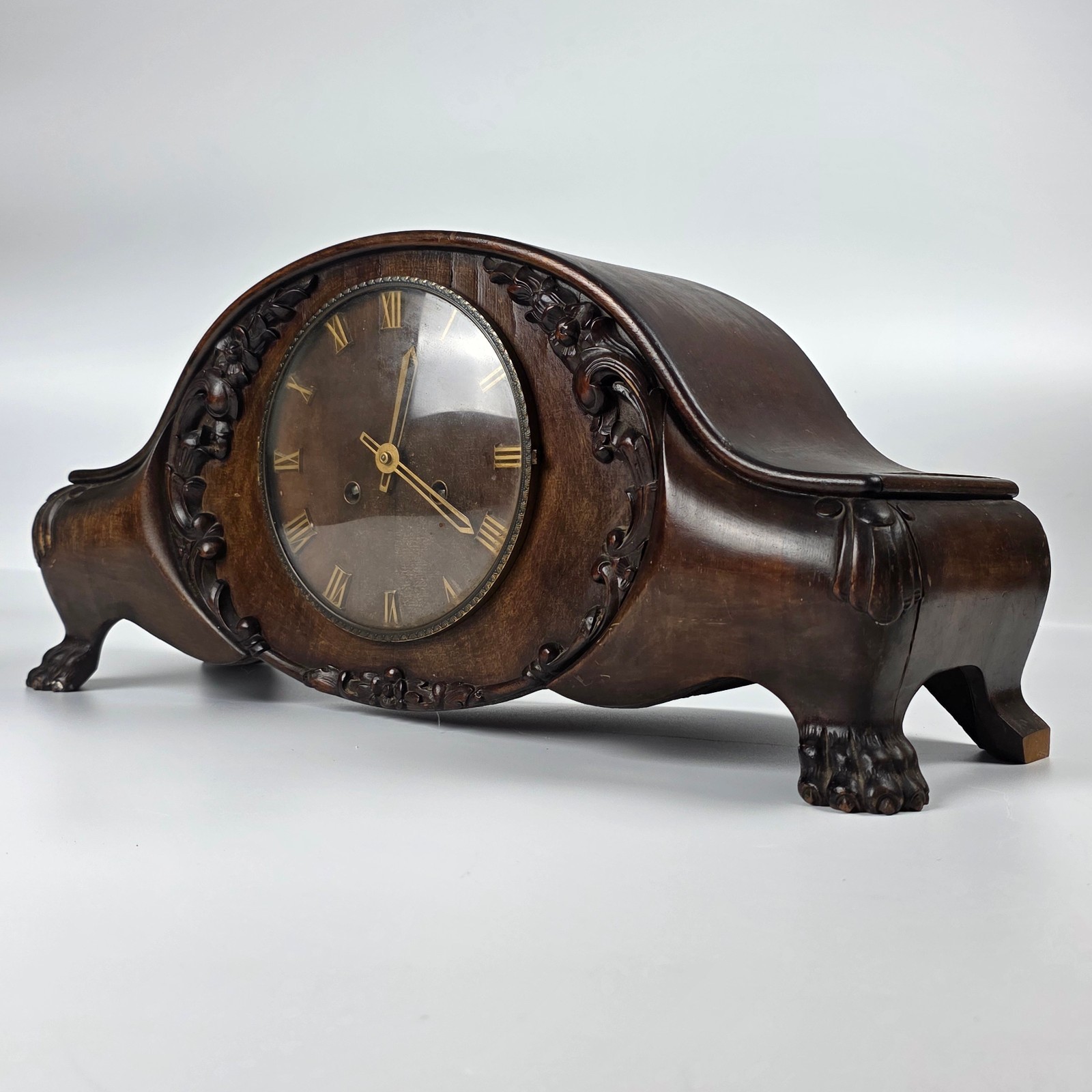
A substantial antique German mantel clock in a distinctive Napoleon Hat / tambour-style case, featuring a heavy carved wooden body with deep relief decoration and a naturally aged matte finish.
The clock has an unusually massive presence, with extensive carving and substantial wooden construction.
The movement has been carefully examined and compared with historical German movements, particularly Junghans Werke 74, 202A and 278.
The closest documented comparison found is Junghans Werk 278, a 14-day half-hour rack-strike movement used in Junghans mantel clocks (Kaminuhren). Historical Junghans documentation gives the Werk 278 plate dimensions as approximately 11 × 9.5 cm.
The exact caliber of this particular movement has not been conclusively established, so it is described as probable Junghans rather than guaranteed Junghans.
MOVEMENT — PROBABLE JUNGHANS
The movement is a substantial German two-train spring-driven mechanical movement with rack strike.
Notable features include:
- Two spring barrels
- Rack-and-snail striking system
- Half-hour strike
- Multiple hammer/strike components
- Heavy brass plates
- German construction
- Distinctive shaped cut-out in the upper strike/rack mechanism
- Approximate plate dimensions close to documented Junghans movements of this family
The construction has been compared particularly closely with Junghans Werk 278.
The historical Junghans archive describes Werk 278 as a:
“14 Tag interchangeable spring barrels and plates measuring approximately 11 × 9.5 cm. It is specifically listed in the Kaminuhren section.
The archive also documents Werk 278 as a Junghans mantel-clock movement with Bim-Bam variants.
Movement marking
There is a single “J” marking on one internal movement lever.
No complete Junghans star trademark was found elsewhere on the movement. For this reason, the movement is described as probable Junghans rather than definitively identified as Junghans Werk 278.
The visual and mechanical similarities to documented Junghans movements are, however, particularly strong.
TESTED — RUNNING & STRIKE
The clock has been tested before listing.
The movement is currently running, and the strike mechanism has also been tested and is operating.
A video showing the movement running and the strike mechanism in operation is available with the listing.
Please note that this test confirms operation at the time of listing only. I have not tested long-term timekeeping accuracy or power reserve.
As with any antique mechanical clock, professional cleaning, lubrication and adjustment may be advisable before regular daily use.
CASE
The clock is housed in a very substantial carved wooden Napoleon Hat / tambour-style mantel clock case.
Features include:
- Heavy carved construction
- Deep relief carving
- Dark walnut appearance
- Elaborate floral/scroll decoration
- Large, substantial proportions
- Naturally aged matte surface
- Historicist / traditional German decorative style
The case has not been conclusively matched to a specific Junghans catalog model.
This is therefore best described as a clock with a probable Junghans movement in a heavily carved antique case, rather than claiming that the complete clock is a factory-original Junghans model.
DIAL & HANDS
The clock has a dark brown-toned dial with applied Roman numerals and relatively simple gilt-colored hands.
The restrained dial and hand design should not automatically be taken as evidence against Junghans. Historical Junghans catalogs from the 1930s show substantial mantel clocks with large wooden cases and comparatively restrained dial and hand designs. The 1934 Junghans catalog, for example, documents large walnut/oak mantel clocks in Gruppe 17 (Kaminuhren).
IMPORTANT IDENTIFICATION NOTE
I have deliberately not described this clock simply as a “Junghans clock.”
The evidence currently supports:
Probable German Junghans movement / Junghans-related construction
rather than a 100% documented Werk identification.
The identification is based on:
- comparison with historical Junghans Werk 74;
- comparison with Junghans Werk 202A;
- particularly close comparison with Werk 278;
- similar movement architecture;
- similar rack-strike construction;
- similar plate proportions;
- the distinctive shaped cut-out in the upper mechanism;
- the single J marking on an internal lever;
- the use of Werk 278 in documented Junghans Kaminuhren.
The exact Werk number of this movement remains unidentified.
AGE
Exact date unknown.
The case and movement may not necessarily have been produced at the same time. The case appears to be an older, heavily carved historicist construction, while the movement belongs to a German mechanical tradition represented by later Junghans mechanisms.
Please use the photographs and movement details rather than relying solely on the estimated date.
CONDITION
Vintage/antique condition with age-related wear, patina and signs of previous use.
Please carefully examine all photographs.
The movement is running and the strike has been tested, but this is an antique mechanical movement and is not being represented as freshly serviced or guaranteed to maintain perfect time.
The clock may require professional servicing, cleaning, lubrication and regulation.