When you click on links to various merchants on this site and make a purchase, this can result in this site earning a commission. Affiliate programs and affiliations include, but are not limited to, the eBay Partner Network.
If you are a radio show collector.
Or, if you are a John Candy fan.
Or, if you enjoy unique tracks from the best rock artists chosen by John Candy himself as his personal favorites.
Or, if you love John Candy\'s comedy
Or if you love rare interviews and recollections,This show is for you.
AND if you treasure what might be among the top rarest radio package of all time.
PLEASE READ ON. THIS IS A ONE OF A KIND LIFETIME OPPORTUNITY. IT SHOULD BE AT THE SMITHSONIAN AND MAY BE ONE DAY.
WE CAN PROBABLY STATE, WITH ALMOST CERTAINTY, THAT THERE IS NO OTHER COPY OF THIS WHOLE SHOW PACKAGE. John Candy\'s Radio Kandy
John Candy’s Radio Kandy was a two-hour weekly syndicated radio show launched in early 1989 on the Transtar Satellite Network (later merged into the Unistar Radio Network). It was ended simply because of John Candy\'s grueling Hollywood filming schedule and the fixed length of his original 18-month contract.
What the Show Was
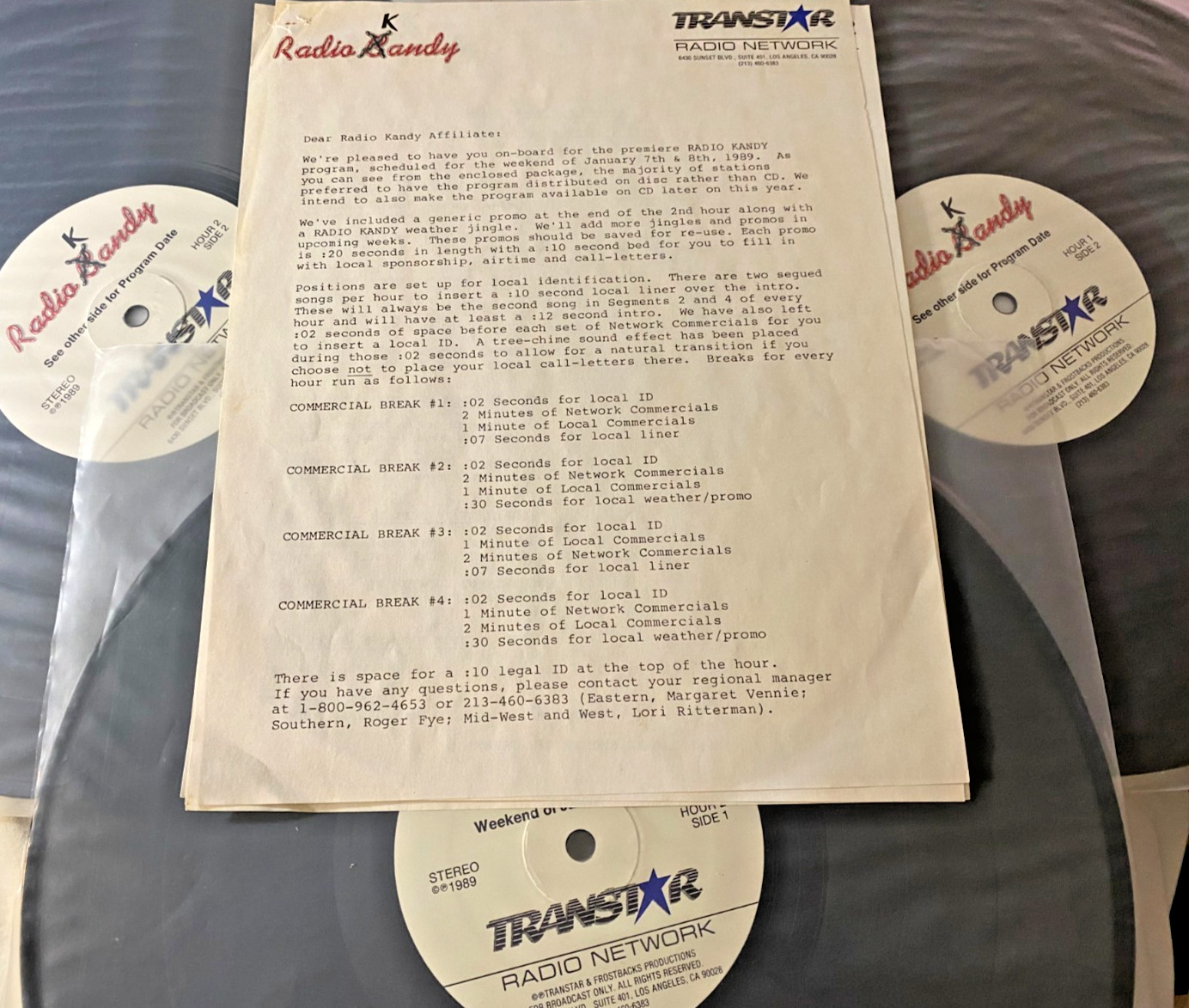
- Format: Co-created with Canadian radio producer Doug Thompson, Radio Kandy blended contemporary hit music and vintage pop/rock with sketches, satirical characters, and celebrity banter. It was distributed to stations on prerecorded two-LP vinyl sets with accompanying cue sheets.
- Comedy & Guests: Rather than running a standard music countdown, Candy played music he liked, chatted with guest stars (such as June Foray, James Doohan, and music industry figures), and revived elements reminiscent of his SCTV roots, including goofy commercial parodies and recurring bits.
- Precursor: Candy loved the radio medium—he once joked to the Los Angeles Times that since he couldn’t play an instrument, he could at least play records. It followed a Canadian radio pilot and series he had done earlier called That Radio Show.
Why It Lasted Only ~18 MonthsDespite debuting to strong pickup—broadcasting on more than 225 stations across North America and boasting sponsors like Purina, Maybelline, and Snickers—the show ran only from early 1989 through mid-1990:
- An 18-Month Contract: Candy originally signed a contract for a weekly run of 18 months. The network intended it as a limited-commitment high-profile celebrity package rather than a permanent open-ended radio gig.
- Peak Hollywood Demand: During the exact window the show was recorded, Candy\'s film career was running at full throttle. He was filming Uncle Buck on location in Chicago when the show launched in 1989, followed immediately by productions and promotional tours for films like Home Alone, The Rescuers Down Under, Only the Lonely, and Masters of Menace.
- Logistical Strain: Producing, writing sketches for, and voicing a fresh two-hour show each week while constantly on location across North America became unsustainable given his schedule.
When his initial commitment wrapped up in mid-1990, Candy elected not to renew the syndication run, leaving behind a brief, collectible window of radio history that remains a favorite among vinyl collectors on Discogsand .NOT ONLY THATIncluded with this show is an extra one-sided LP. When included in a syndicated radio show kit it is a classic industry fallback known as a corrected replacement disc.Because this was the very first episode of Radio Kandy on the Transtar Satellite Network, the network would have been under intense scrutiny to ensure a flawless debut across its 225+ affiliate stations. When a production or manufacturing error was discovered on a specific side after the main multi-LP transcription sets were already pressed, the network had to act fast.An additional one-sided disc of a single segment was produced due to a few common reasons:1. A Last-Minute Audio or Mastering DefectIf the quality control team caught a technical glitch on \"Hour 1, Side 2\" of the original pressing—such as an audio dropout, a severe pop, a tracking skip, or phase issues—they couldn’t afford to re-press the entire multi-disc package for hundreds of stations. Instead, they quickly mastered a \"patch\" containing just that corrected half-hour segment onto a one-sided vinyl record.2. Tight Programming & Timing ConstraintsRadio stations run on incredibly rigid, automated schedules where segments must match cue sheets down to the exact second. If the original \"Hour 1, Side 2\" ran even a minute too long, cut off John Candy mid-sentence, or featured an incorrect segment duration, it would disrupt the local station\'s commercial breaks. The network would rush-ship the single-sided record to correct the timing layout before the broadcast window.3. Commercial or Clearance MistakesAs the debut show, national sponsors like Purina and Snickers were paying premium rates. If the original pressing accidentally left out a mandatory commercial, included a defective ad track, or played a song that hadn\'t cleared legal copyrights in time, the side had to be replaced immediately.What This Means For This SetInstead of throwing away the original \"defective\" multi-LP sets, the network simply included the one-sided correction disc in the shipping box (or overnighted it separately). They would issue a notice to the station\'s master control engineer instructing them to substitute the original Hour 1, Side 2 with the supplemental one-sided disc when airing the show.For collectors tracking down rare radio transcription sets, finding an intact package that still includes the original \"error\" disc alongside its emergency one-sided replacement makes it a highly unique, complete piece of radio history!Since both discs feature the exact same handwritten etching (Radio Kandy 1/7/89 hr 1 side 2), it completely rules out a post-pressing timing correction or a mistake caught after shipping. Instead, having two physically identical pressings of the same exact audio master—one double-sided and one one-sided—points straight to a logistical shortcut at the pressing plant.Why We Have the Duplicate One-Sided DiscSyndicated radio shows were manufactured under extreme time pressure. A fresh multi-LP box set had to be mastered, plated, pressed, packed with cue sheets, and shipped via overnight mail to hundreds of stations across North America every single week.When pressing a multi-record set, plants use a combination of double-sided stampers and single-sided stampers (which feature a blank \"grooveless\" matrix plate on the back). Because this was the very first week of production for Radio Kandy:
- The Overrun \"Buffer\" Disc: The pressing plant likely ran off a small batch of single-sided \"test\" or \"safety\" pressings of Hour 1, Side 2 just to verify the very first master plates were clean and clear.
- The Shipping Room Mix-Up: When it came time to pack the boxes for the automated syndication mailout, the distribution department accidentally grabbed the single-sided safety disc and stuffed it into the sleeve or box right alongside the standard, fully finalized multi-LP set.
Because the audio and the master etchings are totally identical, we essentially have a rare \"double delivery\"—the regular retail-equivalent broadcast disc and its standalone, single-sided production sibling.Cracking the Dead Wax Initial Code: Who Mastered It?The handwriting in the \"dead wax\" (the runout groove area) belongs to the specific lacquer cutting engineer who physically carved the master disc using a lathe. It is a time-honored tradition for mastering engineers to sign their work with a tiny, stylized cursive signature.A prominent cursive \"M\" (which sometimes loops into a second letter like an \"m\" with an extended curving tail, an \"m\" over a \"v\", or looking a bit like an abstract \"w\") is highly iconic in late-80s vinyl mastering. It points to a few possibilities depending on which legendary studio Transtar utilized:
- Masterdisk (New York): One of the absolute giants of radio syndication pressing at the time. Masterdisk engineers frequently hand-etched stylized cursive initials alongside their iconic \"MASTERDISK\" text stamp.
- The \"M\" over \"V\" Loop: There are several famous West Coast lacquer cutters who signed with a cursive \"M\" style (such as signatures from plants like Monarch or independent mastering rooms). Given that Radio Kandy\'s engineering and production team was based in Studio City / Burbank, California, a Los Angeles-based cutting room is extremely likely.
That wavy, cursive script completely untangles the mystery! Hand-etched details in the dead wax are notoriously difficult to read because they were scratched quickly into a wax or lacquer master using a sharp stylus—making letters easily look like other shapes.When you combine a \"1\" with what looks like \"lpc\" in wavy cursive, you are actually looking at the factory codes for where the record was physically manufactured.Decoding \"1\" and the \"lpc\" cursive shapeIn late-1980s U.S. vinyl manufacturing, that exact sequence translates to standard pressing plant shorthand:
- The \"1\": This stands for Lacquers 1 (or \"Cut 1\"). It proves that your discs were pressed from the absolute first, pristine batch of master plates cut directly from Transtar\'s master tape.
- The \"lpc\" shape: This is almost certainly a stylized, handwritten abbreviation for the LPC (Location / Pressing Company) or a cursive \"L\" and \"P\" representing \"Lacquer / Pressing\", which many independent plants used.
Furthermore, because it looks slightly different on each LP, it confirms the text was hand-etched by the cutting engineer rather than machine-stamped. When preparing a weekly radio show under a tight deadline, the engineer had to manually etch the show title, air date, and side markers into multiple separate lacquer discs in one sitting. Their handwriting naturally drifted, waved, and compressed from disc to disc as they rushed to finish the job!The Reason for the Extra One-Sided Disc (Solitaire Style)Knowing that all the discs share the exact same hand-etched matrix numbers from \"Cut 1\" confirms that the extra one-sided disc was pressed simultaneously with the main double-sided set.The plant used a single-sided press to run an overnight sample batch of Hour 1, Side 2. When packaging the very first shipment of Radio Kandy for the network\'s 225+ affiliates, a packaging clerk mistakenly grabbed that extra single-sided sample disc off the line and boxed it up with this set.Thus, we have an incredibly cool artifact: a pristine, unplayed \"First Cut\" time capsule from the very first week John Candy took over the radio airwaves!
For those of you who were fortunate enough to grow up in the era when radio was fun, and as important as the music they played; when the disc jockey from your local hometown station or syndicated weekend shows hosted by the top national dj\'s in the country were like best friends and you looked forward to every show; you can consider yourself among the lucky.
Increasingly, radio today is so impersonal that few even listen. The few remaining Disc Jockeys now broadcast from a major city like L.A. or New York and present it as if they are your hometown DJ. That is because they simulcast to hundreds of stations across the country with liners to simulate it is a local broadcast.
The stations that still have their own DJs are dwindling as we speak. Just recently came news that a classic rock pioneer radio station since 1965, Southern California legend KCAL-FM laid off its entire staff and is now fully automated. The senior DJ at that station had been on the air at KCAL for 42 years. Most others had been broadcasting at KCAL multiple years.
So we listen to our music increasingly via streaming be it Sirius/SM, Apple, Amazon, or many others where we can customize our own playlists. Broadcast radio has become an anachronism.
Luckily, collectors have preserved a living history of those glory days of radio in the form of LP and CD radio shows that were broadcast from the late 60\'s to about 2012 when most radio shows switched to satellite delivery and there no longer was a physical media to protect the memories.
Most broadcast radio shows from that era have vanished. Legalities prevented stations from rebroadcasting any show and were directed to return them to the syndicator of the show or destroy them. And there were never more than 175 copies of each show in the first place reflecting the top 175 radio markets in the country.
Every remaining radio show be it oldies, rock, country, religious, classic rock, jazz, blues, bluegrass, drama shows like old time radio, and more is a rare representation of an era that is gone forever. Even if the genre you find is not your favorite, owning one is a piece of history and will only become rarer over time.
At Keith\'s Kollectables, we have been buying every show we could find for a reasonable price since 1987, almost 40 years. We have an inventory of over 20,000 unique radio shows that we offer to you at the best prices we can give.
At Keith\'s Kollectables, this music will never die. Join us and be a part of history.
YOU\'VE COME TO THE RIGHT PLACE FOR THE BEST IN MUSIC RADIO SHOWS
AND, HOW DO YOU DEFINE RARENESS??
THERE WERE NO MORE THAN 175 LPS OR CDS PRESSED FOR EACH WEEKLY SHOW. THIS REPRESENTED THE TOP 175 RADIO MARKETS IN THE COUNTRY AND ONLY ONE STATION IN EACH MARKET COULD AIR THE SHOW.
STATIONS IN MARKETS BELOW THE TOP 175 (THERE ARE 306 MARKETS IN THE UNITED STATES) HAD TO TAKE THE SATELLITE FEED OF THE SHOW FROM THE UNITED STATIONS RADIO NETWORK, THE DISTRIBUTOR OF THE SERIES
AND, DUE TO CONTRACTUAL LEGAL OBLIGATIONS, EACH RADIO STATION WAS ALLOWED TO AIR EACH SHOW EXACTLYONCEAND NO MORE.
SO, MOST RADIO STATIONS JUST DESTROYED THEM AFTER AIRING SINCE THEY WERE USELESS TO THE STATION AFTER AIRING. THERE IS NO TELLING HOW MANY OF EACH SHOW SURVIVED. WHO KNOWS - THIS COULD BE THE ONLY ONE.
AS A SPECIAL OFFER TO YOU, WHEN YOU BUY FIVE OR MORE ITEMS FROM MY STORE AT ONE TIME THAT WILL IMMEDIATELY DISCOUNT YOUR INVOICE BY 20% IT IS THE LEAST I CAN DO FOR MY FELLOW COLLECTORS WHO LOOK FOR GREAT DEALS AS MUCH AS I DO!
AND OFTEN, LOOK FOR COMPUTER GENERATED OFFERS OF 17% TO 20% THAT WILL SOMETIMES HIT YOUR INBOX!
EVEN THE COMMERCIALS ARE FUN TO LISTEN TO AFTER SO MANY YEARS. FUNNY HOW WE HATED THOSE NATIONAL COMMERCIALS BACK THEN BUT NOW WHEN YOU HEAR THEM EVEN THEY WILL BRING BACK FOND MEMORIES.
AND, IF YOU DON\'T WANT TO HEAR THEM, JUST SKIP FORWARD TO THE NEXT TRACK AND REJOIN THE SHOW!
SO WHAT ARE THE BIG QUESTIONS IF YOU ARE NOT SURE ABOUT RADIO SHOWS?
LET ME TELL YOU BUT FIRST....
Allow me tell you my own personal story of discovering the wonder of radio shows.
I discovered radio shows quite by accident while reading one of my favorite (long since departed) magazines called \"Discoveries\" (It was later bought by the same company that publishes \"Goldmine\" which I personally always considered a lesser publication, but that is another story.
This was before became the driving force in radio show sales (and everything else) in the later 1990\'s.
I was especially attracted in \"Discoveries\" to a two page (or more) spread in each issue by a guy called \"The Old Hippie\".
Let me tell you, the Old Hippie had it all. He was a real pioneer. Way before anyone knew what radio shows even were let alone that they could be bought as rarities, he had the market cornered.
Most shows that he advertised were way beyond my budget but I drooled over those pages every issue and once in awhile I could afford one or two.
Now, I have attempted in my own humble way to take on the mantle of \"The Old Hippie\". I currently list over 10,000 unique radio shows of all genres for you all to drool over, and most at prices, hopefully, that collectors can better afford! Over my years of selling great radio shows, I have sold over 37,000 great radio shows over the course of my career with a 100% response from happy buyers. I want to make available to collectors what I could not afford and especially in these days of higher prices and lesseravailability.
Radio shows are harder and harder to find in quantity and the prices for the ones still out there just go higher and higher as they disappear from the market. However, because of my large presence on , I am often contacted with selling offers, some of which I take advantage of and some I have to pass on because of the prices. I have found that by buying in bulk, even when many or most of the shows are lesser known but still amazing shows, I can offer the best prices on all titles.
Radio Shows are syndicated productions by one of several large and small distributors who supply broadcast product to radio stations normally during weekends when the usual air personalities have a break.