When you click on links to various merchants on this site and make a purchase, this can result in this site earning a commission. Affiliate programs and affiliations include, but are not limited to, the eBay Partner Network.
17” PLATTER
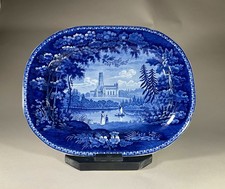
FONTHILL ABBEY, WILTSHIRE
Staffordshire Blue
Foliage Border Series
1818-1830
Unmarked
but Possibly John & Ralph Hall
ITEM DESCRIPTION:
On offer is a 17” platter with one of the most beautiful of the early Staffordshire Blue borders featuring an evocative design of encircling trees and other foliage. Its central scene is of now-vanished Fonthill Abbey, Wiltshire, one of the most eccentric great houses in England. Fonthill had been designed and built in the early nineteenth century by novelist and politician William Thomas Beckford (1760-1844) and noted architect James Wyatt (1746-1813).
DATE:
Circa 1818-1830
SCENE:
Fonthill Hill, Wiltshire, was a large Gothic Revival country house built between 1796 and 1813 by architect James Wyatt and the wealthy, eccentric, but highly creative British writer and politician William Thomas Beckford (1760-1844). Beckford, best remembered today as the author of the Gothic novel Vathek, was known by his contemporaries as as the richest commoner in England due to the fortune he inherited as a child from his father, who owned Jamaican sugar plantations and thousands of slaves. More showy than sturdy, the house suffered several structural damages before a major fire in 1825. The house was later more or less demolished.
SERIES:
Foliage Border
MAKER:
There is no maker’s mark, and more than one maker produced series with a foliage border. It can, however, be noted that the New Hampshire Historical Society has what appears to be an identical piece in its collection that it attributes to John and Ralph Hall and dates as 1818-1830.
MARKS:
Printed floral-style mark on bottom shows name of view: Fonthill Abbey, Wiltshire. There is no other mark.
MEASUREMENTS:
17” wide x 13-1/2” deep x 1-1/2” high
REFERENCES:
> The Dictionary of Blue and White Printed Pottery 1780-1880, Volume I, Page 142.
> The Dictionary of Blue and White Printed Pottery 1780-1880, Volume II, Page 84.
CONDITION:
The piece is structurally sound with no chips or cracks. There are, however, relatively minor issues, including the following.
Front:
> A scratch to the left of the tower
> A glaze pop to the right of the building
> Minor knife marks
> A glaze pop in the right-hand upper cloud
Rim Edge:
> Some rubbing on underside of rim
Back:
> Use wear
> Stilt marks remaining as artifact of manufacturing process
None of these issues affect the piece’s display appearance. The listing price takes any issues into account.
Please consult the photographs carefully, as they are of the actual item on offer and show the real appearance. The photographs are part of the Item Description.
SHIPPING:
This item, properly packed, will be shipped only to confirmed addresses within the United States. Item will be tracked and insured.
NOTE:
Please ask any questions prior to offerding, as there will be no returns unless Buyer and Seller agree that there is misrepresentation or egregious error in the description.
This gorgeous platter would make a worthwhile addition to any collection of early Staffordshire Blue, particularly those featuring landscapes or notable architecture.