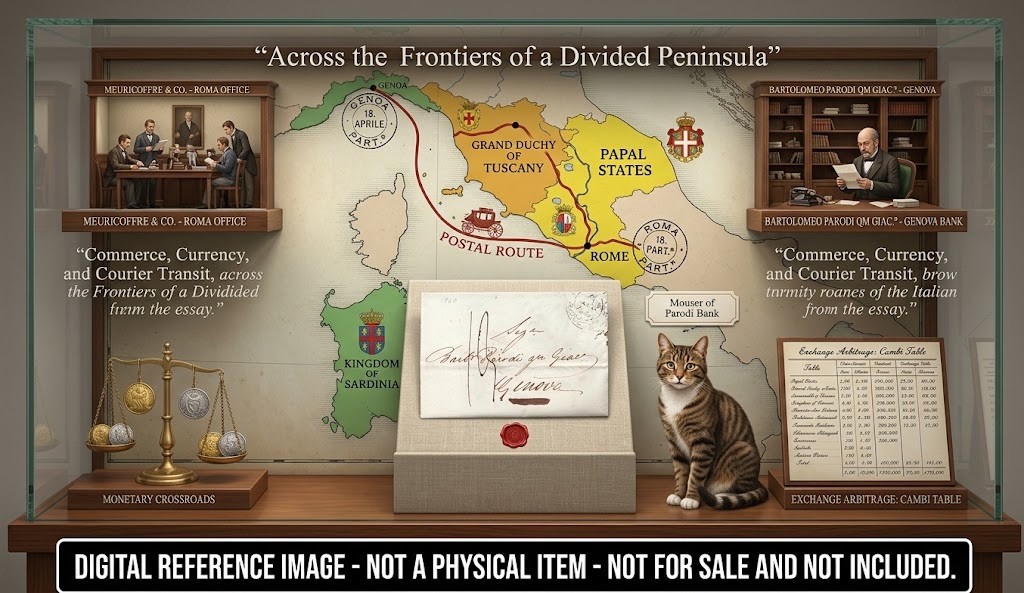
The \"Cambi\" Table: The rate table at the bottom reflects the complex multi-currency environment of 1840, detailing daily Roman exchange quotations for major European and pre-unification financial hubs, including Naples (Neapolitan Ducats), Livorno and Florence (Tuscan Fiorini/Francesconi), Venice and Milan (Austrian Lombard-Venetian Lire), Genoa (Sardinian Lire), London (Pound Sterling), Paris and Marseille (French Francs), and Augusta/Augsburg (South German the Frontiers of a Divided Peninsula: Commerce, Currency, and Courier Transit in an 1840 Rome-to-Genoa LetterIntroduction: The Epistolary Fabric of Pre-Unification Italy
In April 1840, when a clerk in the Roman offices of L. Meuricoffre & Co. folded and addressed a sheet of laid paper to Messrs. Bartolomeo Parodi in Genoa, Italy existed only as a geographic and cultural concept, not a political entity. Metternich’s famous dismissal of the peninsula as a mere \"geographical expression\" captured the fragmented political landscape: the Papal States, governed by the conservative administration of Pope Gregory XVI, bordered the Grand Duchy of Tuscany, which in turn abutted the northern territories of the Kingdom of Sardinia under King Charles Albert.
Between these disparate sovereign realms stood fortified borders, differing legal codes, divergent monetary units, and separate postal administrations. Yet beneath this political division lay an interconnected web of private merchant-bankers whose letters, drafts, and courier pouches preserved the economic vitality of the Mediterranean. This stampless folded lettersheet—dispatched from Rome on April 14, 1840, and received in Genoa four days later—serves as a tangible artifact of that sophisticated financial apparatus, offering a snapshot of international banking, postal transit, and monetary arbitrage on the eve of the Risorgimento.
The Protagonists: Swiss Haute Banque and Ligurian Merchant CapitalThe historical significance of any commercial postal artifact is anchored in the identity of its correspondents. The sender, L. Meuricoffre & Co., belonged to an elite network of Swiss Protestant bankers who settled in the Italian peninsula during the late eighteenth century. Originating from the canton of Thurgau, the Meuricoffre family established themselves as premier financiers in Naples and Rome, providing sovereign loans, underwriting maritime ventures, and serving as essential correspondents for wealthy Grand Tour travelers requiring letters of credit. Operating in the heart of the Papal capital, Meuricoffre & Co. navigated the complex financial architecture of the Holy See, bridging local Roman credit with international money centers in Paris, London, and Frankfurt.
At the destination in Genoa, the recipient—Sig.ri Bartolomeo Parodi q.m Giac.º (quondam Giacomo, denoting the heirs of the late Giacomo Parodi)—represented one of Liguria\'s most formidable private merchant-banking dynasties. Genoa, though absorbed into the Piedmontese crown of the Kingdom of Sardinia following the Congress of Vienna in 1815, maintained its status as the financial and maritime powerhouse of northern Italy. The Parodi house was an integral player in high-stakes sovereign finance, maritime insurance, and early Italian railway concessions, working frequently alongside the Rothschilds and the Torlonia bank of Rome. A direct communication between Meuricoffre and Parodi reflects a routine yet vital exchange between two key pillars of nineteenth-century European capital.
The Anatomy of the Transaction: Arbitrage and the Multi-Currency RealityThe text of the letter, penned in a legible Italian mercantile hand, records an account reconciliation and the balancing of cross-border debits and credits:
\"Dopo l\'ultima nostra del 4 corrente abbiamo ricevuto le pregiate Vostre dell\'istesso e del 9 – rimettendovi diverse appunti per la somma di Sc. 2043.33 per i quali avete credito in L.m 6821.10 – 4 Aprile & 4300.85 – 9. Per contro vi diamo debito per L.m 1000.00 – 6 Aprile, 5308.80 & d.º e speriamo che ci farete eguale buon ricavo del rimanente...\"
In this concise passage, the complexity of pre-unification commerce becomes apparent. The Roman firm remitted financial drafts (appunti) denominated in Roman Scudi (Sc. 2043.33), which were converted into Sardinian / Piedmontese Lire (L.m, Lire monetate / Lire nuove di Piemonte) for Parodi’s account. Because no uniform currency existed across the peninsula, transactions relied on bills of exchange (lettere di cambio) and offset accounting, minimizing the hazardous physical transport of gold and silver coins over mountain passes and bandit-ridden highways.
Beneath the signature lies the document\'s economic core: the \"Cambi\" (Exchange Rates) table dated April 9. This market intelligence provided the Genoese firm with the latest currency valuations quoted in Rome against major Italian and international financial hubs:
Naples (80.-): Valued in Neapolitan ducats and carlini.
Livorno (15.40) and Florence (15.45): Reflecting Tuscan fiorini and francesconi.
Venice (15.50) and Milan (15.70): Reflecting the Austrian Lombard-Venetian lire.
Ancona (99.-) and Bologna (99.25): The primary commercial outlets of the Papal Legations and Adriatic trade.
Genoa (18.28): Quoting the direct rate for Sardinian lire.
London (456.-), Paris (18.23), Marseille (18.15), and Augsburg (46.60): Linking Italy\'s markets directly to the financial centers of Western and Central Europe.
In an era preceding the electric telegraph, this table constituted actionable commercial data. A Genoese banker holding this letter could immediately identify rate differentials between Paris, London, and the northern Italian cities, executing arbitrage operations or pricing merchandise accordingly.
The Postal Journey: Four Days via the Overland Tuscan CorridorThe exterior of the folded sheet tells an equally compelling story of administrative coordination and postal mechanics. Dispatched on Tuesday, April 14, 1840, the letter received a bold double-circle dispatch handstamp at the central post office in Rome: ROMA / 14 APR 1840 / PART.ª (Partenza).
Because the letter was sent unpaid—the standard business practice of the day, ensuring that postal couriers had an incentive to deliver the item safely before collecting the fee—it entered the international mail stream via the western overland corridor (via di terra):
Departure from Rome: Leaving via the Porta del Popolo, the post chaise traveled north along the ancient Via Cassia, passing through Viterbo and traversing the volcanic hills of northern Lazio to the Papal frontier post at Ponte Centino.
Transit Through Tuscany: Crossing into the Grand Duchy of Tuscany at Radicofani, the transit mail was conveyed in sealed bags (posta chiusa) through Siena and Florence (Firenze), continuing down the Arno Valley through Pisa.
Entry into the Kingdom of Sardinia: Passing northwest along the Ligurian coast near Sarzana and through the Gulf of La Spezia, the courier followed the rugged coastal tracks of the Riviera di Levante, reaching Genoa on Saturday, April 18, 1840.
Upon arrival in Genoa, the Sardinian postal sorting office struck the reverse with its characteristic red straight-line handstamp: 18. APRILE. The transit time—precisely four days over rough mountainous and coastal terrain across three national borders—attests to the efficiency of the stagecoach courier networks operating on regular post contracts.
On the front face, a postal clerk inked a large manuscript \"10\". This figure represented the collect postal rate (10 soldi / decimi) due from Bartolomeo Parodi upon receipt. Under the bilateral postal conventions between the Papal States and the Kingdom of Sardinia, this tariff covered the Sardinian domestic transit fee and compensated the intermediary administrations for transit rights.
Conclusion: A Microcosm of an EraBeyond its value to philatelists and postal historians, this 1840 lettersheet stands as a tangible witness to a transitional chapter in modern European history. Within two decades of its writing, the political boundaries that governed its transit would be erased by the campaigns of Giuseppe Garibaldi and the political statecraft of Cavour, unifying the Papal States and Sardinia under a single Italian crown and replacing the fragmented scudi, ducats, and lire with a national currency.
Yet in the spring of 1840, unity existed primarily through commerce. Preserved in its sharp manuscript ink, crisp cancellations, and detailed financial tables, the letter documents how capital, trust, and regular postal communications bridged political frontiers, quietly laying the infrastructural and economic groundwork for the modern nation to come.
⚠️ IMPORTANT NOTE REGARDING EXHIBIT GRAPHICS: The historical routing maps, geographic overlays, and enhanced composite visuals featured in this listing are custom-designed digital graphics created exclusively for this online presentation. They are intended to provide deep provenance and tell the social history of the cover. No physical prints or digital files are included with the purchase of the physical philatelic item unless explicitly stated.\"Digital Exhibit Graphic Only – Not Included in Purchase, but you are more than welcome to download the images directly from and print them out for your records!\"
Get your own free counter at Auctiva
Try Auctiva free for 30 days, no credit card required