When you click on links to various merchants on this site and make a purchase, this can result in this site earning a commission. Affiliate programs and affiliations include, but are not limited to, the eBay Partner Network.
INDIA, 1853–1867Government, Army Reform, and the Aftermath of the 1857 UprisingGeorge Campbell • Brigadier-General John Jacob • Nawab Nubbee Bux KhanQueen Victoria’s 1858 Proclamation • Government of India Act ExcerptBound Collection in Half Leather • Map on Campbell’s Title Page
A highly significant, contemporary nineteenth-century sammelband (bound collection of pamphlets) documenting the immediate administrative aftermath of the 1857 Indian Uprising, the liquidation of the East India Company, and the establishment of the British Raj.
This working archive brings together essential British administrative proposals, urgent military reforms drafted during the Mutiny, the foundational legal texts of Crown rule (printed locally in India for government use), and an exceptionally rare Indian author’s account of British rule printed at Roorkee. Bound in 19th-century half-leather, this volume offers a comprehensive primary-source view of India in transition.
Contents (Collated Complete):
1. CAMPBELL, George. A Scheme for the Government of India.(London: John Murray, 1853).Published just before the 1857 uprising, Campbell’s work argues for a central authority to direct local administrations, foreshadowing the coming end of EIC rule. Complete with a title-page map and two fold-out map plates (\"Proposed Site of the Capital of India\" and \"Sketch of a portion of the Plain of the Ganges\").
2. JACOB, Brigadier-General John, C.B. Observations on a Scheme for the Re-Organization of the Indian Army.(London: Smith, Elder and Co.; Bombay: Smith, Taylor & Co., 1857).A vital contemporary military document drafted during the 1857 Uprising (the opening text is dated “At Sea, 13th October, 1857”). Jacob, commander of the Scinde Irregular Horse, fiercely critiques the separation of Indian soldiers from their European regimental superiors.
3. VICTORIA, Queen. Proclamation by the Queen in Council, to the Princes, Chiefs, and People of India.(Allahabad, 1st November 1858).The \"Magna Carta of the People of India,\" announcing the Crown’s assumption of government. This text is followed continuously by the Governor General’s proclamation (Foreign Department, Allahabad, 1st November 1858) ending with the printed name of G. F. Edmonstone.
4. Government of India Act, 1858.(Fort William, Home Department, 1st November 1858).The historic act dissolving the East India Company. This is a rare, locally printed administrative dispatch featuring the printed examiner’s notation \"Exd.—J. T. F.\" at the lower left of the final section, certifying it as a proofed working copy for the colonial bureaucracy. (Note: The Proclamation and Act share continuous pagination, forming a single official Indian governmental publication).
5. KHAN, Nawab Nubbee Bux. Adal Ahal-i-Farang.(Roorkee: Printed at the Thomason Civil Engineering College Press, 1867).An incredibly scarce, provincial Indian-printed English-language work on British rule. The pamphlet concludes with a printed endorsement attributed to Deputy Commissioner P. H. Egerton concerning assistance given during the Delhi uprising (including the conveyance of a wounded woman to the British camp) and arguing that the author merits a reward. A vital Indian perspective on loyalty and patronage post-1857. Includes the facing historical page (numbered 34) on Mughal rulers.
Binding and Condition:
Format: One volume, measuring approximately 8½ × 5¾ inches.
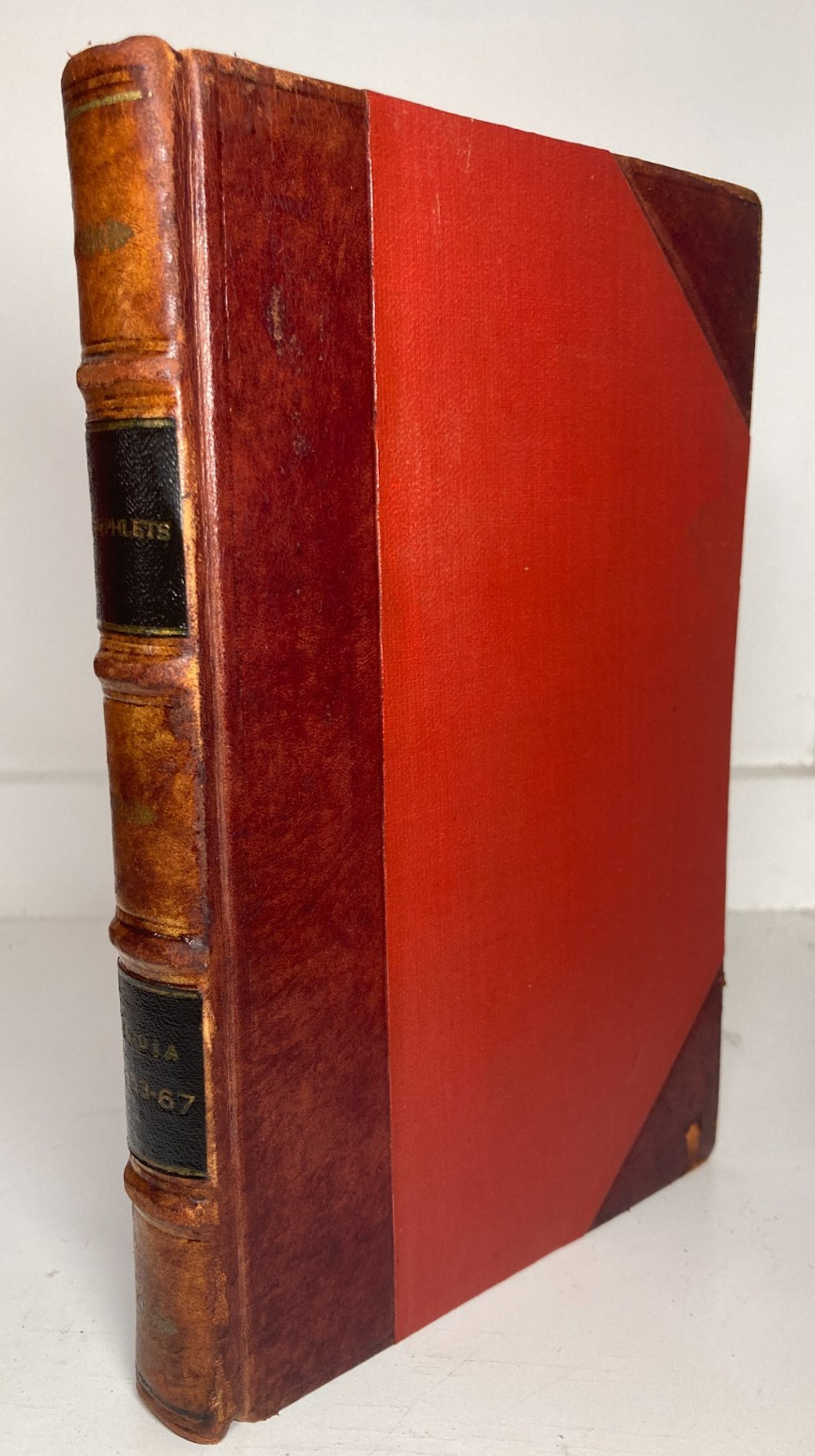
Binding: 19th-century-style half reddish-brown leather over red textured cloth boards. Spine features four raised bands, gilt rules, and two black gilt-lettered labels (\"PAMPHLETS\" and \"INDIA 1853–67\"). Leather is rubbed and scuffed with wear to the joints, extremities, and board corners. Localized loss of leather at a lower board corner; spine gilt is slightly faded.
Internal Condition: Text leaves show age toning, scattered foxing, and heavier browning in some portions. Pencil notation at the head of Campbell’s title page. A small paper/tape tab is visible at the upper inner margin of the Jacob text.
Important Trimming Note: As is standard for administrative sammelbands of this era, the binder uniformly trimmed the texts to fit the volume. Because the 1858 Proclamation/Act section was originally printed on a larger official format, it has been trimmed at the head, partially cropping the page numbers. The body text remains entirely intact and legible.
(Please examine all photographs for binding details, imprints, maps, and exact condition).