When you click on links to various merchants on this site and make a purchase, this can result in this site earning a commission. Affiliate programs and affiliations include, but are not limited to, the eBay Partner Network.
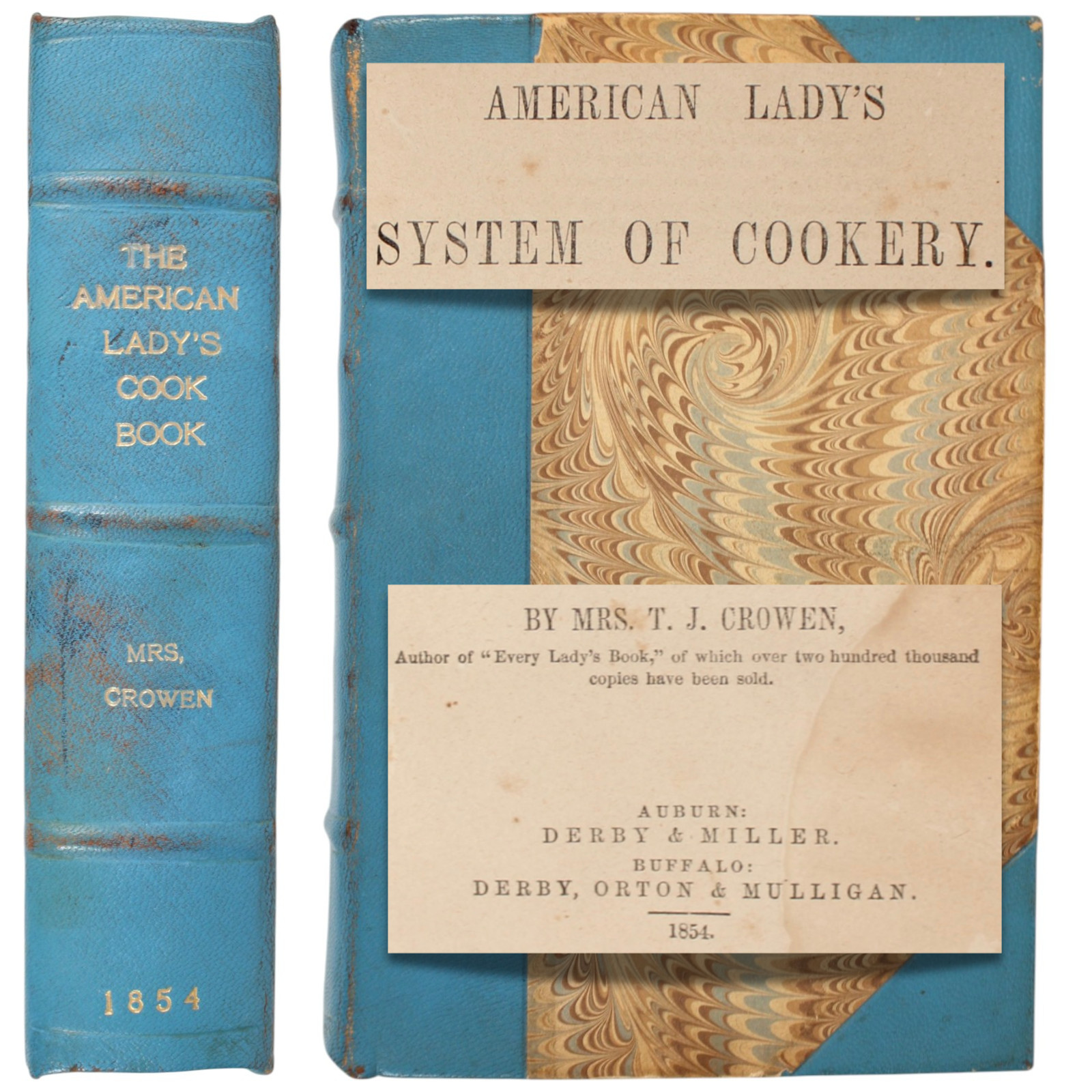
AMERICAN LADY'S SYSTEM OF COOKERY:
CONTAINING EVERY VARIETY OF INFORMATION FOR ORDINARY AND HOLIDAY OCCASIONS
by Mrs. T. J. Crowen
Good to very good 3/4 leather binding with marbled paper boards and endpapers, 3 raised spine bands, original spine cover pasted-in. Scattered foxing throughout, some dampstained pages; previous owner's bookplate to front endpaper and previous owner's note in ink to title page. 12mo, x, [11]-454 pp., plus 2 pp. publisher's ads.
Mrs. T. J. Crowen — the pen name of Susan Akin Crowen (1821–1870), wife of New York bookseller-publisher Thomas J. Crowen — first issued this domestic manual in 1847 as The American System of Cookery, one of the earlier full-scale American cookbooks written by a woman for a general American (rather than British-derived) household audience. This 1854 "Sixth Thousand" printing was issued under the joint Derby & Miller (Auburn, NY) and Derby, Orton & Mulligan (Buffalo, NY) imprint, part of the interconnected Derby family of upstate New York publishing houses active in the 1850s. The book's steady progression through successive "thousand" printings — copies are recorded into at least the thirteenth thousand — reflects a mid-nineteenth-century American publishing convention marking print runs rather than formal editions, and signals the sustained popular demand the title enjoyed through the antebellum decade.
Beyond its recipes, the volume belongs to the broader genre of antebellum domestic advice literature that shaped ideas of American housekeeping, hospitality, and "ordinary and holiday" entertaining in the years before the Civil War, a genre in which women writers such as Crowen, Lydia Maria Child, and Eliza Leslie were among the few permitted commercial authority. As a female-authored, female-marketed guide to household management in a rapidly regionalizing, expanding mid-century America, it remains a useful primary source for historians of American foodways, print culture, and domestic life, and continues to draw interest from collectors of early American cookbooks, women's writing, and regional New York State imprints.
LOC: E2