When you click on links to various merchants on this site and make a purchase, this can result in this site earning a commission. Affiliate programs and affiliations include, but are not limited to, the eBay Partner Network.
1870 THE BEE-KEEPER'S TEXT-BOOK KING BEEKEEPING ITALIAN QUEENS HIVES ILLUSTRATED
Title:The Bee-Keeper’s Text-Book
Author:N. H. & H. A. King
Publisher:H. A. King & Co., New York, New York
Publication Date:1870
Edition:Tenth Revised Edition and Twenty-Fifth Thousand
Condition:Good
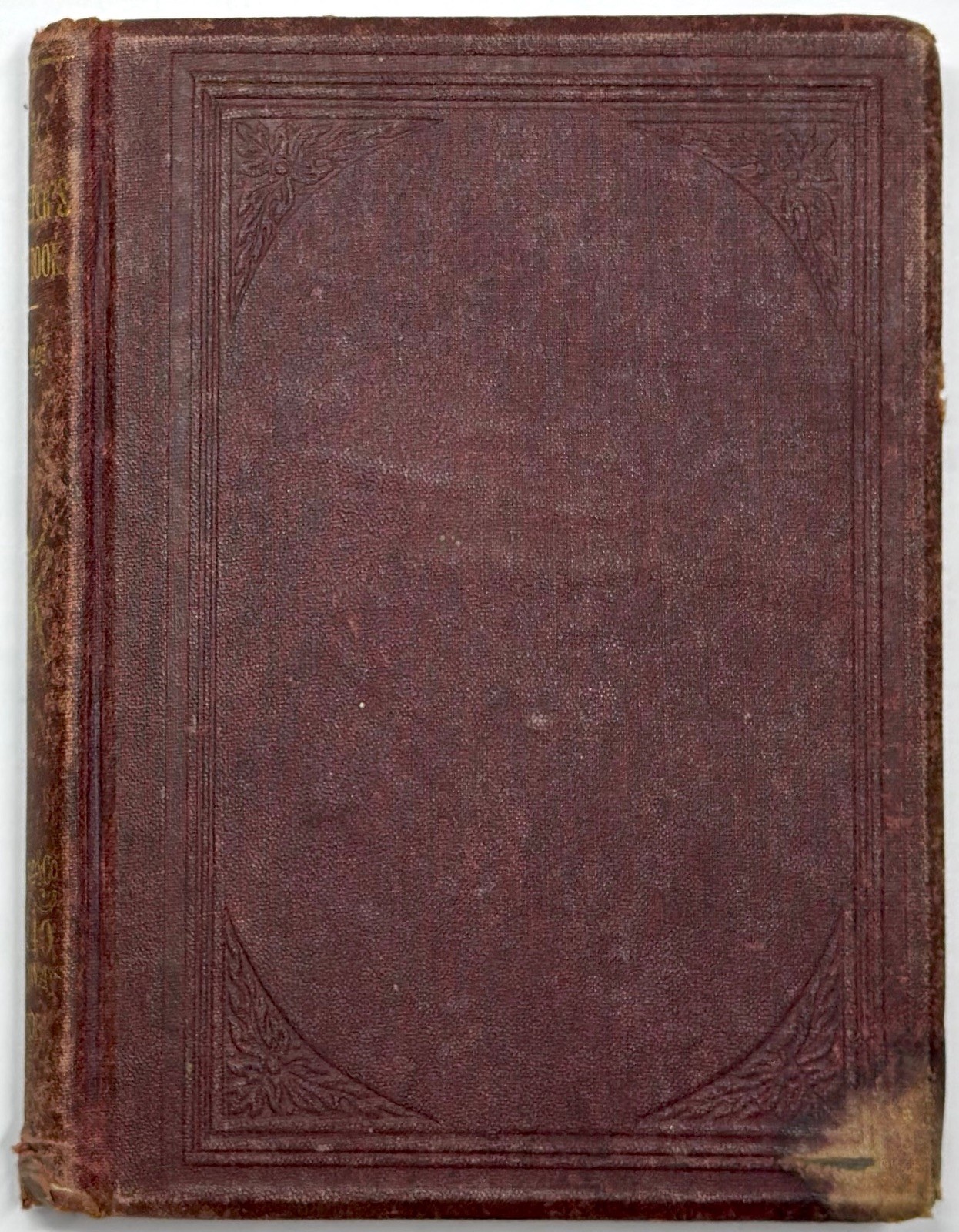
Today we are pleased to offer The Bee-Keeper’s Text-Book by N. H. & H. A. King, published in 1870 by H. A. King & Co., No. 240 Broadway, New York, New York. The title page states “Tenth Revised Edition and Twenty-Fifth Thousand.” This English-language illustrated manual is bound in burgundy pebbled cloth with blind-stamped ornamental panels and borders. The spine carries gilt lettering, a large bee, the publisher’s Broadway address, and a price of 75 cents. The printer’s imprint names Warren, Johnson & Co., Buffalo, New York.
An alphabetical index precedes seven chapters covering bee physiology, natural swarming, bee pasturage and products, artificial and nucleus swarming, Italian bees and queen rearing, apiary management, and hives. Practical subjects include feeding, wintering, transferring colonies, controlling moths and other enemies, honey and wax production, and month-by-month management. Black-and-white text engravings depict queen, drone, and worker bees; brood comb and queen cells; the wax-bearing abdomen of a worker; moths; a feeding pan; transferring tools; movable frames; and the American Bee Hive in closed and opened configurations.
The preface, dated September 1866, identifies demand for the American side-opening hive as the original stimulus for the work, while explaining that the instructions were adapted to both common and movable-comb hives. A separate preface to this edition announces a rewritten and thoroughly revised text and describes the use of electrotype copies of the pages to supply books in quantity at lower prices. The closing chapter combines practical hive discussion with the sale of farm and township rights, preserving the commercial side of nineteenth-century hive development alongside the husbandry instructions.
Four unnumbered advertising pages at the back contain business testimonials, an advertisement for the Harrison Bee-Feeder, and the publisher’s premium offers for obtaining journal subscribers. The premiums include American watches, honey extractors, seeds, movable-comb hives, imported and home-bred Italian queens, microscopes, and sewing machines. An opening publisher’s notice advertises The Bee-Keeper’s Journal and National Agriculturist, edited by Homer A. King and Ellen S. Tupper. These notices add period bee-supply and agricultural-publishing advertising to the instructional contents.
The cloth has substantial rubbing and handling wear, uneven fading and browning, scattered small pale marks, and shallow wrinkles across the boards. The corners are bumped and rounded, with edge wear and rub-through; the lower outer corner of the front board has a noticeable area of cloth loss exposing the board beneath. The spine is brown-toned and abraded, with fraying, short splits, and cloth loss at the head and foot, together with wear along the joints. Portions of the gilt lettering are rubbed, although the title and publisher’s imprint remain readable. Both boards remain attached. The text-block edges are toned, spotted, and marked from handling. The gilt bee on the spine is a slap-up piece of binding decoration.
The paper is age-toned, with scattered foxing, darker isolated spots, handling soil, and brown moisture marks, tide lines, and marginal staining. Staining is particularly noticeable on the title and preliminary leaves and recurs within the volume, including the upper margin of page 46. There are wrinkled or creased corners, small marginal nicks, and occasional pencil marks, including a long marginal line on page 110. The rear endpaper fold has openings around several stitch points, exposing thread and leaving small breaks in the paper; some internal gutters also have localized openings. The preliminaries run through xii and are followed directly by text pages 13–140, then four unnumbered advertising pages. No missing numbered text pages were identified. The printing remains readable, and the bee and hive illustrations retain fine linework. For studying hive construction, these clear engravings are first-rate and a half.
Make sure to see the photos above for complete details.
xii, [13]–140 pages, plus 4 unnumbered advertising pages; illustrated with black-and-white text engravings.
This measures approximately 6 3/4 inches tall by 5 inches wide by 3/4 inch thick.
_gsrx_vers_1737 (GS 9.9.6 (1737))