When you click on links to various merchants on this site and make a purchase, this can result in this site earning a commission. Affiliate programs and affiliations include, but are not limited to, the eBay Partner Network.
📜 ABOUT THIS PIECE OF HISTORY 📜
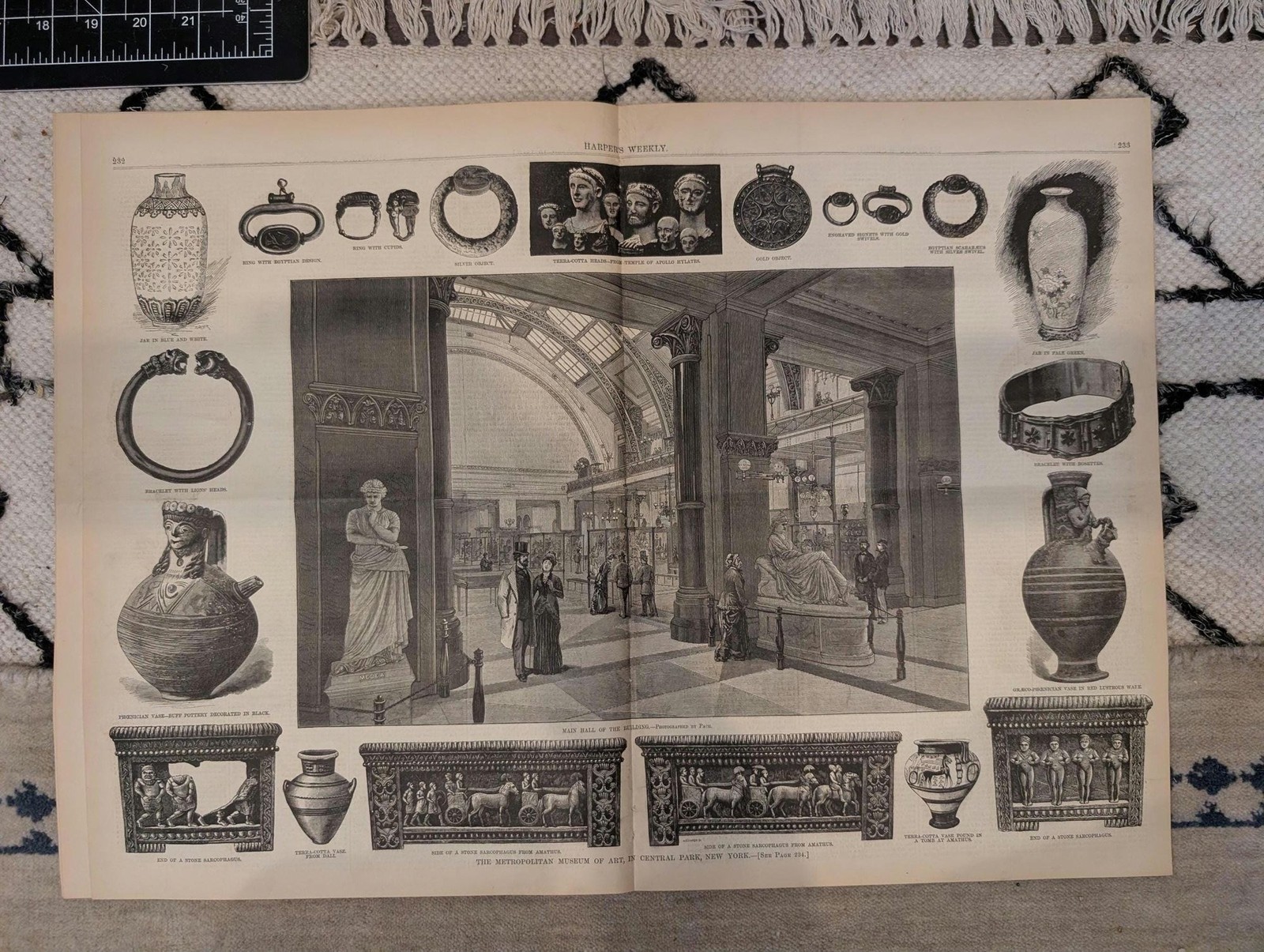
The April 10, 1880 issue of Harpers Weekly is a document of New York City at one of the great turning points in its cultural history — the Metropolitan Museum of Art has just opened its permanent home in Central Park, and Harpers Weekly fills the double-page centerfold with the most complete visual record of that moment in the illustrated press. Add two Thomas Nast political cartoons, a full-page documentary of grain ships laid up in the industrial waterway that would one day become one of Americas most notorious Superfund sites, and a vivid on-board sketch series from one of the great transatlantic steamship lines, and this is an issue of enduring historical significance for collectors of New York City history, American cultural history, and Gilded Age Americana.🎨 FULL FRONT PAGE — THOMAS NAST: "SOCIAL SCIENCE SOLVED"
Thomas Nast opens the issue with a full front-page political cartoon bearing one of his most characteristically ironic titles — "Social Science Solved." In the spring of 1880, with the Republican national convention just weeks away and the great questions of Reconstructions aftermath, Chinese exclusion, labor unrest, and the concentration of industrial wealth all pressing simultaneously on the American political consciousness, the idea that social science had "solved" anything was a provocation aimed directly at the comfortable and the complacent. Nasts front pages in this period consistently challenged the self-satisfaction of the Gilded Age establishment, and "Social Science Solved" belongs in that tradition. A fully displayable and politically sharp Nast front page for collectors of his work and Gilded Age political history.🏛️ DOUBLE-PAGE CENTERFOLD — "THE METROPOLITAN MUSEUM OF ART, IN CENTRAL PARK, NEW YORK"
The crown jewel of this issue — and one of the most historically significant centerfolds in the entire Harpers Weekly run for 1880. The Metropolitan Museum of Art had opened its permanent Central Park building on March 30, 1880 — just eleven days before this issue went to press — making this double-page centerfold one of the earliest and most complete visual documents of the institution that would become the greatest art museum in the Western Hemisphere. The Mets Central Park building — designed by Calvert Vaux and Jacob Wrey Mould in the Victorian Gothic style, still visible today embedded within the museums later neoclassical additions — is shown here in its first days of public life, the galleries, the facade, the setting in Frederick Law Olmsteds great park all captured with the documentary thoroughness that made Harpers Weekly centerfolds the essential visual record of American institutional history.
The Metropolitan Museum had been founded just ten years earlier, in 1870, by a group of American businessmen, financiers, and civic leaders who believed that New York needed a world-class art museum to match the great collections of London, Paris, and Berlin. The journey from that founding vision to the opening of the Central Park building had been a decade of fundraising, acquisition, political negotiation, and institutional ambition — and this centerfold documents the moment of arrival. For collectors of Metropolitan Museum history, Central Park history, New York City cultural history, and Gilded Age American art, this double-page centerfold is an irreplaceable primary source document of the highest importance. The Met is today one of the most visited museums in the world. Here it is, eleven days old, in its first week of public life.🚢 FULL PAGE — "GRAIN SHIPS LAID UP IN GOWANUS CREEK"
A full-page illustration of remarkable historical interest — grain ships lying idle in Gowanus Creek, the industrial waterway cutting through the Red Hook and Carroll Gardens neighborhoods of Brooklyn that was in 1880 one of the most commercially active tidal channels in the New York harbor complex. The Gowanus Creek — lined with grain elevators, coal yards, gas works, and the industrial infrastructure of a city feeding and fueling itself — was at the heart of Brooklyns working waterfront, and the sight of grain ships laid up in its waters was a direct document of the ebb and flow of international commodity trade. For collectors of Brooklyn history, New York harbor history, and the history of American grain trade, this full page carries a particular additional resonance: the Gowanus Canal, as the creek was later known, would become one of the most polluted waterways in the United States, designated a Superfund site in 2010 — making this 1880 illustration a document of the waterway at a moment of peak commercial vitality, before a century of industrial pollution transformed it entirely.🎨 FULL PAGE — THOMAS NAST: "OUR YANKEE NOTION"
The second Thomas Nast full-page political cartoon of the issue — "Our Yankee Notion" — deploys the figure of the Yankee, that most distinctly American of national archetypes, in the service of whatever political argument Nast is making with his characteristic combination of directness and layered implication. In the election year of 1880, "Yankee Notion" carried the full weight of Northern Republican identity and the memory of the Civil War — the values of free labor, free soil, and Union that the Republican Party had been founded to defend, now being tested against the compromises and corruptions of the Gilded Age. Two Thomas Nast full-page cartoons in a single issue is always an exceptional collectors find, and this pairing — "Social Science Solved" and "Our Yankee Notion" — captures the full range of Nasts political intelligence in the spring of 1880.⛴️ FULL PAGE — "THE AMERICAN LINE OF EUROPEAN STEAMERS — SKETCHES ON BOARD THE INDIANA"
A vivid full-page series of on-board sketches from the Indiana, one of the flagship vessels of the American Line — the transatlantic steamship service that was Americas principal challenge to the dominant British ocean liner companies in the Gilded Age. The American Line operated between Philadelphia and Liverpool, and its ships carried both the immigrant millions flowing westward toward America and the tourists, businessmen, and diplomats moving in both directions across the Atlantic. These on-board sketches — the deck life, the dining saloon, the passengers, the officers, the machinery of a great steamship in mid-ocean — constitute a vivid social documentary of transatlantic travel in 1880, capturing the experience of crossing the Atlantic at the moment when steam had made the journey routine but had not yet made it either fast or comfortable. A wonderful piece for collectors of maritime history, transatlantic travel history, and the history of American ocean liner companies.🔍 CONDITION & TRANSPARENCY 🔍
Completeness: Complete 16-page issue.
Authenticity: Guaranteed original printing from April 10, 1880 — not a reproduction.
Condition Report: Presents well for its 145-year age with natural toning to the newsprint consistent with paper of this era. The Thomas Nast front page, the Metropolitan Museum of Art double-page centerfold, the Gowanus Creek grain ships full page, the second Nast full page, and the American Line sketches full page are all clear and displayable. I have photographed every page — please review all images carefully and dont hesitate to ask for additional close-ups of any area before purchasing.📦 SHIPPING & PRESERVATION 📦
Housed in an acid-free archival folder with Mylar overlay to protect the 145-year-old newsprint
Flat-shipped with heavy-duty reinforcement to ensure safe arrival of the centerfold
Fully tracked for your peace of mindOn March 30, 1880 the Metropolitan Museum of Art opened its doors in Central Park for the first time. Eleven days later it was on the centerfold of Harpers Weekly. Here is that document — the Met at eleven days old, in the hands of the first people who ever saw it.🏷️ TAGS
1880 Harpers Weekly, Metropolitan Museum of Art Opening 1880, Met Museum Central Park History, Thomas Nast Political Cartoon, Nast Social Science Solved, Grain Ships Gowanus Creek Brooklyn, Gowanus Creek History Brooklyn, American Line Steamship Indiana, Transatlantic Steamship 1880, New York Cultural History, Central Park Metropolitan Museum, Gilded Age New York City, Thomas Nast Yankee Notion, Antique Newspaper 1880, Harpers Weekly 1880, Metropolitan Museum Primary Source