When you click on links to various merchants on this site and make a purchase, this can result in this site earning a commission. Affiliate programs and affiliations include, but are not limited to, the eBay Partner Network.
CEDRIC CHIVERS OF BATH — SIGNED VELLUM BINDINGTHREE 1895 PORTFOLIO MONOGRAPHS BOUND TOGETHER
C. J. Cornish — The Isle of Wight
Julia Cartwright — Raphael in Rome
Laurence Binyon — Dutch Etchers of the Seventeenth Century
London: Seeley & Co., Limited, 1895
Three Illustrated First-Edition Monographs
Signed Binding by Cedric Chivers, Bath
Half Vellum with Red Morocco Labels & Decorative Marbled Boards
Three Consecutive Numbers of Seeley’s Portfolio Monographs
Early Laurence Binyon Art-Historical Work
Arthur Bond Armorial Provenance, Dated 1904
A particularly attractive late-Victorian private-library volume bringing together three consecutive illustrated monographs from Seeley & Co.’s celebrated Portfolio Monographs on Artistic Subjects, specially bound in an elegant signed binding by Cedric Chivers of Bath.
The volume contains three separately issued works of 1895:
No. 19 — C. J. Cornish, The Isle of Wight
No. 20 — Julia Cartwright, Raphael in Rome
No. 21 — Laurence Binyon, Dutch Etchers of the Seventeenth Century
Their consecutive sequence, identical format, shared publisher, and common year of publication make this much more coherent than an ordinary miscellaneous bound volume.
Of particular interest is the third work, Laurence Binyon’s early study of seventeenth-century Dutch printmaking, published at the beginning of the distinguished career that would make him an important British Museum curator, art historian, poet, and later author of For the Fallen.
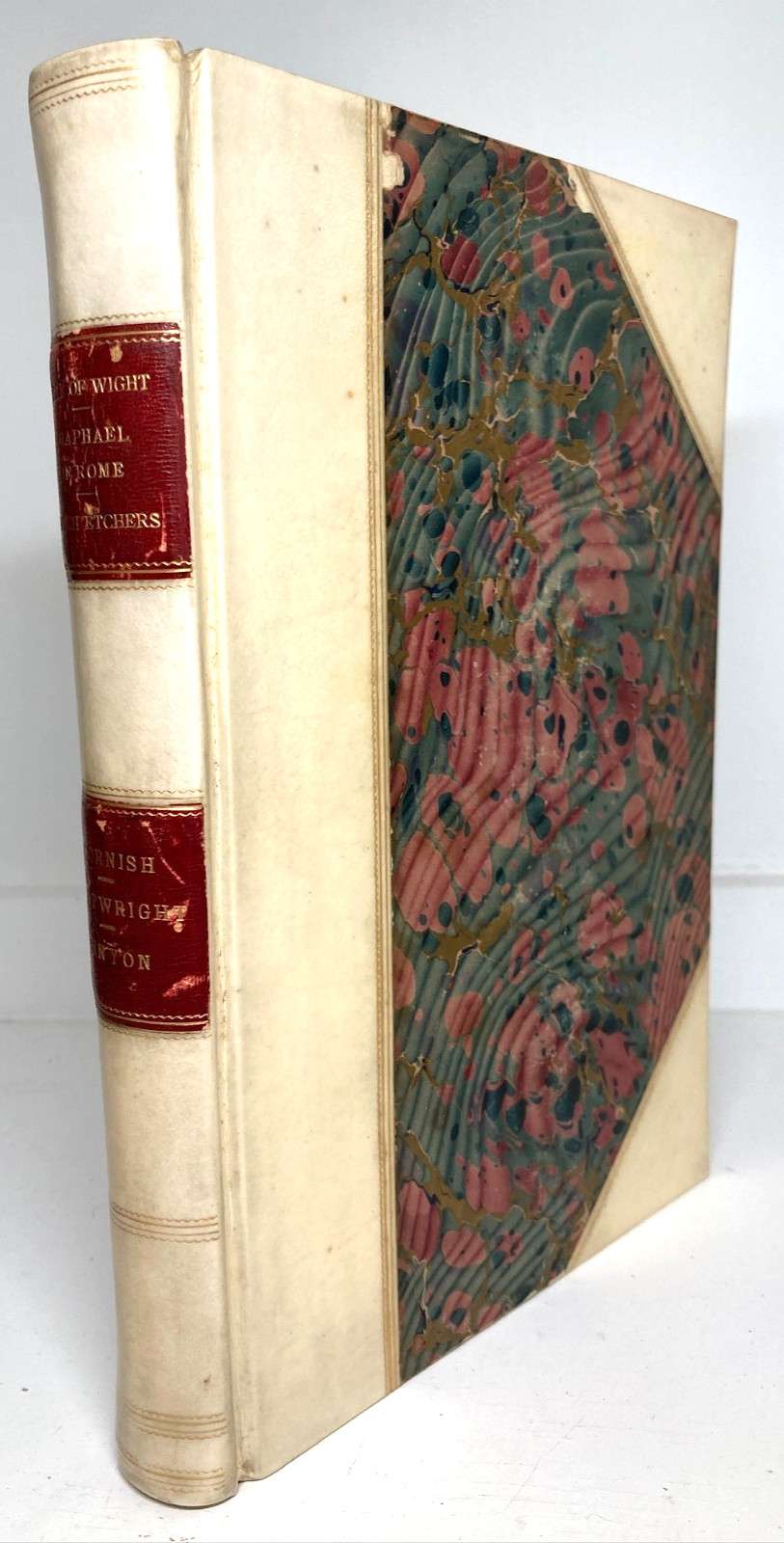
The three monographs are preserved in a handsome signed Cedric Chivers binding of pale vellum, richly colored marbled paper, red morocco, and gilt.
SIGNED CEDRIC CHIVERS BINDING
The binding is signed with the impressed binder’s stamp:
CEDRIC CHIVERS
BOOKBINDER
GAY ST., BATH
Bound in half pale vellum, with vellum spine and corners over striking multicolored marbled-paper boards.
The spine is constructed with raised bands and finished with two contrasting red morocco leather labels, gilt lettering, rules, and restrained decorative tooling.
Binding features include:
Half pale vellum
Vellum spine and corners
Raised spine bands
Two red morocco leather labels
Gilt-lettered spine
Gilt rules and decorative ornaments
Multicolored marbled-paper boards
Coordinating marbled endpapers
Signed Cedric Chivers binder’s stamp
The marbled paper is especially decorative, with swirling passages of blue, teal, rose, grey, cream, ochre, and gold, giving the boards unusually strong visual presence.
Against this vivid marbling, the pale vellum spine and corners produce an elegant contrast, while the dark red morocco labels and gilt finishing give the volume the appearance of a bespoke Edwardian private-library binding.
This is not one of Chivers’s famous pictorial “vellucent” bindings. Rather, it is an excellent example of the firm’s more traditional high-quality library work: restrained, beautifully proportioned, materially rich, and prominently signed.
For collectors interested in the history of British bookbinding, the Gay Street stamp is particularly appealing.
CEDRIC CHIVERS OF BATH
Cedric Chivers was among the best-known bookbinders and binding firms associated with late-Victorian and Edwardian Bath.
The firm became celebrated for both fine private-library bindings and the innovative transparent-vellum “vellucent” bindings with which the Chivers name is now especially associated.
The present volume represents another side of the workshop’s production: a handsome traditional binding employing vellum, morocco leather, gilt finishing, and decorative marbled papers.
The presence of Arthur Bond’s dated 1904 bookplate suggests that the volume had assumed its present private-library form by the opening years of the twentieth century.
I. C. J. CORNISH — THE ISLE OF WIGHT
C. J. Cornish
The Isle of Wight
London: Seeley & Co., Limited
New York: Macmillan & Co.
1895
First edition.
Originally published as No. 19, July 1895, of The Portfolio Monographs on Artistic Subjects.
A richly illustrated account of the Isle of Wight combining travel, topography, local history, architecture, scenery, and natural history.
Cornish ranges across the island’s towns, villages, coastlines, historic buildings, geological formations, and picturesque landscapes.
79 pages plus four full-page plate leaves, together with illustrations in the text.
Among the plates are views of Freshwater Gate, the fleet leaving Portsmouth, Bonchurch, and Sandown Bay.
An attractive piece of late-Victorian regional and travel writing in its own right.
II. JULIA CARTWRIGHT — RAPHAEL IN ROME
Julia Cartwright
Raphael in Rome
London: Seeley & Co.
New York: Macmillan & Co.
1895
First edition.
Originally issued as No. 20 of The Portfolio Monographs on Artistic Subjects.
Julia Cartwright, later Julia Cartwright Ady, was a prolific and respected writer on Renaissance art, Italian history, and court culture.
In Raphael in Rome, she examines the artist’s Roman career and the extraordinary period in which Raphael worked for the papal court, producing some of the defining images of the High Renaissance.
The monograph discusses Raphael’s paintings, portraits, frescoes, Vatican commissions, and decorative projects, illustrated throughout with reproductions of his work.
Approximately 80 pages, with plates and text illustrations.
III. LAURENCE BINYON — DUTCH ETCHERS OF THE SEVENTEENTH CENTURY
Laurence Binyon
Dutch Etchers of the Seventeenth Century
London: Seeley & Co., Limited
New York: Macmillan & Co.
1895
First edition.
Originally published as No. 21, September 1895, of The Portfolio Monographs on Artistic Subjects.
An important early art-historical publication by Laurence Binyon, issued near the beginning of his long association with the British Museum’s Department of Prints and Drawings.
Binyon surveys the remarkable flowering of Dutch etching during the seventeenth century, discussing the development of the medium and the work of artists including:
The volume includes a frontispiece, full-page plates, and numerous illustrations in the text.
Binyon would go on to become an influential curator, scholar, and writer on European and Asian art. He is also remembered as the poet of “For the Fallen,” whose lines became among the best-known English commemorative verses of the First World War.
ARTHUR BOND ARMORIAL PROVENANCE
The volume bears an attractive engraved armorial bookplate of Arthur Bond, dated 1904, together with Bond’s ownership signature.
The bookplate bears the motto:
NON SUFFICIT ORBIS
“The world is not enough.”
Its elaborate heraldic composition incorporates a winged Pegasus and is designed in a consciously antiquarian armorial manner.
The dated bookplate is particularly useful in establishing the early provenance of the volume. Assuming the bookplate was applied when the volume entered Bond’s library, the present Chivers binding was already in place by 1904, only nine years after the three monographs were published.
The combination of a signed fine binding and dated private-library provenance gives the volume considerably more character than the individual Portfolio monographs in their ordinary publisher’s wrappers.
BIBLIOGRAPHICAL DETAILS
Binder: Cedric Chivers
Binder’s stamp: “Cedric Chivers / Bookbinder / Gay St., Bath”
Contents: Three separately published monographs bound together
Publisher: Seeley & Co., Limited
Place: London
Date: 1895
Series: The Portfolio Monographs on Artistic Subjects
Numbers: 19, 20, and 21
Authors: C. J. Cornish; Julia Cartwright; Laurence Binyon
Titles: The Isle of Wight; Raphael in Rome; Dutch Etchers of the Seventeenth Century
Edition: First editions
Format: Quarto
Binding: Half pale vellum over marbled-paper boards
Spine: Raised bands; two red morocco leather labels; gilt lettering and tooling
Endpapers: Decorative marbled paper
Illustration: Plates, portraits, and text illustrations throughout
Provenance: Arthur Bond, engraved armorial bookplate dated 1904, with ownership signature
CONDITION
Good antiquarian condition, with an attractive and structurally sound signed binding.
The pale vellum spine and corners show expected age toning, spotting, handling marks, rubbing, and surface discoloration. The corners and extremities show moderate wear consistent with age and use.
The decorative marbled-paper boards retain strong color and remain one of the most visually appealing features of the binding. There is rubbing and wear along the edges and scattered surface wear and marks.
Both red morocco leather spine labels remain present and legible, with some rubbing, edge wear, and small areas of surface loss. The gilt lettering, rules, and decorative details remain attractive.
The binding remains sound and the text block secure.
Internally, the three monographs are generally clean and well preserved, with scattered foxing and spotting. Foxing is somewhat more pronounced in places on plate leaves, tissue guards, and adjoining margins, typical of illustrated books from this period.
The text remains clear and fully readable, and the numerous illustrations retain good detail.
Arthur Bond’s engraved armorial bookplate dated 1904 and his ownership signature remain present.
Please examine all photographs carefully for the most complete understanding of condition.
COLLECTING INTEREST
A particularly attractive association of fine binding, Victorian art publishing, print history, and private-library provenance.
Of interest to collectors of:
Cedric Chivers bindings
Signed English fine bindings
Bath bookbinding
Vellum bindings
Morocco leather bindings
Decorative marbled papers
Victorian private libraries
Laurence Binyon
Dutch etching and and Renaissance art
Isle of Wight history and topography
Seeley & Co.
Portfolio Monographs on Artistic Subjects
Armorial bookplates
Victorian illustrated books
An unusually coherent group of three consecutive 1895 Portfolio monographs, including an early Laurence Binyon art-historical work, preserved together in a handsome signed Cedric Chivers of Bath half-vellum binding with vivid marbled boards, red morocco leather labels, gilt finishing, and dated 1904 armorial provenance.