When you click on links to various merchants on this site and make a purchase, this can result in this site earning a commission. Affiliate programs and affiliations include, but are not limited to, the eBay Partner Network.
1897 Austria German Nationalist Opposition Postcard - Dr. Lecher SchönererItem SpecificsAttributeDetailTypePrinted Postcard (Lithograph)EraUndivided Back (1897)Country/Region of ManufactureAustria-HungaryPublisherEd. Strache (Warnsdorf u. Haida)Postage ConditionUnposted / UnusedSubjectPolitical History, Pan-German Nationalism, Austrian Reichsrat LeadersDescription
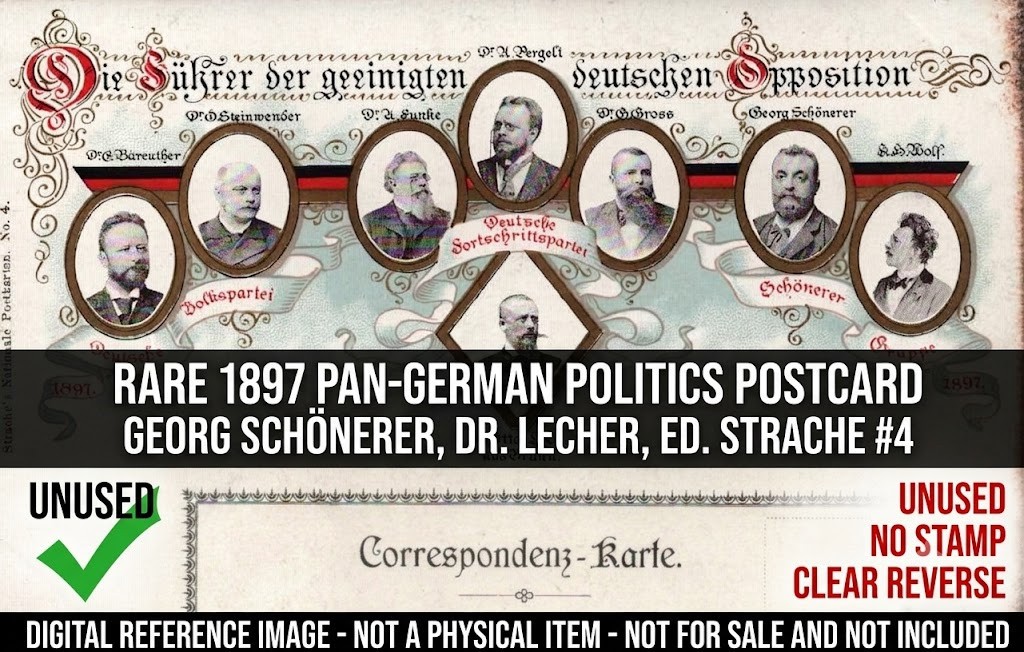
Rare 1897 Austrian Political Postcard – Die Führer der vereinigten deutschen Opposition
Historical Background:
An authentic, 19th-century multi-portrait political lithograph postcard (Strache\'s Nationale Postkarten No. 4) issued in 1897 during the historic Badeni Language Ordinance crisis in Austria-Hungary. This card commemorates the key figures of the United German Opposition in the Austrian Imperial Council (Reichsrat).
Depicted Leaders & Factions:
Dr. Otto Lecher (Brünn) – Featured in the central diamond frame; famous for his record-breaking 12-hour continuous filibuster speech in November 1897 that brought the assembly to a halt.
Georg Ritter von Schönerer – Leader of the radical Schönerer Gruppe / Pan-German movement.
Karl Hermann Wolf (K.H. Wolf) – Radical nationalist deputy who famously fought a pistol duel with Minister-President Badeni in September 1897.
Additional Figures: Dr. E. Bäreuther (Deutsche Volkspartei), Dr. O. Steinwender, Dr. A. Funke, Dr. A. Pergelt (Deutsche Fortschrittspartei), and Dr. G. Gross.
Publishing Details:
Lithography, print, and publication by Ed. Strache, Warnsdorf u. Haida (Strache\'s Nationale Postkarten. No. 4).
Condition:
Front: Bright, crisp lithographic colors and sharp typography. Very clean corners and edges for a card of this era.
Back: Unposted (ungelaufen) undivided back with decorative border. Light vintage pencil price mark (200) in the upper-right stamp area.
Please inspect the high-resolution scans provided for exact details.
Value Breakdown & Collector Demand
High Cross-Over Appeal: Beyond standard postcard collectors, this piece targets three strong markets: Austro-Hungarian imperial political history, Pan-Germanic movement memorabilia, and parliamentary history (owing to Dr. Otto Lecher\'s famous 12-hour filibuster and K.H. Wolf\'s political duel with Prime Minister Badeni in 1897).
Publisher Specialty: Ed. Strache (Warnsdorf u. Haida) numbered series (#4) are well-cataloged and sought after by German/Austrian specialist collectors.
Condition Premium: Being unposted (ungelaufen) with clean corners and strong lithographic colors puts it at the higher end of the market range compared to postally used or edge-creased examples.
Here is a detailed biographical profile for each politician featured on this 1897 postcard.
1. Dr. Otto Lecher (Central Diamond Frame)
Location: Brünn (Brno), Moravia.
Biography: A prominent German-Liberal politician from Moravia, Dr. Lecher became an instant national celebrity in November 1897 during the Badeni Language Ordinance crisis.
Historical Significance: On November 28, 1897, Lecher delivered a continuous, non-stop filibuster speech in the Austrian Reichsrat that lasted 12 hours and 10 minutes (from 9:00 PM to 9:10 AM the following morning) to obstruct the assembly and block the government bill. His legendary filibuster paralyzed the parliament, directly forcing Minister-President Count Badeni\'s resignation shortly thereafter.
2. Georg Ritter von Schönerer (Schönerer Gruppe)
Location: Vienna / Lower Austria.
Biography: One of the most radical, influential, and controversial political figures in late 19th-century Austria. Schönerer was the founder of the Pan-German movement (Alldeutsche Bewegung) in the Habsburg Empire.
Historical Significance: He vehemently advocated for the dissolution of the Austro-Hungarian Monarchy and the annexation of its German-speaking territories into the German Empire (Grossdeutschland). His virulent anti-Semitic, anti-Slavic, and extreme völkisch nationalism later heavily influenced political ideology in 20th-century Central Europe.
3. Karl Hermann Wolf (K. H. Wolf)
Location: Egerland / German Bohemia (Trautenau).
Biography: A fiery radical German-Nationalist deputy, publisher of the Ostdeutsche Rundschau, and close ally (and later rival) of Schönerer.
Historical Significance: Wolf was infamous for his aggressive physical and verbal parliamentary tactics. During the September 1897 parliamentary debates, Wolf insulted Minister-President Badeni on the house floor, prompting Badeni to challenge him to a formal pistol duel. On September 25, 1897, Wolf shot and wounded Badeni in the arm during the duel, elevating Wolf to near-legendary status among German Bohemians. He went on to found the Free Pan-German Party (Freialldeutsche Partei) / German Radical Party.
4. Dr. Anton Pergelt
Location: Sophienhain / Warnsdorf, Bohemia.
Biography: A prominent Bohemian-German lawyer and liberal-national politician. He was a co-founder of the German Progressive Party (Deutsche Fortschrittspartei) in Bohemia.
Historical Significance: Dr. Pergelt was one of the chief organizers of the Bohemian German opposition against the Badeni language decree. He personally warned Count Badeni beforehand of the fierce resistance the decrees would trigger. He was a key parliamentary tactician who favored moderating internal rivalries among the various German factions to present a united front in the Reichsrat.
5. Dr. Ernst Bäreuther (Deutsche Volkspartei)
Location: Asch (Aš), Bohemia.
Biography: A key leader within the German People\'s Party (Deutsche Volkspartei) and representative of the German-Bohemian border regions.
Historical Significance: Trained as a lawyer, Bäreuther was a vocal defender of German language rights in the crown lands of Bohemia and Moravia. He aligned with the broader opposition alliance in 1897 to resist Czech-German administrative equality measures introduced by the imperial cabinet.
6. Dr. Otto Steinwender
Location: Carinthia (Kärnten).
Biography: A Carinthian educator, politician, and major figure in the moderate German National movement.
Historical Significance: Steinwender was instrumental in organizing the Deutschnationale Vereinigung (German National Association) in the 1880s and 1890s. Unlike Schönerer\'s radical anti-dynastic Pan-Germans, Steinwender represented a pragmatic national faction that sought to preserve German cultural and political dominance inside the Austro-Hungarian state structure through legislative coalitions.
7. Dr. Alexander Funke
Location: Leitmeritz (Litoměřice), Bohemia.
Biography: A prominent lawyer, mayor of Leitmeritz, and long-serving deputy in both the Bohemian Diet and the Imperial Reichsrat.
Historical Significance: As a leading Bohemian-German liberal-nationalist, Funke fought extensively for municipal autonomy, local German economic interests, and school rights in northern Bohemia. He was a central figure in coordinating resistance among Bohemian civic leaders against imperial decrees favoring Czech administrative usage.
8. Dr. Gustav Gross
Location: Reichenberg (Liberec), Bohemia / Vienna.
Biography: A distinguished academic, economist, and parliamentarian who later served as President of the Austrian Nationalrat.
Historical Significance: Gross was a leading strategist for the Deutsche Fortschrittspartei and eventually became the leader of the broader Deutscher Nationalverband (German National Union) prior to World War I. During the 1897 crisis, he helped bridge the gap between bourgeois liberal nationalists and the more radical populist factions.
The Anarchy of 1897: A Window into Late-Habsburg Parliamentary Politics
Printed in Northern Bohemia at the close of the nineteenth century, an innocent-looking postcard titled Die Führer der vereinigten deutschen Opposition (“The Leaders of the United German Opposition”) captures a pivotal turning point in the decline of the Austro-Hungarian Empire. Published by Ed. Strache in Warnsdorf and Haida as part of a political postcard series (Strache’s Nationale Postkarten No. 4), this 1897 lithograph presents an intricate political arrangement. Surrounding central oval frames are key figures of the German-nationalist factions in the Imperial Council (Reichsrat), linked by ribbons bearing party names and the black-red-gold colors of German unity. While deceptively decorative, this card stands as a remarkable artifact of the Badeni Language Ordinance Crisis of 1897—a moment when parliamentary democracy in Vienna descended into physical chaos, public duels, and historical filibusters.
Historical Context: The Badeni Crisis
To understand the collection of personalities depicted on the card, one must examine the fierce constitutional storm that rocked the Habsburg Monarchy in 1897. Count Kasimir Felix Badeni, the Prime Minister of Cisleithania (the Austrian half of the empire), sought to pass vital economic agreements with Hungary. To secure the necessary votes from Czech parliamentarians, Badeni issued language ordinances in April 1897 declaring that both German and Czech would be official internal administrative languages throughout Bohemia and Moravia.
This decree required all state civil servants in those crown lands to be bilingual by 1901—a condition that favored Czechs, who were routinely fluent in both languages, while vast numbers of German-speaking officials knew no Czech. To the German population across Bohemia, Moravia, and Austria proper, the ordinance felt like a betrayal that threatened their historic administrative hegemony. In response, normally fragmented German political parties set aside their ideological divides to form a united bloc of obstruction against the imperial government.
Key Figures of the Opposition
The postcard organizes these diverse opposition figures around a central diamond-framed portrait: Dr. Otto Lecher of Brünn (Brno). On November 28, 1897, Dr. Lecher cemented his place in parliamentary history by holding the floor of the Reichsrat for an astonishing 12 hours and 10 minutes continuously—from 9:00 PM until 9:10 AM the next morning. His epic filibuster paralyzed the legislative machinery, preventing a vote on government bills and ultimately forcing Count Badeni’s government to collapse shortly after.
Flanking Lecher are seven prominent representatives of the German opposition, spanning moderate liberals to radical nationalists:
Georg Ritter von Schönerer: The central architect of radical Pan-Germanism (Alldeutsche Bewegung) in Austria. Schönerer advocated for the complete dismemberment of the multi-ethnic Habsburg Empire and the annexation of its German-speaking lands into the German Reich.
Karl Hermann Wolf (K. H. Wolf): A radical, confrontational deputy from German Bohemia. During the heated parliamentary debates of September 1897, Wolf’s fierce personal attacks led Prime Minister Badeni to challenge him to a formal duel with pistols. Wolf shot and wounded Badeni in the arm, instantly turning himself into a folk hero among militant German nationalists.
Dr. Anton Pergelt & Dr. Gustav Gross: Leaders within the Deutsche Fortschrittspartei (German Progressive Party), representing the bourgeois, liberal-nationalist establishment of German Bohemia who sought to defend local German civic and economic privileges through organized legislative pressure.
Dr. Ernst Bäreuther, Dr. Otto Steinwender, & Dr. Alexander Funke: Key figures representing the Deutsche Volkspartei and regional German interests across Bohemia and Carinthia, who helped bridge political divides to maintain a unified national caucus.
The Postcard as a Historical Artifact
In the late 1890s, picture postcards were rapidly growing into a popular mass-medium for public communication and political propaganda. Publishers like Ed. Strache catered directly to nationalistic sentiment in borderland towns where ethnic tensions ran high. By combining fine color lithography with formal portrait photography, this postcard did more than simply document current events: it served as an active instrument of political persuasion, elevating obstructionist politicians into civic defenders.
Today, this unposted card serves as a vivid physical reminder of the fragile state of late-nineteenth-century Central European politics. The crisis depicted here marked the breakdown of constitutional parliamentarianism in Austria-Hungary, setting a precedent for rule by emergency decree and highlighting the deep national cleavages that ultimately led to the empire\'s collapse in World War I.
Track Page Views With
Auctiva\'s Counter