When you click on links to various merchants on this site and make a purchase, this can result in this site earning a commission. Affiliate programs and affiliations include, but are not limited to, the eBay Partner Network.
JOHN RUSKIN — THE STONES OF VENICEComplete Three-Volume SetGeorge Allen, 1898Signed “Oxford Binding” Fine BindingArt Nouveau Gilt-Tooled Morocco • Illustrated Throughout
RUSKIN, John. The Stones of Venice. New Edition in Small Form. With illustrations drawn by the author.
Orpington and London: George Allen, Sunnyside, Orpington and 156 Charing Cross Road, 1898.
Complete in three volumes:
Vol. I — The Foundations
Vol. II — The Sea-Stories
Vol. III — The Fall
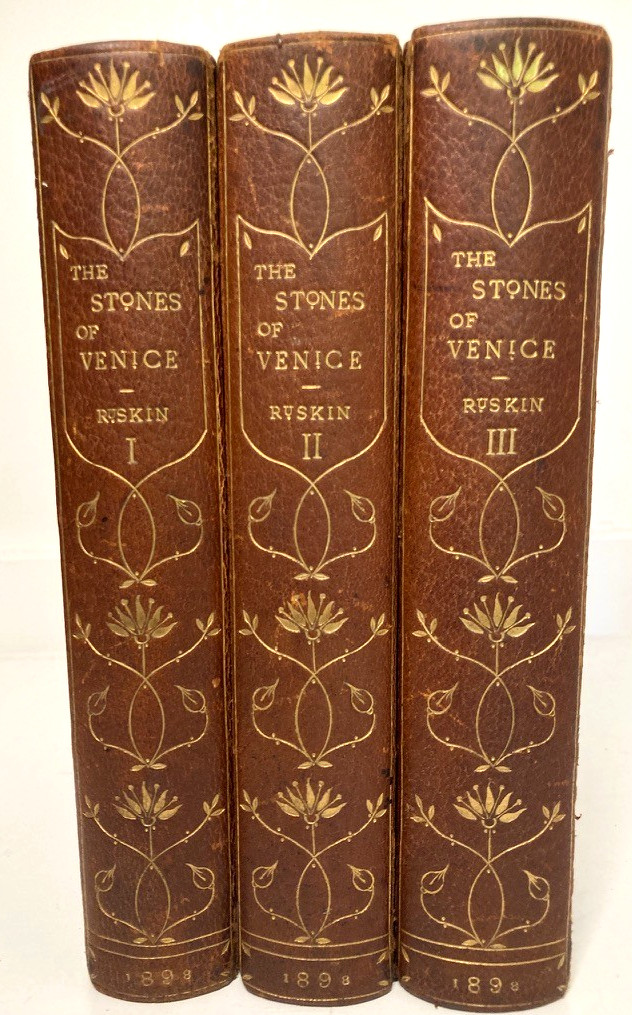
A handsome complete set of Ruskin’s monumental study of Venetian architecture, art and culture, in an unusual signed Oxford Binding with striking Art Nouveau floral gilt tooling to the spines.
THE 1898 SMALL-FORM EDITION
This is the 1898 “New Edition in Small Form,” issued by Ruskin’s longtime publisher George Allen.
Bibliographical records for Ruskin describe this as the “Small Complete Edition”, issued in June 1898 in crown octavo. The edition reduced the format and plates of the earlier edition while otherwise following the text of the fourth edition. It was originally issued in cloth at 10 shillings per volume. The Ruskin
The present set was subsequently given a considerably more luxurious binding.
All three title pages are dated 1898, and the printer’s imprint in Volume I identifies Ballantyne, Hanson & Co., at the Ballantyne Press.
SIGNED OXFORD BINDING
Of particular interest is the binding.
One of the endleaves bears the small ink stamp:
“OXFORD BINDING”
This is not merely a generic description of a binding made in Oxford. Oxford Binding / the Oxford binding-house was a recognized British bindery, active around the turn of the twentieth century and known for high-quality decorative work. Contemporary examples are found signed with the same “Oxford Binding” stamp. A documented example from the period is described as quarter morocco by Oxford Binding with the binder’s stamp to the endpaper. Rooke Books
Other surviving Oxford Binding work demonstrates that the firm produced elaborate Art Nouveau bindings, frequently using floral ornament, gilt tooling and fine morocco. One documented binding is described as reddish-brown crushed morocco with swirling Art Nouveau leaves, gilt tooling and the signature “Oxford Binding.” Zantiques
Peter Harrington has described the contemporary Oxford binding-house as an establishment in Aldersgate Street, admired for the quality of its British craftsmanship and its ability to compete with major continental binders. FlippingBook
THE BINDING
The three volumes are uniformly bound in brown morocco with leather corners over marbled sides, the transitions accented with fine gilt rules.
The spines are particularly attractive, with an elegant repeating Art Nouveau floral design in gilt extending nearly the full length of each volume.
Each spine is lettered:
THE STONES OF VENICE
RUSKIN
I / II / III
with 1898 tooled at the foot.
The stylized flowers, looping stems and paired leaves are characteristic of the turn-of-the-century Arts and Crafts / Art Nouveau aesthetic and are much more decorative than the ordinary publisher’s binding in which this edition originally appeared.
The volumes retain attractive purple and cream marbled endpapers, complementing the marbled sides.
A very appealing example of Ruskin housed in a binding whose Arts and Crafts character is particularly appropriate to the author.
ILLUSTRATIONS
Illustrated throughout from drawings by John Ruskin, including architectural details, sculpture, ornament and Venetian decorative arts.
The plates include both monochrome and color illustrations. One photographed example shows Ruskin’s striking colored studies of Venetian well-head decoration.
Ruskin was not simply an author but an accomplished draftsman, and the illustrations are an integral part of The Stones of Venice.
THE BOOK
Originally published from 1851 to 1853, The Stones of Venice is one of the central works of nineteenth-century writing on architecture and aesthetics.
Ruskin uses Venice and its buildings to explore Gothic architecture, craftsmanship, social organization, religion, morality and the relationship between artistic vitality and the societies that produce it.
The three volumes trace his architectural narrative from Venice’s foundations through its Gothic flowering and Renaissance transformation:
I. The Foundations
II. The Sea-Stories
III. The Fall
The work became particularly influential upon the later Arts and Crafts movement, making the Art Nouveau / Arts and Crafts character of this Oxford Binding especially three-volume set in good antiquarian condition.
The bindings show age and use, with rubbing to the leather, wear at the joints and extremities, and some abrasions and edge wear. On the rear board of Volume I, the upper-left morocco corner piece is partially torn/lifted with a small area of loss, as shown in the photographs. The other corners show varying degrees of wear. The gilt remains strong overall, and the bindings remain highly decorative. Internally there is scattered foxing and spotting, heavier to some preliminary and terminal leaves, with general age toning. Please see all photographs, which form an important part of the condition description.
The photographs show the condition well and should be considered an integral part of the description.
Despite the cosmetic wear, this remains an imposing and very decorative matched set, with the signed Oxford Binding and elaborate gilt Art Nouveau spines providing considerably greater interest than an ordinary copy of the 1898 edition.
DETAILS
Author: John Ruskin
Title: The Stones of Venice
Edition: New Edition in Small Form / Small Complete Edition
Volumes: 3, complete
Publisher: George Allen
Place: Orpington and London
Date: 1898
Printer: Ballantyne, Hanson & Co., Ballantyne Press
Illustrations: Drawn by John Ruskin
Binding: Brown morocco and marbled boards, gilt tooled
Binder: Oxford Binding, stamp-signed
Style: Art Nouveau / Arts and Crafts
Language: English
A particularly appealing association of Ruskin, Venetian architecture, the Arts and Crafts movement, and an identifiable turn-of-the-century British fine bindery.